Only 25% of organizations have moved 40% or more of their AI pilots into production, according to Deloitte's 2026 enterprise research. Generative AI consulting closes that execution gap by turning experiments into governed workflows with measurable commercial outcomes.
The popular advice is to start by adopting AI everywhere. That's backwards. Adoption is no longer the difficult part. The harder work is choosing the right workflow, redesigning the operating process around it, training the people responsible for results, and proving that the investment improves revenue, cost, speed, or customer experience.
For growth leaders, generative AI consulting should mean more than selecting a model or producing an AI strategy deck. It should connect business priorities to existing CRM, marketing, sales, service, and knowledge systems, then create the accountability needed to move from prototype to production.
Why Generative AI Consulting Matters Now
Large organizations are already using AI broadly. A 2026 summary of enterprise research reported that 88% of large organizations use AI in at least one business function, while Deloitte reported that only 25% of respondents had moved 40% or more of their AI pilots into production. Those findings point to a clear diagnosis: the bottleneck is value capture, not awareness.
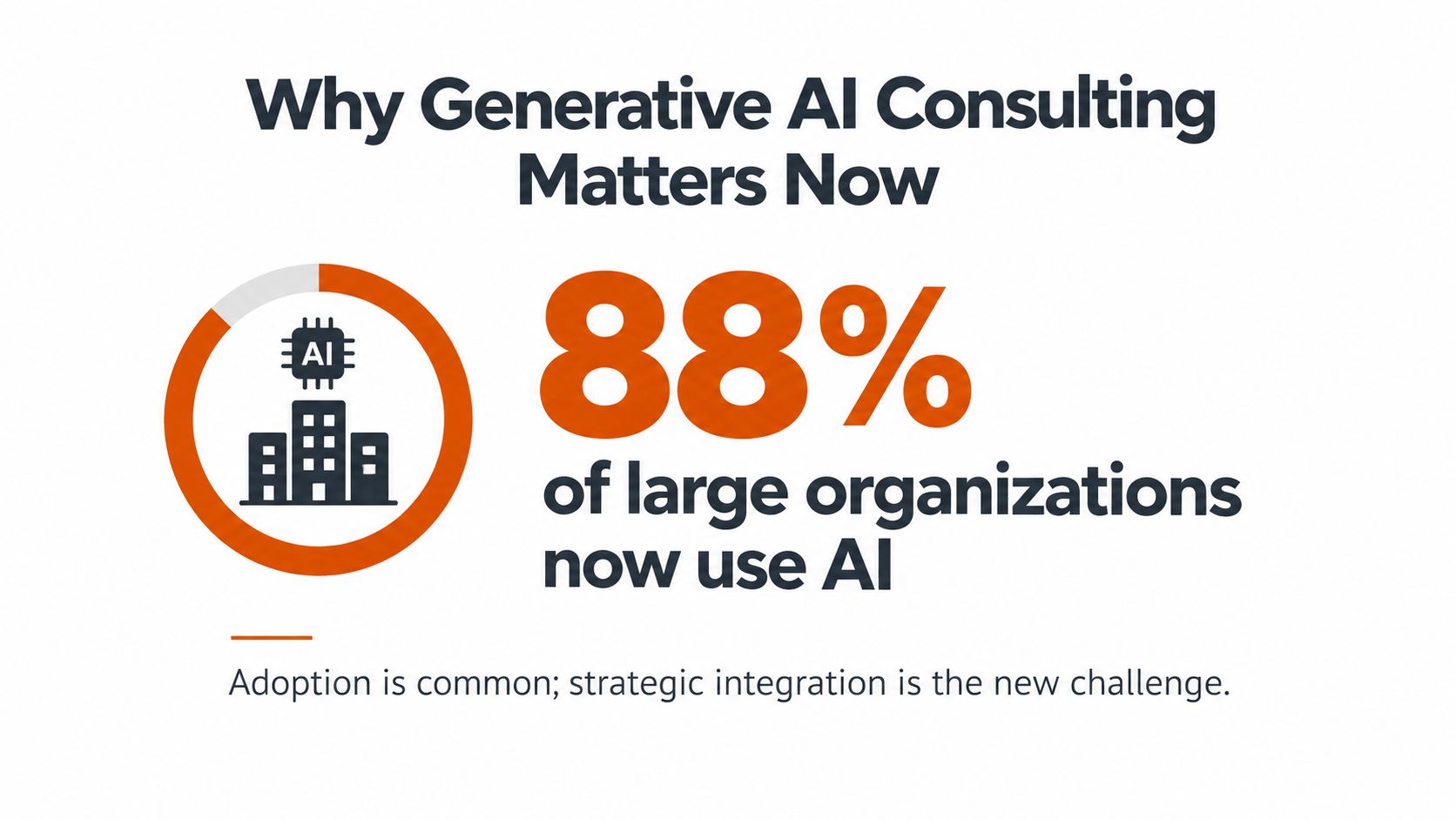
Adoption is not the same as integration
A chatbot demo can generate enthusiasm without changing a single operating metric. A production system must work with approved data, fit an existing process, assign ownership, and produce an output that someone can use without creating new risk.
That's why generative AI consulting has become a business discipline. The consultant's job is to connect strategy, architecture, workflow design, governance, and change management. Model access is only one component.
Practical rule: A use case isn't ready for investment until its owner can name the business process, the baseline metric, the human review point, and the decision that will follow the AI output.
The services market is expanding alongside enterprise demand. Global Market Insights estimates that the broader generative AI market was valued at USD 53.7 billion in 2025 and projects it will reach USD 988.4 billion by 2035. Its services segment is projected to grow at about 32.7% CAGR, rising from USD 14.7 billion in 2025 to USD 293.6 billion by 2035, as described in industry market research on generative AI services.
The value pool is moving downstream
Consulting, integration, training, and managed services aren't peripheral additions to model technology. They're the commercialization layer that helps enterprises use AI within messy technology stacks and complicated human workflows.
The strongest partners don't sell generic automation. They identify where repeated knowledge work slows revenue or inflates operating cost, build a controlled intervention, and measure what changes. That shift creates an impact opportunity for firms that can help clients operationalize AI rather than explain it.
Core Services and Engagement Models
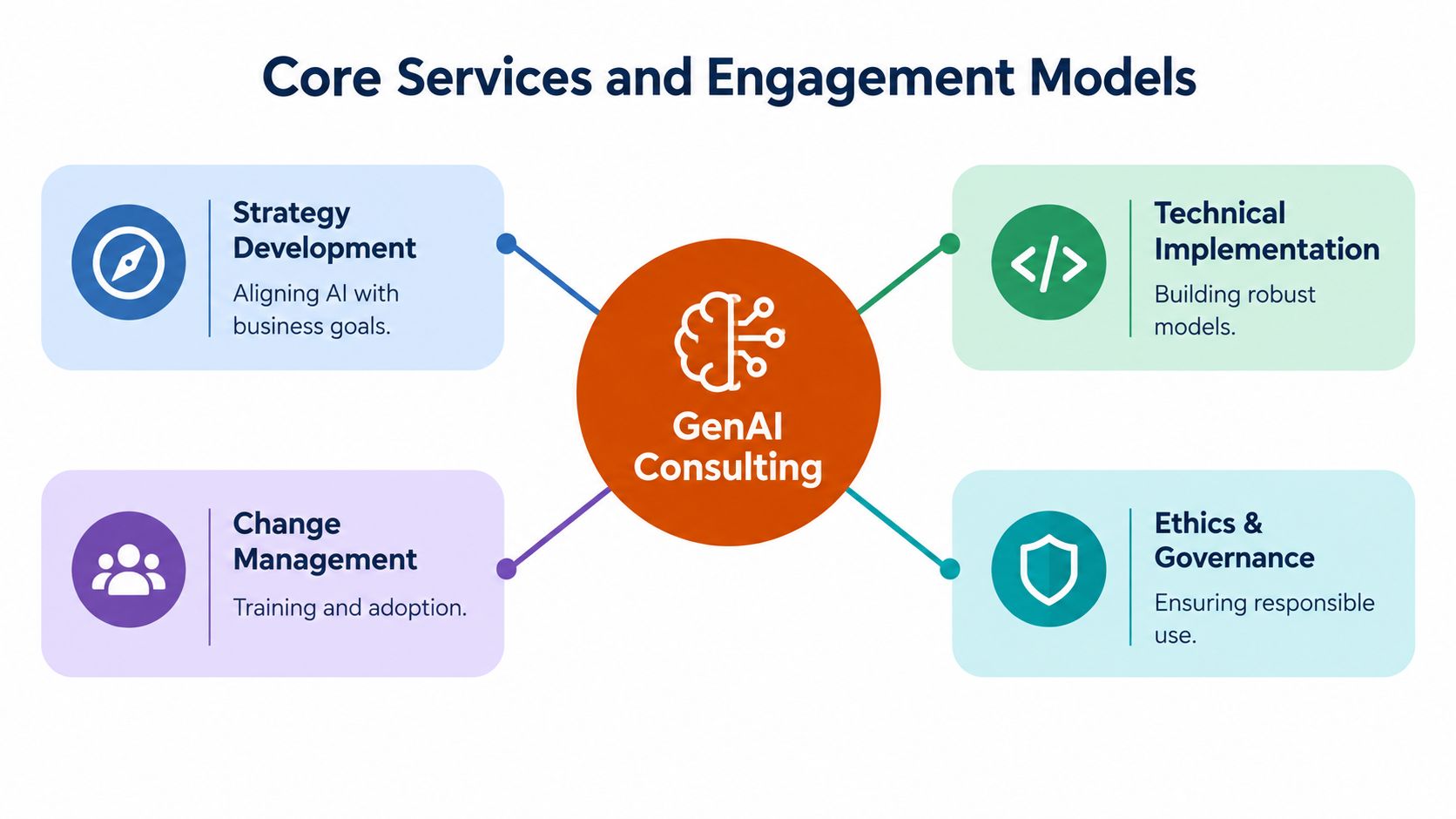
A credible generative AI consulting engagement starts with business outcomes and works backward toward technology. The service mix usually includes five connected responsibilities.
Strategy development links AI opportunities to commercial priorities. A growth team might prioritize lead qualification, account research, proposal preparation, or customer retention instead of pursuing an enterprise-wide chatbot with no accountable owner.
Technical implementation connects models and retrieval systems to existing platforms. This can involve CRM records, approved knowledge bases, marketing automation, service tools, document repositories, and analytics environments. The implementation must define permissions, data flows, logging, testing, and fallback behavior.
Workflow redesign determines what people do differently. If AI drafts a response but a manager still performs the original research manually, the company hasn't captured the full benefit. Consultants map the old process, remove redundant steps, and place review gates where judgment matters.
Training and change management turn a working system into a used system. Teams need role-specific guidance, examples from their actual work, escalation paths, and performance expectations. Training without process ownership creates short-lived enthusiasm.
Governance and managed services keep the system safe and useful after launch. This includes monitoring quality, reviewing access, updating prompts or retrieval sources, documenting usage, and responding to policy changes. The OECD guidance on generative AI governance calls for human review of AI-generated content, internal recording and disclosure of AI usage, and risk assessment for approved tools.
Choosing an engagement model
A project-based engagement works when the problem is defined, such as deploying an internal knowledge assistant or redesigning a sales research workflow. It should end with adoption evidence and an operating handoff, not just a technical release.
A retainer suits organizations with several use cases, evolving governance needs, or limited internal capacity. The consultant can prioritize a pipeline, support optimization, and help teams learn from production usage.
An outcome-based partnership aligns fees or milestones with agreed business measures. It requires clean baselines, shared access to data, and agreement on what the partner can influence. Without those conditions, outcome pricing can create disputes rather than accountability.
For a practical framework on turning advisory work into implementation, review generative AI strategic advisory. The right model depends less on company size than on process complexity, internal ownership, data readiness, and the number of workflows that must change.
Real-World Use Cases and ROI Examples
The most useful examples begin with a commercial constraint, not an AI feature. A niche SaaS company entering the U.S. market needed a repeatable way to generate qualified demand across channels. Prometheus Agency built an omni-channel account-based marketing engine, and the company doubled qualified leads entering that market.
That example matters because the intervention wasn't content generation. The system connected targeting, messaging, channel execution, and measurement. AI becomes commercially useful when it coordinates a revenue process rather than producing isolated assets.

A community bank faced an efficiency problem in customer acquisition. Its full-funnel paid media program reduced cost per lead by 83% and generated $5.9 million in new deposits. The lesson for consulting buyers is that AI or automation should be evaluated against the economics of the funnel, not against the novelty of the underlying technology.
A national pest-control brand presented a different operational challenge. Leads were taking too long to become appointments, so an in-CRM lookup tool supported faster action within the existing sales workflow. The result was a 69% faster lead-to-appointment time.
What these examples have in common
Each case connects an intervention to a measurable commercial outcome:
- Demand generation: qualified leads entering a defined market.
- Acquisition efficiency: cost per lead and new deposits.
- Sales velocity: elapsed time from lead creation to appointment.
The cases also show why implementation context matters. A generic language model might draft outreach or summarize a lead, but it won't automatically fix targeting, CRM routing, funnel measurement, or employee behavior.
Impact opportunity: Start with a workflow where the business already measures performance. Existing baselines make it easier to distinguish genuine improvement from increased activity.
The results shouldn't be treated as a promise for every company. Different data quality, market conditions, offer design, team capability, and process discipline produce different outcomes. Use documented examples to shape hypotheses, then validate your own baseline through a controlled pilot.
Understanding the Productivity Evidence
Productivity claims become useful only when tied to a task. A review of workplace studies reported that a randomized controlled trial involving 453 professionals found ChatGPT reduced task completion time by 40% and improved output quality by 18%, with the largest gains among initially lower-performing workers. The same review reported a separate study of 5,179 customer service workers where output increased by 15%. These findings are summarized in Capgemini's research on AI and generative AI in business operations.
The broader review found reported productivity effects ranging from 14% to over 55%, depending on task type and deployment logic. Those figures shouldn't be applied as a universal forecast. They show why task-technology fit matters more than a tool's general reputation.
Structure creates better conditions for value
High-return tasks tend to have clear inputs, repeatable steps, short feedback loops, and a visible quality standard. Examples include structured drafting, summarization against approved documents, research preparation, classification, and customer-service support with human review.
Unbounded strategic judgment is different. AI can surface evidence or propose options, but a senior operator still needs to assess context, trade-offs, and consequences.
Microsoft research cited in Deloitte's enterprise AI reporting found that among users with more than 100 AI uses over 20 weeks, productivity-oriented application actions rose 21.2%, while communication-oriented actions rose 7.1%. The evidence supports designing for repeated use inside tools where work already happens, rather than launching a standalone chatbot that employees must remember to visit.
A sound implementation tracks cycle time, first-pass quality, throughput, rework, and escalation rates. It also records when humans override the system and why. Those measures tell leaders whether AI is removing work, shifting work, or adding another interface.
Evaluating AI Consulting Vendors
Vendor selection should test delivery capability, not presentation quality. Large global firms may offer broad architecture, compliance, and integration resources. Boutique specialists may move faster and bring sharper workflow expertise. Internal teams may understand the business best but lack implementation capacity or independent challenge.
The right partner can translate between all three perspectives. Ask for evidence of production deployments, adoption methods, governance controls, measurement design, and post-launch support.
| Criterion | What to Look For | Red Flags |
|---|---|---|
| Business alignment | A defined process owner, baseline, and target outcome | Generic AI opportunity lists |
| Technical delivery | Integration experience across CRM, data, and workflow tools | A model-first proposal with no system architecture |
| Adoption | Role-specific training, usage monitoring, and change support | Training limited to a single demonstration |
| Governance | Human review, approved tools, access controls, and audit trails | Vague promises about responsible AI |
| Measurement | KPIs tied to revenue, cost, speed, quality, or risk | “AI adoption” used as the primary success metric |
| Commercial model | Milestones and responsibilities that match the engagement | Unclear scope or guaranteed returns without assumptions |
Questions that expose the difference
Ask the vendor to show how it will handle a poor output, an unavailable data source, a policy violation, or a user who bypasses the recommended workflow. Ask who owns the KPI after launch and what happens when the pilot fails to meet its threshold.
Also ask what the team will stop doing. If the answer only describes new AI activity, the proposal may create more work rather than remove it.
This AI evaluation framework for vendor selection can help structure due diligence around capability, risk, and implementation fit. A partner should be comfortable defining a narrow first use case, documenting assumptions, and changing course when the evidence doesn't support scale.
Implementation Roadmap from Pilot to Scale
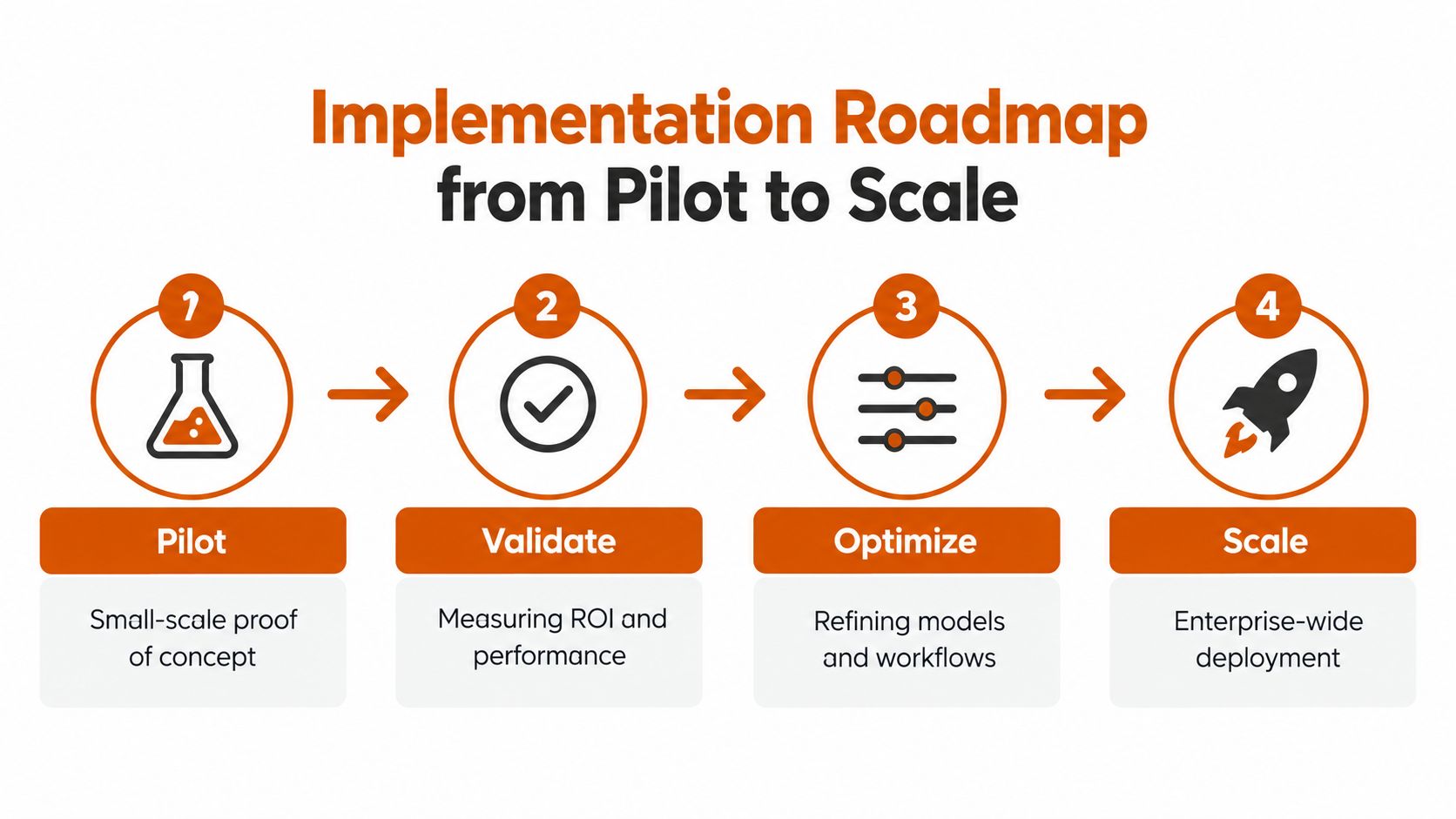
A production transition needs explicit gates. Treating a pilot as a smaller version of the final system usually causes problems because the pilot may use cleaner data, more motivated users, and manual support that won't exist at scale.
Phase one, prove the use case
Choose one repeated workflow with a named owner and a baseline. Define the acceptable output, review requirement, data boundary, and decision threshold before building. A proof of concept should answer whether the system can perform the task safely and consistently enough to justify a live pilot.
Phase two, validate in real conditions
Put the workflow in front of its intended users. Track usage, cycle time, quality, rework, exceptions, and user behavior. Include ordinary data and difficult cases, not only examples selected for a successful demonstration.
Phase three, prepare production
Production requires more than a better prompt. Establish access controls, logging, approved sources, escalation paths, support ownership, and a process for updating the system. Deloitte's enterprise research identifies insufficient worker skills as the biggest barrier to integrating AI into existing workflows, so training belongs inside the deployment plan rather than after it.
Phase four, scale with control
Expand only after the workflow meets its agreed thresholds. Replicate the operating pattern across related processes, but reassess data quality, risk, and ownership for each new domain. Scaling a flawed process multiplies waste and exposes more users to the same failure mode.
This applied generative AI guide for digital transformation is relevant for leaders connecting pilots to broader operating-model change.
The governance gate should remain active after launch. Deloitte reported that regulatory compliance rose from 28% to 38% as a primary deployment roadblock, so production teams need a documented way to review policy changes, model behavior, data access, and human accountability.
Key Takeaways and Next Steps
Generative AI consulting creates value when it improves a business process that already matters. The technology is part of the solution, but measurable impact depends on workflow design, adoption, governance, and ownership.
Key Takeaways
- Adoption isn't the finish line: Organizations may use AI widely while still struggling to move pilots into production.
- Start with repeated work: Structured tasks with clear feedback and quality standards provide stronger conditions for measurement.
- Build around existing systems: CRM, knowledge bases, marketing platforms, and service tools should support the workflow rather than sit outside it.
- Treat governance as operational design: Human review, approved tools, usage records, and risk assessment should be defined before launch.
- Measure commercial movement: Track revenue, qualified demand, acquisition cost, sales speed, throughput, quality, or risk reduction, depending on the use case.
- Make ownership explicit: A pilot without a process owner becomes a demonstration. A production system needs someone accountable for performance after the consultant leaves.
A practical starting checklist
- Document the current process and its baseline.
- Identify one repeated workflow with a clear economic consequence.
- Confirm data permissions, quality, and approved tools.
- Define the human review gate and escalation path.
- Select a partner based on implementation evidence, not model vocabulary.
- Agree on pilot thresholds, production criteria, and post-launch ownership.
Pricing varies with integration depth, governance requirements, data readiness, training needs, and the number of workflows involved. A narrow diagnostic costs less than a multi-system transformation, but an inexpensive pilot that cannot reach production may cost more than a properly scoped implementation.
The immediate impact opportunity is to find the point where your team loses time, speed, or consistency inside an existing revenue process. Then build the smallest controlled intervention that can prove whether AI changes that metric.
Prometheus Agency helps growth leaders turn existing technology stacks into scalable revenue systems through AI enablement, CRM implementation and optimization, go-to-market strategy, training, and change management. Start with a complimentary Growth Audit and AI strategy session by visiting Prometheus Agency to discuss a practical path from pilot to measurable business impact.