The hardest part of ERP AI isn't the AI. It's deciding whether your ERP can safely let software act on the business. Benchmark evidence makes that uncomfortable: in a production-grade ERP simulation covering pricing, inventory, procurement, and finance, frontier models satisfied explicit task constraints in only 26.1% of trials and reached a fully optimal solution in 17.4% (ERP Research benchmark coverage). That gap turns ERP AI from a model-selection exercise into a governance, data, and workflow-design program.
ERP systems control the general ledger, purchase orders, inventory positions, production schedules, customer orders, and service obligations. A bad answer in a chat window wastes time. A bad action inside a stateful transaction system can create financial, operational, or compliance exposure. The leaders who win with ERP AI will treat trusted execution as the product, not a side effect.
Why ERP AI Is the Hardest AI Problem Most Leaders Underestimate
Most executives begin with the wrong question: “Which model should we use?” The better question is, “What must be true before an AI system can recommend or execute a business action safely?”
Your ERP environment has to provide clean transactional data, governed master data, identity-aware permissions, deterministic posting logic, and an audit trail that explains what happened. An agent touching a vendor record or production schedule must operate within segregation-of-duties rules and approved thresholds. A standalone copilot can produce a plausible response without understanding whether the user is authorized to release a purchase order or alter a financial record.
Treat the Environment as the Primary Deliverable
Start with the operating conditions, not a vendor demo. Leaders should require clear answers to these questions:
- Data ownership: Who owns customer, supplier, product, entity, and chart-of-accounts data?
- Action authority: Which users, roles, and agents may recommend, approve, post, release, or reverse a transaction?
- Traceability: Can the organization reconstruct the inputs, policy version, model output, user decision, and resulting ERP change?
- Exception handling: What happens when data conflicts, a rule fails, or the model lacks confidence?
- Rollback: Can the business safely reverse an automated action without creating a second reconciliation problem?
If those answers aren't documented, the organization isn't ready for autonomous ERP AI. It may still be ready for read-only search, anomaly detection, summarization, or decision support. That distinction matters because assistive use cases create learning without granting an immature system permission to change the books or the plan.
Make architecture a business decision
Legacy customization often blocks the clean interfaces, identity controls, and event access that AI execution requires. Before adding agents, assess whether modernization work is needed to expose reliable transactions and preserve control. A practical starting point is this legacy system modernization guide, especially when the ERP has accumulated brittle integrations and undocumented process variants.
Practical rule: If the team can't explain who owns the data, who approves the action, and how the action gets reversed, the use case belongs in recommendation mode.
The rest of the program should follow that logic. First establish trustworthy data and permissions. Then select where intelligence belongs. Only after that should the organization decide which actions can move from suggestion to controlled execution.
What ERP AI Actually Means in a Modern Enterprise Stack
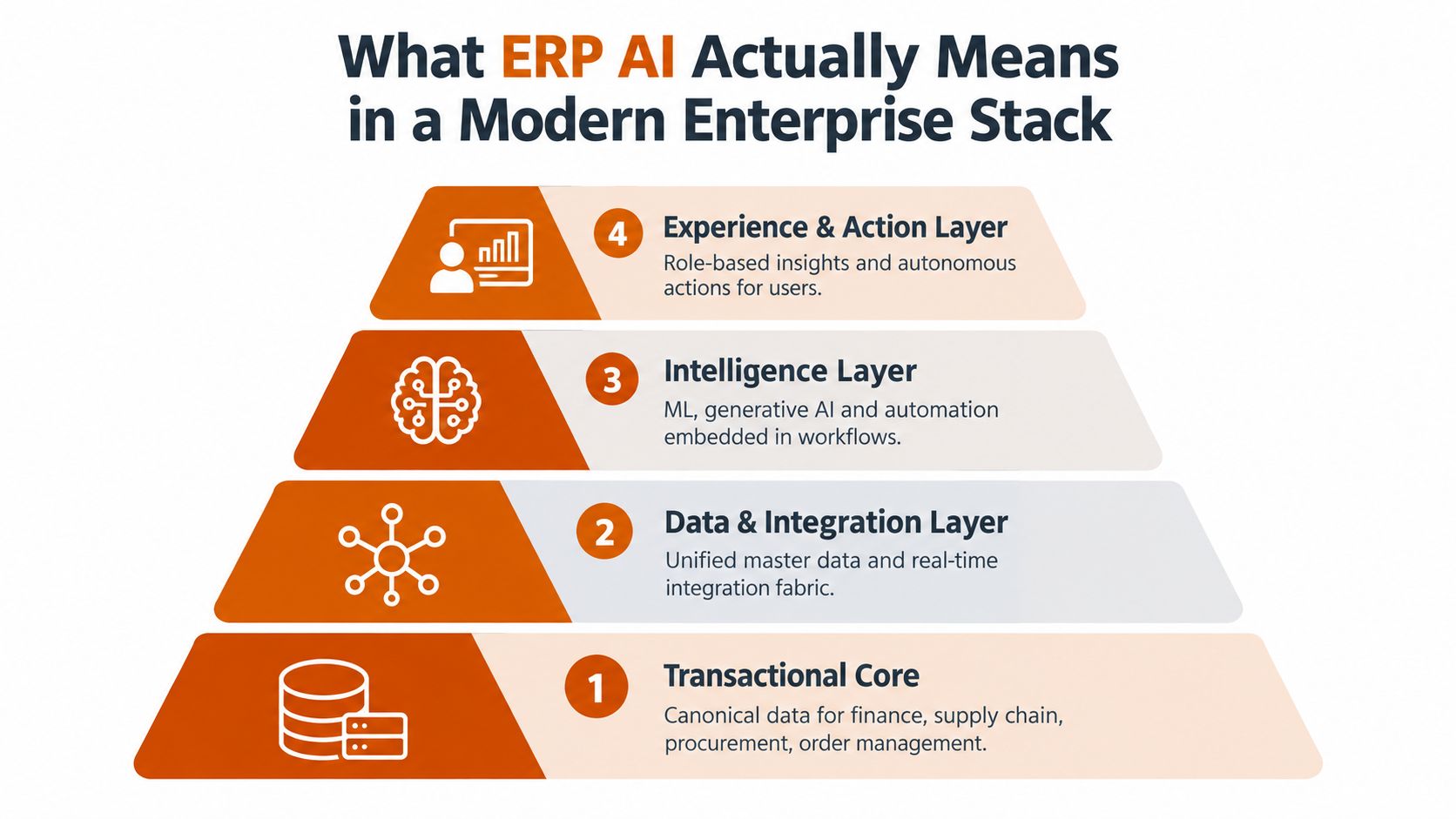
ERP AI is a layered operating capability, not a chatbot bolted onto an enterprise application. The bottom layer is the transactional core, which holds canonical records for finance, supply chain, procurement, and order management. Above that sits the data and integration layer, where master data, documents, events, policies, and external signals become usable across workflows.
The intelligence layer provides three distinct modes. Predictive models score demand, cash, risk, or exceptions. Generative tools explain records, draft responses, summarize cases, and guide employees. Agents monitor conditions, invoke approved tools, and execute multi-step work under defined permissions. The top experience layer puts those insights and actions where employees already operate, ideally inside the ERP transaction or service workspace.
Embedded intelligence versus standalone tools
Embedded ERP AI inherits the ERP's identity model, posting logic, workflow state, and audit controls. That gives the system context that a separate tool must reconstruct through exports, APIs, duplicate permissions, and synchronization jobs. Standalone tools can still be useful, particularly for experimentation or cross-system analysis, but data-copy sprawl becomes dangerous when the recommendation needs to update a canonical record.
For example, a demand model can identify a likely shortage. Trusted execution requires more than the prediction. The system must know the item's approved suppliers, current commitments, purchasing policy, plant constraints, currency rules, and authorization limits. It must also record why the proposed purchase order was created and which person or policy approved it.
Choose the layer according to the decision
Use predictive scoring when the organization needs prioritization. Use generative assistance when employees need context faster. Use agents only when the process has stable rules, clear permissions, observable outcomes, and an accountable owner.
A useful architectural comparison looks like this:
| Layer | Primary job | Appropriate ERP AI pattern |
|---|---|---|
| Transactional core | Preserve the system of record | Controlled write-back and deterministic postings |
| Data and integration | Connect entities, events, documents, and policies | Master-data harmonization and event access |
| Intelligence | Recommend, explain, predict, and orchestrate | Models, generative assistance, and agents |
| Experience and action | Put decisions into the operator's workflow | Role-based work queues and governed execution |
Leaders evaluating vendor capabilities should separate embedded functionality from marketing labels. A useful comparison of Odoo and NetSuite AI capabilities in 2026 should focus on data access, permission inheritance, workflow coverage, auditability, and write-back controls, not merely the presence of a copilot.
The Market Signal That ERP AI Is Now a Budget Decision
ERP AI is now a budget decision, not a lab experiment. One industry analysis forecasts that the AI-in-ERP market will grow by USD 13.08 billion from 2024 to 2029 at a 27.3% CAGR, while another projects growth from USD 4.68 billion in 2025 to USD 10.95 billion by 2030 at an 18.6% CAGR (Technavio's AI-in-ERP market analysis). The forecasts use different market definitions, but both point to sustained investment.
The spending question has changed. Leaders are deciding which ERP modernization, automation, analytics, integration, and external-service budgets belong in a governed ERP AI portfolio. That portfolio should fund trusted execution, not just add copilots or dashboards to an ERP environment that lacks reliable data, clear ownership, and controlled permissions.
Gartner-related reporting indicates that AI-enabled solutions could account for 62% of cloud ERP spending by 2027, up from 14% in 2024 (ERP AI adoption statistics and projections). McKinsey reported that 88% of surveyed organizations regularly used AI in at least one business function in 2025, up from 78% the year before, while 31% of prioritized AI use cases reached full production in 2025, double the prior year. The market has moved past awareness. Integration, controls, data readiness, and process ownership now determine whether spending produces operating value.
Read the budget shift correctly
| Budget Category | 2024 Posture | 2026 Posture | Driver of Shift |
|---|---|---|---|
| ERP platform investment | Core transactions and reporting | Embedded intelligence and governed workflows | Cloud ERP modernization |
| Automation and RPA | Isolated task automation | AI-assisted exception handling and orchestration | Pressure to remove handoff delays |
| Analytics | Separate dashboards and reporting teams | Intelligence embedded in operating processes | Demand for decisions inside workflows |
| BPO and manual operations | Human-heavy exception management | Selective automation with human escalation | Need to scale throughput without multiplying rework |
North America is identified as the dominant region in one forecast, while cloud-based deployment and software components held the largest shares in 2023 in that analysis. The implication is practical: fund ERP AI through the cloud and platform modernization agenda, with explicit budgets for data quality, integration, governance, and operational controls.
The executive trade-off is direct. Fund scattered pilots and preserve fragmented processes, or concentrate investment on a small set of high-value workflows with measurable controls. Choose the second option. It requires stronger ownership at the start, but it creates reusable foundations for governed AI execution across functions. Model capability is rarely the limiting factor. The ERP environment's ability to support reliable decisions and controlled action is.
High-Value ERP AI Use Cases Across the Operating Backbone
ERP AI creates durable value in workflows with high transaction volume, recognizable rules, reusable master data, and a clear approval point before execution. Start there. A dashboard that merely summarizes activity is less valuable than an AI workflow that identifies an exception, recommends a response, and records who approved the outcome.
Finance
Finance teams can apply AI to continuous close support, journal-entry anomaly detection, cash forecasting, and vendor-master reconciliation. Relevant inputs include ledger activity, payment history, open receivables, supplier records, approval policies, and supporting documents.
Keep the first automated decisions narrow. An anomaly model can route a journal entry for review, identify duplicate vendor records, or prioritize collections activity. A finance user validates the explanation, then approves, rejects, or escalates the recommendation. The audit record should retain the source transactions, decision rationale, and final disposition.
Supply chain and procurement
Supply chain offers broader decision coverage and greater operational exposure. Demand sensing can combine point-of-sale and shipment signals with inventory and replenishment data. AI can flag likely inbound delays, suggest safety-stock changes, acknowledge purchase orders, and prioritize supplier exceptions.
Do not give an agent authority to rewrite planning parameters across the network at launch. Begin with recommendations and bounded acknowledgements. Require human approval for changes affecting supplier commitments, production availability, customer promise dates, or working capital. The agent should also state which records and rules drove its recommendation.
Manufacturing
Manufacturing use cases gain value when AI connects operational signals to ERP work orders. Line-level yield and OEE anomaly detection can route a quality hold. Predictive maintenance can propose a work order when equipment signals indicate a developing issue.
The plant manager or maintenance owner needs a defined checkpoint. The system should display the signal, affected asset, relevant work history, recommended response, and operational consequence. AI can shorten investigation time, while the production team retains authority over shutdowns, holds, and schedule changes.
Service and order management
Service organizations can use AI for case triage, contract-entitlement matching, and order promising based on live available-to-promise data. The model can classify the issue, retrieve contract terms, identify the correct queue, and suggest a resolution. A service lead approves exceptions when entitlement, warranty, pricing, or customer commitments conflict.
| Function | Use Case | Data Inputs | Automated Decision | Human Checkpoint |
|---|---|---|---|---|
| Finance | Journal anomaly detection | Ledger entries, policies, supplier records | Route unusual entries for review | Controller validates disposition |
| Supply chain | Inbound delay prediction | Shipment events, purchase orders, supplier history | Prioritize at-risk receipts | Planner approves response |
| Manufacturing | Quality hold routing | Inspection results, production data, work orders | Assign hold to the correct workflow | Quality owner confirms action |
| Service | Entitlement matching | Contracts, installed base, case history | Classify coverage and route case | Service lead resolves conflicts |
| Order management | Order promising | Inventory, allocations, production plans | Recommend feasible promise date | Order manager approves exceptions |
A study covering 143 organizations reported a 43.7% reduction in process execution time and a 31.6% improvement in data accuracy compared with traditional automation approaches (WJARR study on AI-enhanced ERP implementation). Treat those findings as directional evidence, not a universal business case. The sounder recommendation is to target repetitive processes where document classification, anomaly detection, and early decision support remove latency before it creates downstream rework.
Across every function, control design comes before autonomy. Confirm data ownership, define the agent's permitted actions, preserve an audit trail, and set an explicit human checkpoint for decisions that affect customers, suppliers, production, or cash. That is the difference between an ERP AI pilot and a trusted operating capability.
An Implementation Roadmap Leaders Can Actually Govern
A credible ERP AI roadmap has gates, owners, and reasons to stop. The steering committee should measure roadmap quality by how often it rejects weak use cases, poor data, and unsafe permissions, not by how many demos reach production.
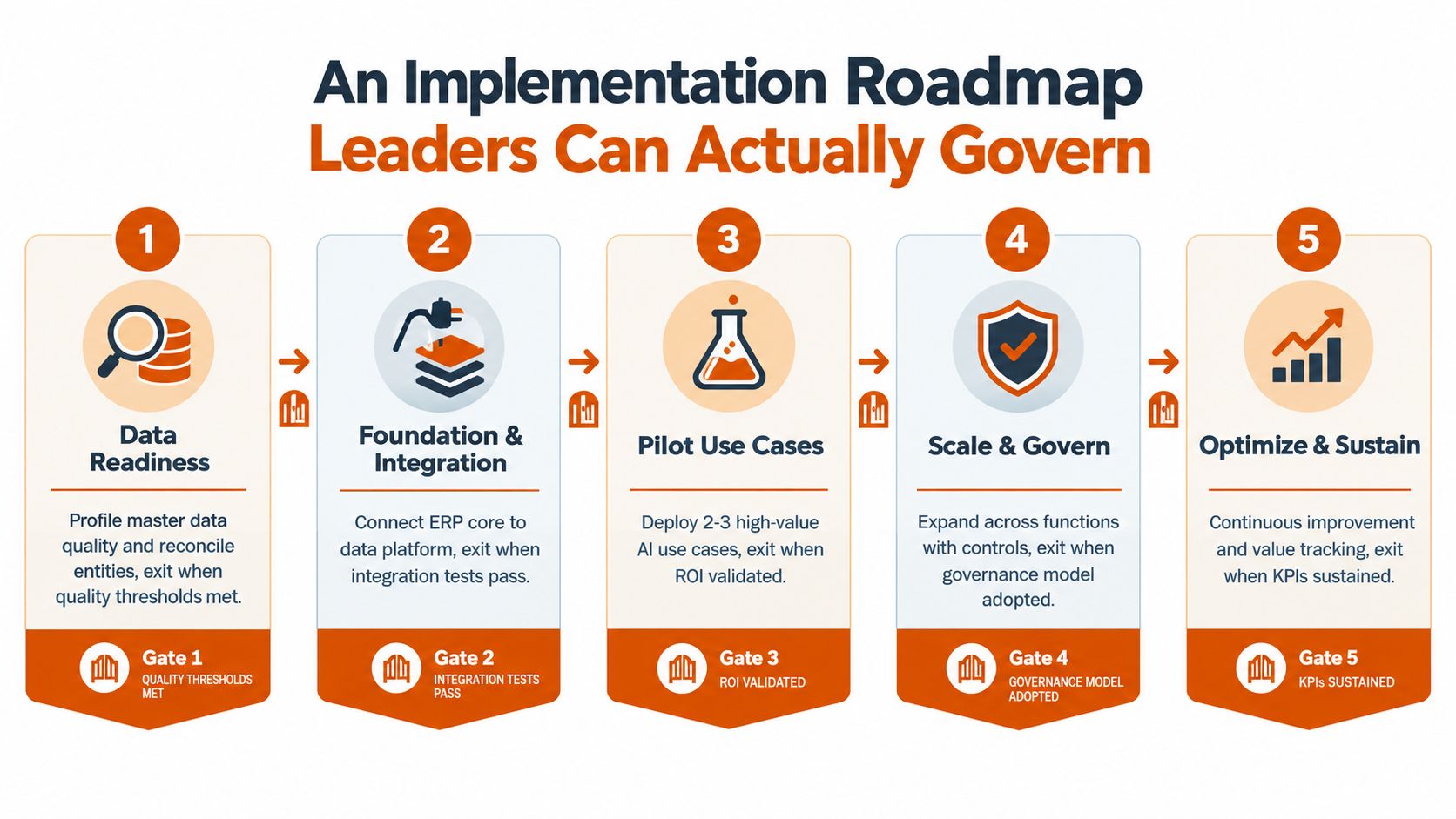
Stage one is data readiness
Profile supplier, customer, product, employee, entity, and financial master data. Reconcile duplicate identifiers across ERP, CRM, warehouse, and external systems. Publish a readiness scorecard that shows ownership, completeness, conflicts, refresh expectations, and known exceptions.
The exit criterion is not “the data looks good.” It's documented evidence that the selected use case has reliable inputs and an owner responsible for remediation.
Stage two is foundation and integration
Choose among embedded vendor AI, side-by-side agents connected through the integration layer, or a data-platform middle layer. Document trade-offs involving latency, identity inheritance, event access, write-back, security, and operational support.
Integration tests must prove that the agent can retrieve the right record, respect the right role, invoke only approved tools, and record the transaction outcome.
Stage three is a bounded pilot
Run pilots for 8 to 12 weeks, as a controlled program constraint rather than an industry statistic. Give each pilot one primary metric. Require a written handoff plan before launch, including process ownership, training, exception handling, rollback, and support.
Pick a workflow such as invoice exception routing or purchase-order acknowledgement. Don't combine several loosely related outcomes and call the result ROI.
Stage four is governance
Create an AI control tower covering prompt and policy versioning, model drift, action-level audit trails, access reviews, incident response, and segregation of duties. The control tower should meet the same operational standard as other ERP controls, with named owners and evidence retained for review.
Stage five is scale and change
Sequence rollout by business unit and appoint a named process owner for every release. Tie enablement to the metric the pilot proved, so users understand how the change affects their work and why the new workflow deserves adoption.
Teams that need a structured way to connect objectives, owners, and measurable outcomes can use this practical OKR rollout plan alongside the ERP governance process.
A short implementation video can help steering committees align on the sequence before they approve investment.
The committee should approve the next stage only when the previous stage has produced evidence. A failed data gate is useful information. A vague approval creates expensive rework later.
Why Most ERP AI Becomes Shelfware and How to Prevent It
ERP AI becomes shelfware when leaders buy a capability before fixing the workflow, data, ownership, and controls required to run it. Recent coverage warns that many organizations still lack sufficient data quality for advanced ERP AI, with projections that only 30% will have sufficient data quality by 2027 and that more than 70% of acquired ERP AI capabilities could become shelfware by 2030 (coverage of ERP's shift toward workflow execution). Model capability is rarely the bottleneck. Trusted execution is.
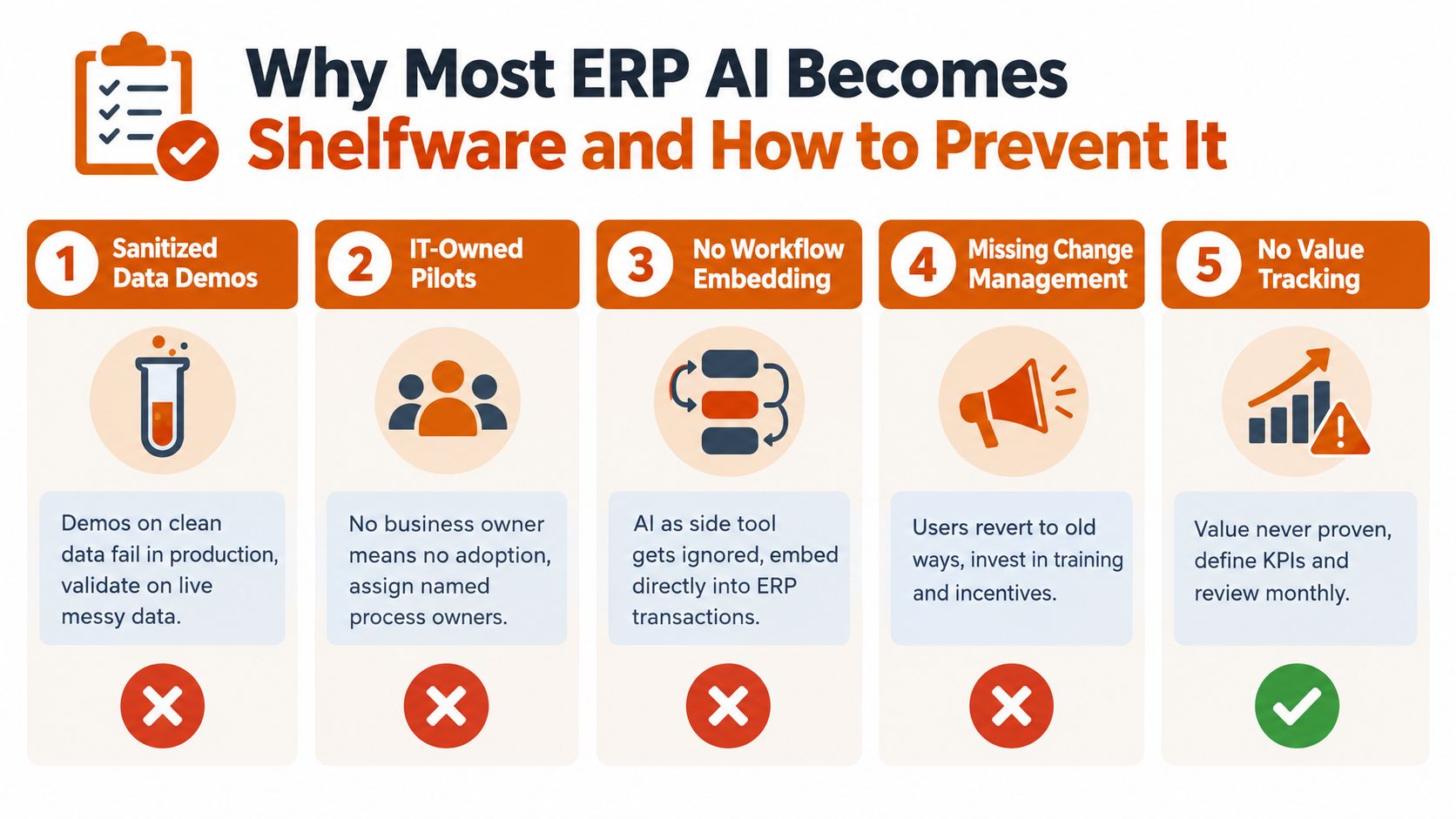
The failure patterns are predictable:
- Sanitized demos: Clean sample data conceals duplicate records, missing fields, conflicting policies, and delayed updates. Test on live, imperfect data before approving scale.
- IT-owned pilots: IT can deploy the capability, but the process owner must define the decision, approve the workflow, and defend the result. Assign an owner with operating authority and budget responsibility.
- Disconnected action surfaces: Recommendations in a separate portal are easy to ignore. Place the action inside the transaction screen, work queue, or service console already used by operators.
- Shadow write-back: An agent has not automated work if it writes to a table no operator reads. Map every action to an ERP field, approval state, or accountable queue.
- Legal-only governance: A one-time review cannot manage drift, policy changes, access changes, or new exception types. Governance needs recurring operating routines.
Design for adoption before autonomy
Set refresh cadences against master-data service levels. Require pre-action controls for any autonomous step that can move money, alter a commitment, change a customer promise, or affect production. Show users why the system made its recommendation and provide a clear escalation path.
Use a practical Software Modernization Intelligence approach to connect modernization decisions with application dependencies, integration constraints, and execution risk. Treating ERP AI as an isolated feature purchase hides the conditions that determine whether it can operate safely.
ERP AI shelfware usually reflects weak workflow design, unclear incentives, stale data, missing ownership, or governance that exists on paper but not in daily operations. Leaders prevent it by making those conditions explicit before deployment, then holding named owners accountable for adoption and control.
Measuring ERP AI Outcomes and Avoiding the Common Traps
ERP AI succeeds only when its outcomes can survive finance review and operational scrutiny. Build the measurement system around the ERP process, its control points, and defensible data lineage. Cycle time belongs to the transaction process that produces it. Forecast accuracy belongs to planning data and versioned forecast history. Exception rates require consistent definitions across workflow states. Straight-through processing needs evidence that the transaction completed without hidden manual rework. Working-capital outcomes require reconciled inventory, purchasing, receivables, and payment data.
Prompt volume is not value. A pre-and-post comparison can mislead when demand, seasonality, staffing, or policy changes affect the result. Savings claims fail under review when the program cannot show baseline definitions, excluded work, approvals, reversals, and actual ledger impact. Measure controls and data readiness alongside model performance, because weak governance can make a capable model unsafe to run.
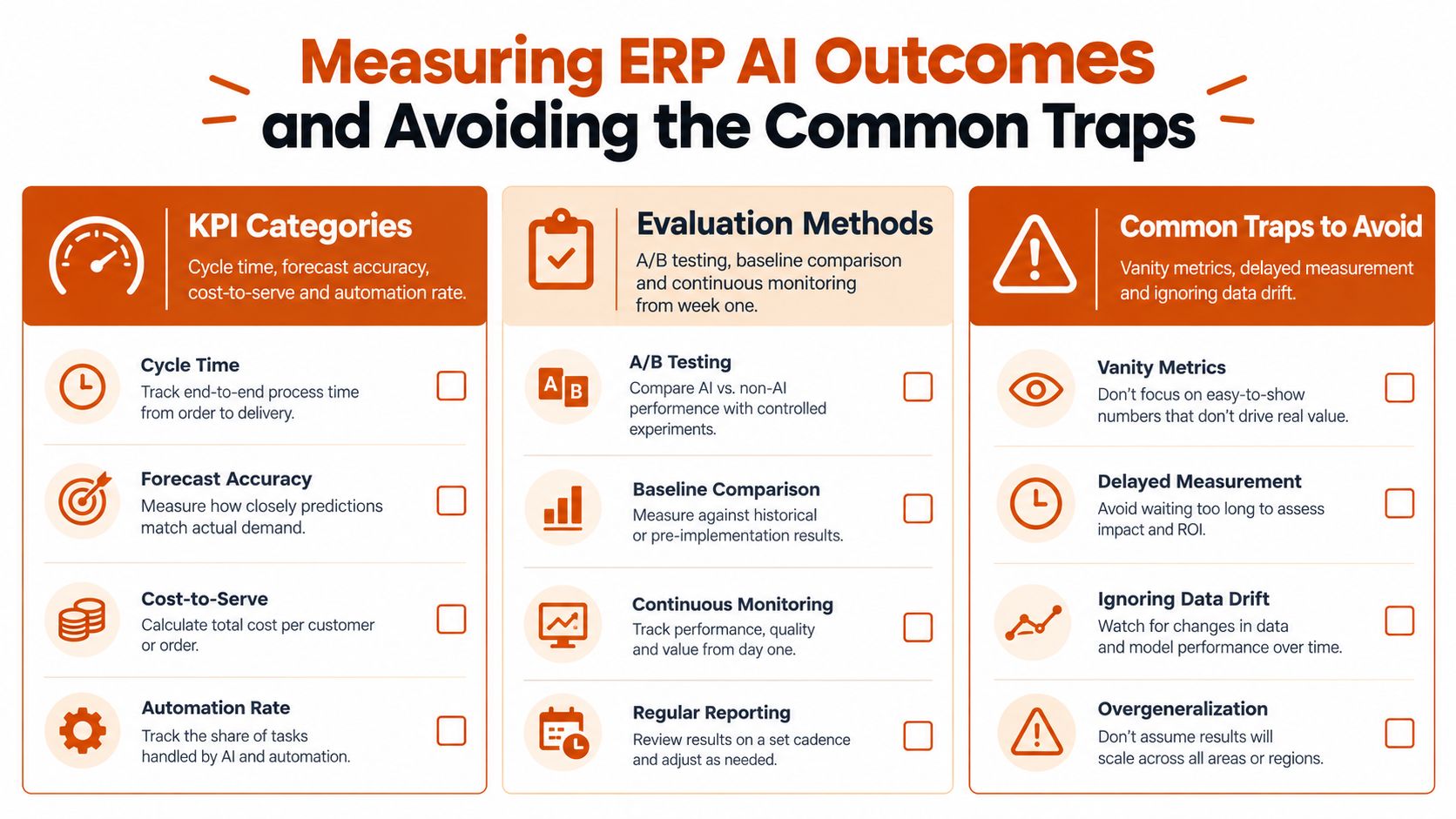
The launch checklist
Use this operating checklist from the first week:
- Capture the baseline: Record current cycle time, exception volume, accuracy, rework, and ownership.
- Define the unit of value: Specify which transaction, decision, or control the AI changes.
- Map data lineage: Document source fields, transformations, refresh timing, and reconciliation.
- Name the control owner: Assign accountability for access, policy, review, and rollback.
- Set the evaluation design: Use baseline comparisons or controlled testing suited to the process.
- Track hidden rework: Measure work that shifts into spreadsheets, email, or manual reconciliation.
- Review drift: Establish a recurring review of data quality, model behavior, and exception patterns.
- Set rollback criteria: Define the conditions that pause automation and return work to the prior process.
- Report realized value: Separate usage, operational improvement, financial impact, and control performance.
- Schedule executive review: Treat value realization as an ERP operating cadence, not a pilot closeout.
The broader adoption context reinforces the need for strict measurement. Enterprise AI adoption remains uneven, and only a small group of organizations reports significant business impact, as noted earlier. ERP AI should be governed as an operating portfolio, with evidence that connects workflow changes to financial results and control performance.
Use this framework to measure AI ROI, linking business outcomes to consistent evaluation methods.
Prometheus Agency helps B2B leaders assess ERP and CRM readiness, design governed AI workflows, and connect existing systems into accountable operating processes. Visit Prometheus Agency to request a Growth Audit and AI strategy session focused on one measurable ERP AI opportunity.