An effective Enterprise AI Transformation Roadmap begins not with technology, but with a candid assessment of your business's current state. This foundational phase is crucial for building momentum. By focusing on projects that deliver clear, measurable value quickly, you secure the early buy-in necessary for long-term success.
Key Takeaways
- Start with Business Problems, Not Technology: A successful AI roadmap identifies and solves specific operational bottlenecks, rather than chasing the latest tech trends.
- Prioritize Quick Wins: Focus initial efforts on high-impact, low-complexity projects to demonstrate value and build organizational momentum.
- Secure Early Buy-In: Proving tangible ROI from the outset is critical for gaining the stakeholder support needed for the entire transformation journey.
Building Your Foundation for AI Success
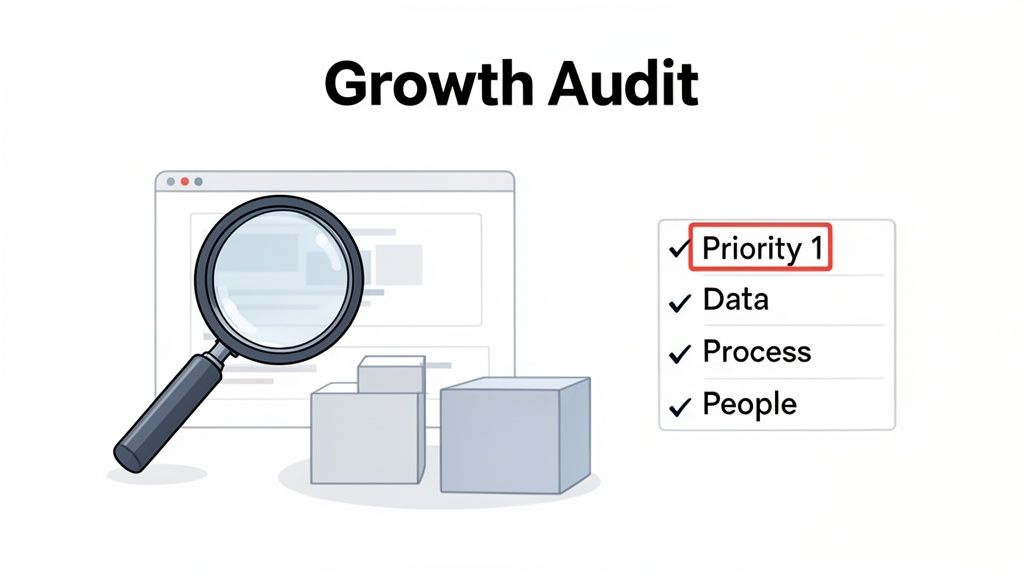
A successful jump into enterprise AI kicks off with a comprehensive 'Growth Audit' to find the high-impact opportunities. Instead of chasing fuzzy goals, this process gives you a prioritized list of quick wins by looking closely at your business functions, data maturity, and how ready your organization truly is.
Too many leaders dive straight into the tech, completely skipping the foundational work needed to make sure AI actually delivers. The real goal here is to pinpoint specific use cases with the highest potential for improvement—whether that’s in marketing automation, supply chain logistics, or customer service.
This initial audit is built around a few critical questions:
- Where are our biggest operational bottlenecks? Find the processes that are slow, manual, or eating up resources.
- Which departments have the best, most accessible data? AI is only as smart as the data it learns from.
- What are the low-hanging-fruit opportunities? Zero in on projects that can show a clear return quickly. This is how you build momentum.
Assessing Your Current State
A proper audit looks at both hard numbers and human feedback. That means digging into CRM usage data, deal cycle lengths, and customer satisfaction scores, but it also means sitting down and talking to key people from sales, IT, and operations.
This dual approach uncovers hidden problems that data alone can’t see.
Practical Example: A spike in support tickets might not just be a customer service issue; it could be a symptom of a clunky product onboarding process that AI could help simplify. A huge part of this is understanding your organization's readiness for AI, or its AI Quotient.
The process is actually pretty straightforward. It’s about moving from a clear-eyed assessment to getting your key stakeholders on board.
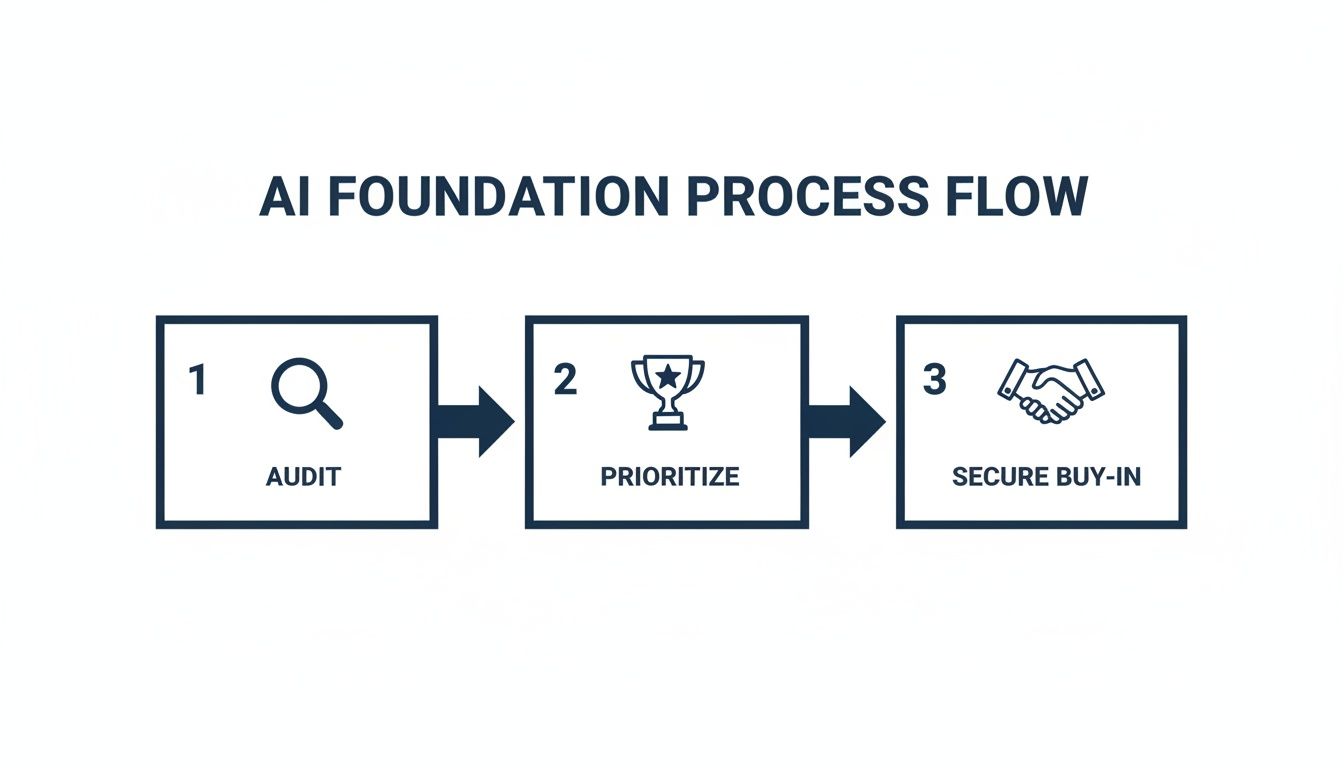
This simple flow ensures your first steps are strategic, putting resources where they have the highest chance of success and impact.
From Audit to Action Plan
The output of your Growth Audit should be a prioritized list of potential AI projects. This isn't just a brainstorm; it’s a strategic selection based on potential impact versus how hard it is to actually implement. A simple scoring matrix can help you sort this out and bring clarity to your priorities.
AI Opportunity Assessment Matrix
To move from a long list of ideas to a focused action plan, you need a framework. This matrix helps you map potential AI initiatives against their business impact and feasibility, ensuring you tackle the high-value, achievable projects first.
| Business Function | Potential Impact (High/Medium/Low) | Data Readiness (High/Medium/Low) | Technical Feasibility (High/Medium/Low) | Priority Score |
|---|---|---|---|---|
| Sales (Lead Scoring) | High | High | High | 1 |
| Marketing (Content Gen) | High | Medium | High | 2 |
| Customer Service (Chatbot) | Medium | High | High | 3 |
| Operations (Forecasting) | High | Low | Medium | 4 |
By scoring each potential project, you create a data-driven hierarchy.
Practical Example: An AI-powered lead scoring model for the sales team might hit the top of the list because it solves a clear business need (better leads), uses CRM data you already have, and promises a quick, measurable return. On the other hand, a complex predictive maintenance model for manufacturing might be a longer-term goal because of data gaps and technical hurdles.
Impact Opportunity: The business case for this is solid. Organizations report 34% operational efficiency gains and 27% cost reductions within just 18 months of rolling out AI. But in the same breath, 73% point to data quality as their biggest obstacle. This is exactly why that initial audit is non-negotiable. Checking your data readiness is a critical step that prevents costly mistakes and ensures your transformation is built to last.
Designing Pilot Projects That Prove Tangible ROI
Once your audit has spotlighted a few high-potential areas, it's time to prove the value. This is where pilot projects come in. Think of them as your proving ground, turning a theoretical benefit into a tangible business case that leadership simply can’t ignore.
A successful pilot isn't just a technical test run; it's a strategic play to get buy-in for bigger changes down the road. The trick is to pick something small enough to be manageable but significant enough to actually mean something.
Selecting The Right Pilot Project
Choosing that first project is everything. You're hunting for an initiative that can deliver a clear, measurable win in a short timeframe—think one or two business quarters. Steer clear of those overly complex, multi-year behemoths that demand massive data cleanup or brand-new infrastructure.
Instead, zero in on problems your team already understands inside and out, especially ones with accessible, clean data ready to go. An ideal pilot tackles a persistent, nagging business pain point.
Practical Examples of High-Impact Pilots
- AI-Powered Lead Scoring: Drop an AI model into your CRM to score inbound leads on their likelihood to convert. This is a direct hit on sales efficiency, helping reps focus their energy on the most promising opportunities first.
- Customer Service Ticket Triage: Roll out an AI tool that automatically categorizes and routes support tickets. You’ll see an immediate drop in manual work and faster resolution times for customers.
- Predictive Inventory Management: Put AI to work analyzing historical sales data and market trends to forecast demand for your key products. This targets a direct financial outcome by cutting down on overstock and preventing costly stockouts.
The whole point is to draw a straight line from the AI solution to a core business function. That clarity makes the value proposition dead simple for stakeholders to get behind.
Defining KPIs That Speak to The Business
Sure, technical metrics like model accuracy or processing speed matter to your data science team, but they mean next to nothing to the C-suite. To prove tangible ROI, your key performance indicators (KPIs) have to be tied directly to business outcomes.
Your pilot’s success needs to be measured in the language of the business—dollars, percentages, and hours saved. This shifts the entire conversation from "Does the AI work?" to "How much value did this AI create?"
Crafting Business-Centric KPIs
Before you launch anything, sit down with department heads and define what success actually looks like. These KPIs should be sharp, measurable, and directly influenced by the AI tool you're testing.
| KPI Category | Example KPIs for an AI Lead Scoring Pilot |
|---|---|
| Revenue Uplift | Increase in marketing-qualified to sales-qualified lead conversion rate by 15%. |
| Cost Savings | Reduction in time spent by sales reps on unqualified leads by 10 hours per week. |
| Efficiency Gains | Decrease in average lead response time from 4 hours to under 1 hour. |
| Customer Impact | Improvement in initial engagement rates with prioritized leads. |
Impact Opportunity: A framework like this makes the return on investment undeniable. When you can walk into a meeting and show that a small pilot led to a 15% spike in conversion rates, you've built an airtight case for scaling up. For a real-world look at AI driving tangible results, check out this case study on real-time AI recruitment, where the tech directly leveled-up a core business process.
Key Takeaway: By focusing on pilots scoped for quick wins and measured with business-centric KPIs, you turn your AI initiative from an abstract idea into a proven engine for growth. That foundational success is the fuel for your entire enterprise AI transformation.
Integrating AI Into Your Core Technology Stack
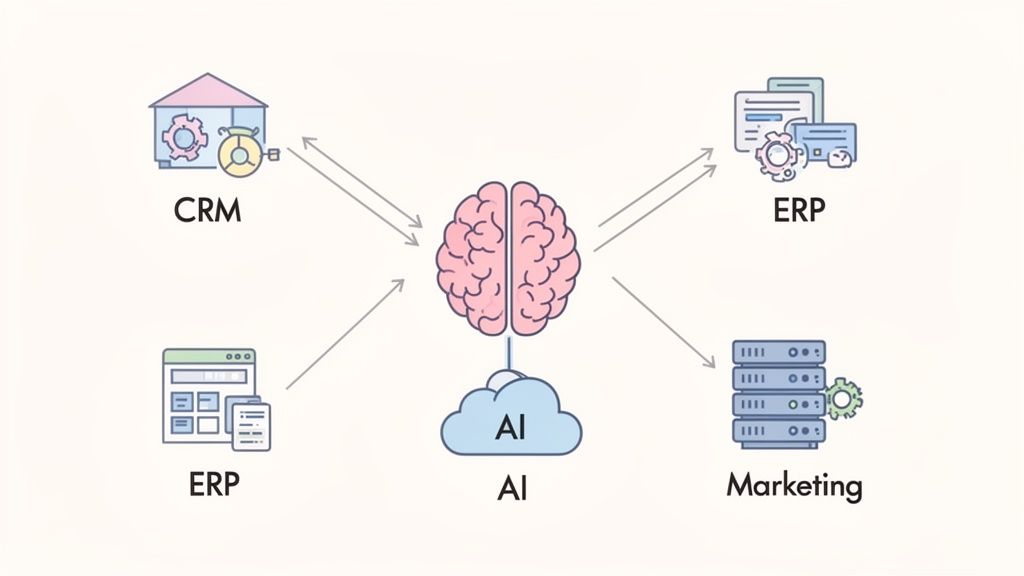
Stand-alone AI tools might give you a quick sugar rush, but they rarely lead to real change. In fact, they usually just create new data silos and add friction to your workflows. The real transformation happens when you weave AI capabilities directly into the systems your team lives in every day—your CRM, ERP, and marketing automation platforms.
This is the phase where your roadmap's technical vision starts to become a reality. The goal isn't to bolt on another complicated piece of software. It's to build a cohesive ecosystem where AI feels like a natural extension of the tools you already use, making everyone's job easier.
Navigating The Build-Versus-Buy Decision
One of the first forks in the road you'll hit is whether to build custom AI models from scratch or buy an off-the-shelf solution. There's no single right answer here. The best choice comes down to your specific use case, your team's skills, and your long-term strategy.
- Buying an AI Solution: This is your fast track. It comes with a lower upfront investment and is perfect for solving common business problems. Think AI-powered chatbots for customer service or a lead scoring plugin for your CRM. You get a proven tool without needing a team of data scientists to build and babysit it.
- Building a Custom Model: This path can give you a serious competitive edge, but only if your needs are truly unique. Building is the right move when you have proprietary data that can train a model to do something far better than any generic tool on the market. Just know that it demands deep technical expertise, significant infrastructure, and ongoing MLOps (Machine Learning Operations) to keep it running smoothly.
For most companies just starting out, a hybrid approach makes the most sense. Buy solutions for standardized tasks to get some quick wins on the board. At the same time, strategically invest in building custom models for the core processes that truly set your business apart.
Key Takeaway: The "build vs. buy" decision isn't just technical; it's strategic. Buying gets you value faster for common problems. Building creates a long-term, defensible advantage for your unique business challenges.
Choosing Your Platform And Architecture
Whether you build or buy, your AI tools need a place to live and a way to talk to everything else. This is where your cloud platform and integration architecture become absolutely critical. The big players like AWS, Azure, and Google Cloud all offer a suite of AI services that make it much easier to deploy and scale.
But don't just pick one based on a feature list. Look at your existing setup. If your company is already all-in on Microsoft Azure, their AI services will probably integrate more smoothly. And don't forget about the data. Your architecture needs to be built to handle the massive data pipelines required to train and run AI models, ensuring data can flow securely from your CRM to the AI tool and back again without a hitch.
This is where an API-led strategy really shines. Using Application Programming Interfaces (APIs) lets your different systems communicate in a standardized way. It makes it far easier to plug in new AI tools—or swap out old ones—without having to tear down and rebuild your entire stack.
Getting Your Data Infrastructure Ready
An AI model is only as good as the data it learns from. Period. Before you can successfully plug in any AI solution, you have to get your data house in order. This is way more than just cleaning up a few spreadsheets; it means building a solid data infrastructure.
Practical Steps for Data Readiness
- Centralize Your Data: Pull your data from all its disparate sources into a single repository, like a data warehouse or data lake. This gives your AI models one source of truth to work from.
- Establish Data Governance: Set up clear rules for data quality, security, and access. You need to know where your data came from, who can use it, and that it's accurate and compliant.
- Automate Data Pipelines: Build automated workflows (ETL/ELT pipelines) that continuously pull in, clean, and transform data so it's always ready for your AI applications.
Impact Opportunity: The mad rush to adopt AI makes this prep work more urgent than ever. Recent stats show 78% of organizations are now using AI in at least one business function, and 71% are deploying generative AI regularly. And yet, very few are seeing a major financial impact. Why? Because their integration and data strategies are lagging way behind. As you map out your plan, remember that the high-performers start with plug-and-play tools and scale effectively because they have solid MLOps. You can dig into more findings on AI adoption trends to see how you stack up.
By focusing on deep integration with your core stack, you make sure AI actually enhances your existing workflows instead of just adding another layer of complexity. That’s how you turn technology into a true servant of your business goals.
Driving Adoption With Strategic Change Management
Let's be honest. The most sophisticated AI model in the world is just an expensive line item on a P&L if your team refuses to use it. This brings us to the human side of your AI roadmap—and it’s almost always the biggest hurdle to clear. A technically flawless implementation will fall flat without a smart change management strategy.
The real work is shifting your organization's mindset from seeing AI as a threat to viewing it as a powerful co-pilot. This doesn’t happen by accident. It requires a deliberate plan to build enthusiasm, offer real support, and show everyone how these new tools make their jobs better, not obsolete.
Building Your Adoption Playbook
Effective change management isn’t a one-off town hall or a single memo. Think of it as a continuous internal campaign designed to bring people along for the ride, addressing their fears head-on while showing the "what's in it for me" at every turn.
Your playbook needs to stand on three pillars:
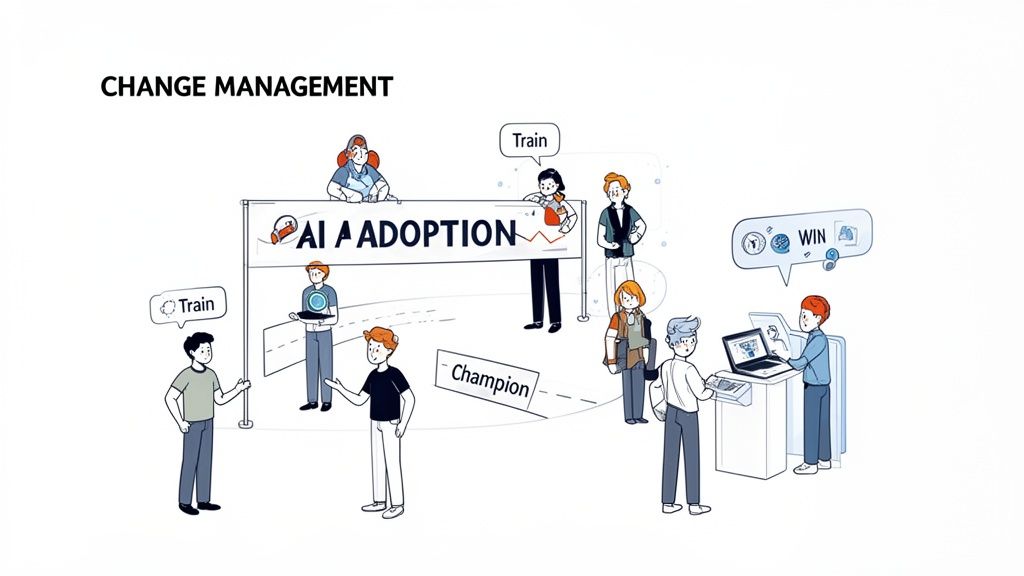
- Targeted Training: Ditch the one-size-fits-all approach. Your sales reps need to understand how an AI lead scorer helps them crush their quota. Your marketing team needs to see how generative AI cuts their content creation time in half. Tailor every training session to specific roles and workflows.
- Transparent Communication: Keep people in the loop, always. Use a mix of channels—newsletters, team huddles, company-wide meetings—to share progress, celebrate the small wins from your pilot projects, and be upfront about any snags you hit. Nothing builds trust faster than transparency.
- Grassroots Support: Find your AI Champions. These are the enthusiastic early adopters in every department who just get it. enable them to provide peer-to-peer coaching, answer questions, and show their colleagues the real-world value of the new tools.
Impact Opportunity: This proactive approach is essential. Research shows that AI initiatives significantly change work for an average of 30% of the workforce. But here's the catch: only 7% of employees see more than half their tasks change, which points to a huge adoption gap. Too many roadmaps focus on the tech but forget the people. Find out how taming your tech with AI-enabled leadership can bridge this divide. Solid change management de-risks your entire AI investment. When you put the human element first, you accelerate adoption, shrink the time-to-value, and make sure the efficiency gains you planned for actually happen.
Clarifying Roles With a RACI Framework
Nothing kills momentum faster than confusion over who’s doing what. People need to know exactly what’s expected of them, who has the final say, and where to go for help.
This is where a RACI chart becomes your best friend.
RACI stands for Responsible, Accountable, Consulted, and Informed. It's a dead-simple matrix that maps out every task and clarifies who owns what.
- Responsible: The person or team actually doing the work.
- Accountable: The one person who owns the final outcome. The buck stops here.
- Consulted: The subject matter experts you loop in for advice.
- Informed: The stakeholders you keep up-to-date on progress.
A well-defined RACI is a game-changer for any AI pilot project. It provides the clarity and structure needed to turn ambiguity into action, ensuring everyone knows their role in the transformation.
Sample AI Project RACI Chart
| Activity/Task | Project Sponsor | Data Science Team | IT Infrastructure | Business Unit Lead | End-Users |
|---|---|---|---|---|---|
| Define Business Case & ROI | Accountable | Consulted | Consulted | Responsible | Informed |
| Secure Budget & Resources | Accountable | Informed | Consulted | Responsible | - |
| Source & Prepare Data | Informed | Responsible | Consulted | Accountable | - |
| Develop & Train AI Model | Informed | Responsible | Consulted | Accountable | Consulted |
| Deploy Model to Production | Informed | Responsible | Accountable | Consulted | Informed |
| User Training & Onboarding | Consulted | Consulted | Informed | Responsible | Accountable |
| Monitor Performance & KPIs | Informed | Responsible | Consulted | Accountable | Consulted |
Key Takeaway: For an AI project, this brings immediate clarity. The data science team might be responsible for building the model, but the business unit lead is accountable for its success. This simple framework turns fear of the unknown into a shared sense of ownership.
Scaling From Successful Pilots to Full Transformation
A successful pilot is a massive win, but it’s just the starting line. The real goal of an enterprise AI roadmap isn't a few isolated victories; it's about weaving AI into the very fabric of your operations. This is where you take the energy from those early projects and build a repeatable, scalable engine for innovation that delivers a lasting edge.
Without a deliberate framework, that initial excitement fizzles out fast. I’ve seen it happen time and again: a promising AI tool gets stuck in a departmental silo, and the momentum dies. To avoid that, you need a structure that actively encourages, governs, and funds AI innovation across the entire business.
Establishing an AI Center of Excellence
The best way I’ve found to manage this scaling phase is by creating a centralized AI Center of Excellence (CoE). Think of the CoE as the central nervous system for your company's AI strategy. It's not a bureaucratic bottleneck but an enablement hub that provides resources, sets guardrails, and shares knowledge.
A well-run CoE handles a few critical jobs:
- Developing best practices: It standardizes tools, methods, and data governance policies based on what you learned from the early pilots.
- Managing a shared resource pool: It offers access to data scientists, MLOps engineers, and other specialists that most individual departments can't afford to hire full-time.
- Vetting new AI initiatives: It creates a clear process for any team to pitch an AI project, making sure it aligns with bigger goals and has a solid business case.
- Disseminating knowledge: It hosts workshops, maintains an internal knowledge base, and celebrates wins to build AI literacy across the board.
Impact Opportunity: This model stops teams from reinventing the wheel. When the marketing team builds a killer customer segmentation model, the CoE makes sure that insight is captured and shared with product and customer success, multiplying its impact.
Building a Repeatable Innovation Framework
Once your CoE is in place, you can move from ad-hoc projects to a structured, repeatable innovation pipeline. It works almost like an internal VC fund, where different business units can pitch ideas and get the support they need to bring them to life.
The process has to be crystal clear:
- Idea Submission: A standard template for new AI proposals, outlining the business problem, expected ROI, and data needs.
- Vetting & Prioritization: The CoE reviews submissions against a scorecard, green-lighting projects with the highest strategic value.
- Pilot Execution: Approved projects get a dedicated team and a set timeline to run a pilot, following the same KPI-driven approach you used for your first tests.
- Scale & Integration: Successful pilots are then handed off from the CoE to the business unit for full-scale integration, with the CoE providing ongoing support.
Key Takeaway: Scaling isn't about launching a dozen pilots at once. It's about building a disciplined system that finds the best ideas, proves their value, and integrates them deeply into the business.
Securing Long-Term Investment and Sponsorship
As you scale, the financial and leadership commitment has to scale with you. Your first pilots were funded on a hypothesis; full transformation needs a long-term investment plan built on proven results.
Use the hard data from your successful pilots to build a multi-year financial model. Show the C-suite exactly how expanding AI from one department to five will move the needle on revenue, efficiency, and market share.
Practical Example: The sales team's lead-scoring pilot boosted conversion rates by 15%. A long-term plan would model the financial impact of rolling out similar models to customer retention and upsell teams, projecting a company-wide lift in customer lifetime value.
This is also where your executive sponsor becomes absolutely critical. They need to keep advocating for the program, clearing roadblocks, and ensuring AI remains a top strategic priority. Without that high-level air cover, other initiatives will inevitably pull away budget and focus.
Impact Opportunity: Moving from pilots to an enterprise program is what turns AI from a series of cool projects into a core business competency. This is when AI stops being something you do and becomes part of how you operate—creating a durable competitive advantage that’s incredibly hard for others to copy.
Governing AI and Measuring Long-Term Impact
Once you move past the pilot phase and start scaling AI, governance stops being a "nice-to-have" and becomes a flat-out necessity. It's the framework that keeps your AI initiatives from turning into a collection of powerful but unmanaged, risky tools.
Think of it as the guardrails. A strong governance structure is your best defense against risk, making sure every AI model you deploy operates ethically, responsibly, and directly supports your business goals.
The foundation for all of this starts with understanding the critical role of data governance. Without clean, well-managed data, your AI systems can't produce reliable or trustworthy outcomes. From there, effective governance rests on a few key pillars: strict data privacy, total transparency into how models work, and clear ethical lines in the sand.
Establishing Your AI Governance Committee
You absolutely need a central AI governance committee to provide oversight. This isn’t a task for one department.
Pull together a cross-functional team of leaders from legal, IT, data science, and your key business units. They’re the ones responsible for setting the rules of the road.
Their primary job is to:
- Define AI Policies: Create clear, practical policies for data usage, model validation, and the ethical principles your company stands by.
- Manage Model Bias: Put processes in place to regularly check models for fairness and fix any biases that could hurt your customers or your brand.
- Ensure Compliance: Keep a close eye on the ever-changing world of regulations to make sure every AI application meets legal and privacy standards.
Key Takeaway: AI governance isn't about slowing down innovation—it's about enabling it safely. A strong framework builds trust with customers and internal teams, turning a potential liability into a strategic advantage.
Measuring Enterprise-Wide Business Impact
With your governance framework in place, you can shift your focus to measuring long-term value. The KPIs from your pilot projects were tactical and short-term. Now, it's about connecting the dots to enterprise-level goals to justify ongoing investment.
This means you have to move beyond technical metrics like model accuracy. No one in the C-suite really cares about a 98% accuracy rate if they can't see how it impacts the bottom line.
Practical Example: Your goal is to draw a straight line from what the AI does to a core business outcome. If you deployed an AI for inventory management, don’t just report on its forecast accuracy. Report on the millions of dollars saved by reducing carrying costs or the revenue protected by preventing stockouts.
Impact Opportunity: This is where comprehensive dashboards come in. For any company trying to turn mountains of data into clear insights, mastering reporting and analytics services is how you prove AI's sustained value. These dashboards give leadership a clear, ongoing view of how AI investments are driving measurable returns. It's what keeps the entire transformation on track and funded.
Common Questions on AI Transformation
If you're mapping out an AI transformation, you've probably got questions. Most leaders do. Let's tackle a few of the most common ones that come up when we're building these roadmaps with enterprise teams.
How Long Should Our AI Roadmap Be?
This is usually the first question I get asked. My advice is always the same: aim for a 12- to 18-month horizon for your initial Enterprise AI Transformation Roadmap.
That timeframe hits the sweet spot. It’s long enough to get meaningful pilot projects off the ground and actually prove real, tangible ROI. But it's also short enough that you can stay nimble. AI tech and business priorities can shift in a heartbeat, and a rigid, five-year plan will be obsolete before the ink is dry.
Practical Example: Build a detailed, month-by-month action plan for the next 12 months. Then, sketch out a higher-level vision for the 24 months after that, knowing you'll refine it every year.
Key Takeaway: Stick to an 18-month actionable window. It gives you the perfect blend of long-term vision and the flexibility you absolutely need to adapt to fast-moving tech and market changes.
What Is The Biggest Mistake to Avoid?
Easy. The single biggest mistake I see is starting with the technology instead of a business problem. So many organizations fall in love with a shiny new AI tool without first pinning down a clear, high-value problem it can solve.
This "technology-first" approach is a recipe for disaster. It almost always leads to pilot projects that go nowhere, fail to deliver any meaningful business impact, and end up burning through resources and eroding the confidence of your stakeholders.
Practical Example: Instead of a vague goal like, "We need a generative AI chatbot," a problem-first approach sounds like this: "Our customer service team spends 40% of its time answering the same ten questions over and over." See the difference? That specific problem ensures your AI solution is tied directly to a business outcome you can actually measure.
Who Should Own The AI Transformation Roadmap?
Ownership has to be a partnership. It can't live in a silo. While you absolutely need a C-level executive—like a CIO or Chief Digital Officer—to be the executive sponsor, the real work of execution requires a cross-functional steering committee.
Practical Example: This isn't just another meeting. This group is essential. It should bring together leaders from IT, data science, and key business units like sales and marketing. Don't forget to include someone from legal, too.
When you structure ownership this way, the roadmap stays grounded in reality—aligned with what's technically feasible and what the business actually needs. It keeps the whole initiative from becoming a purely academic IT exercise that never leaves the server room.
Ready to build a roadmap that delivers real business outcomes? Prometheus Agency is your AI transformation partner, helping you turn your existing tech into a scalable revenue system. Start with our complimentary Growth Audit and AI strategy session.