Manufacturers were investing about $1.1 trillion per year in digital transformation solutions as of 2022, according to the manufacturing investment context documented in KPMG's global technology report. That scale changes the conversation. Digital transformation in manufacturing isn't an IT upgrade sitting in a support budget. It's a board-level capital priority tied to production capacity, supply-chain visibility, customer response, and competitiveness.
The pressure is familiar. A growth leader needs to modernize, vendors are presenting disconnected tools, and plant teams are skeptical of another pilot that creates work without changing results. The core question isn't whether cloud, analytics, industrial IoT, automation, or AI matter. It's how to connect them to operational constraints and commercial outcomes, then move from a contained proof point to a repeatable system.
Introduction
A manufacturer can have automated equipment, an ERP, a CRM, and a collection of dashboards without being transformed. If production data arrives late, sales teams can't see credible lead times, maintenance decisions depend on incomplete information, and quoting still requires manual coordination, the business has digitized pieces of work without changing how it operates.
That distinction matters because the strongest programs connect the factory to the front office. They use operational data to improve throughput and uptime, then carry that visibility into quoting, sales enablement, customer communication, and planning. The commercial side is often left out, even though faster and more reliable customer decisions can influence growth just as directly as an improvement on the line.
Key Takeaways
- Transformation is an operating model change, not a software purchase. It connects technology, process, data, and decision rights across production, supply chain, and commercial teams.
- The best first pilot targets a bottleneck, usually machine uptime, production coordination, or another constraint with an existing baseline.
- The technology stack works in layers. Cloud, industrial IoT, analytics, connectivity, automation, and AI must exchange reliable data.
- Reported benefits are measurable but not guaranteed. Deloitte's 2025 survey reported improvements in output, employee productivity, and newly available capacity after implementation, while McKinsey reports broader ranges for downtime, throughput, labor productivity, and forecasting.
- Scale depends on standards and adoption. Interoperability, master-data consistency, frontline leadership, and training determine whether a pilot becomes an operating capability.
- Revenue belongs in the business case. CRM visibility, CPQ, quoting workflows, and AI-enabled sales support can connect manufacturing transformation to customer experience and top-line growth.
The practical path is straightforward to describe, although it requires discipline to execute. Define the business problem, establish the baseline, build the smallest useful data connection, prove a decision improvement, and design the architecture for the next plant from the beginning.
What Digital Transformation in Manufacturing Really Means
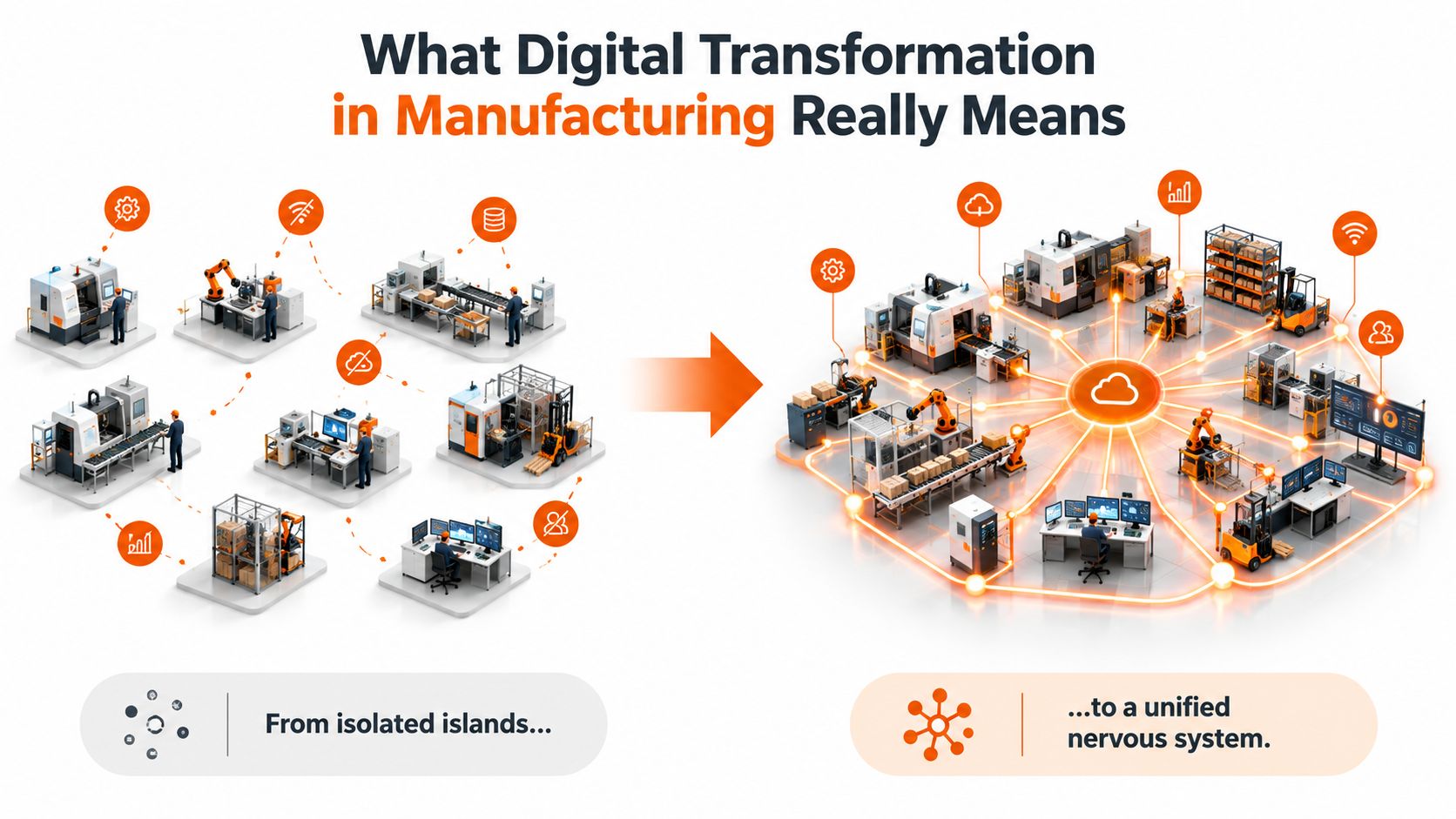
Think of a traditional factory as a group of islands. A machine knows about its own status. Maintenance keeps separate records. The MES tracks production events. The ERP holds orders and inventory. Sales has a different view of commitments, often supplemented by conversations and spreadsheets. Each island may function, but leaders struggle to see the whole system.
A transformed operation behaves more like a connected nervous system. Sensors provide signals, operational systems interpret them, analytics identify patterns, and people act through defined workflows. A production issue can influence maintenance, scheduling, inventory planning, and customer communication without someone manually rebuilding the picture in every department.
The difference between digitization and transformation
Digitization converts physical or manual information into a digital format. A paper inspection form becomes an electronic record. A spreadsheet becomes a database table. That work can reduce transcription and improve access, but it doesn't automatically change decisions.
Digitalization uses digital information to improve an existing process. A supervisor sees a live production dashboard instead of waiting for a daily report. A maintenance planner receives an alert based on equipment condition instead of relying only on a fixed schedule.
Transformation changes how the organization runs. It connects production, supply chain, finance, sales, and service around shared information and redesigned workflows. Decision rights become clearer. Teams act earlier. Leaders measure the system rather than isolated activities.
Buying an automated cell can increase capability at one point in the process. Buying an ERP module can improve a particular record or transaction. Neither creates transformation if the surrounding planning, data, training, and commercial workflows remain disconnected.
A historical shift in operating logic
Manufacturing moved from early automation toward connected, software-defined environments. Cloud platforms, analytics, industrial IoT, and automation now work together, while data standards, architecture standards, and workforce adoption determine whether a manufacturer can repeat improvements across sites.
The strategic shift is from tools treated as support functions to digital capabilities embedded in production strategy, supply-chain visibility, plant performance, and customer commitments. That's why an isolated technology purchase rarely settles the business case. The investment only becomes valuable when the organization converts data into standardized control actions and better decisions.
Executive definition: Digital transformation in manufacturing is the redesign of how a manufacturer makes and acts on decisions, using connected technology, reliable data, and adopted workflows across operations and revenue teams.
The Technology Stack Behind Smart Manufacturing
The technology stack matters less than the business problem each layer solves. Manufacturers shouldn't start with a list of fashionable tools. They should start with decision latency, equipment risk, coordination cost, and visibility gaps, then select the minimum stack required to improve those conditions.
Deloitte's 2025 smart manufacturing survey found that 57% of manufacturers use cloud computing, 57% use data analytics, 46% use industrial IoT, and 42% use 5G, as reported in the 2025 smart manufacturing survey. The pattern is important. Adoption spans multiple layers, which supports the view that smart manufacturing is an integrated operating model rather than one technology purchase.
The layers and their jobs
Cloud computing gives leaders a shared environment for plant, supply-chain, and commercial visibility. Its value appears when teams can compare facilities, access governed information, and support applications without creating a separate data silo for every location.
Industrial IoT connects machines and processes to the data model. Sensors can expose equipment conditions, cycle behavior, energy patterns, and production events. The business driver is earlier intervention, especially where machine uptime constrains output.
Connectivity, including 5G where appropriate, reduces the friction of moving operational information. It can support mobile workers, connected equipment, and time-sensitive applications, but connectivity alone won't fix inconsistent definitions or poor-quality records.
Data analytics turns signals into operating insight. Analytics should answer questions such as which line is losing time, where variation is appearing, and which settings correlate with stronger performance. Its purpose is to reduce the delay between an event and a useful response.
Automation executes repeatable actions. It can remove manual reporting, coordinate workflows, and enforce process consistency, but automating a broken process only produces errors faster.
AI sits above the data and workflow foundation. In manufacturing, the practical starting points are production bottlenecks, machine uptime, quality variation, and labor-intensive coordination. AI is less useful as an isolated point tool when the underlying data can't be trusted or when nobody owns the resulting decision.
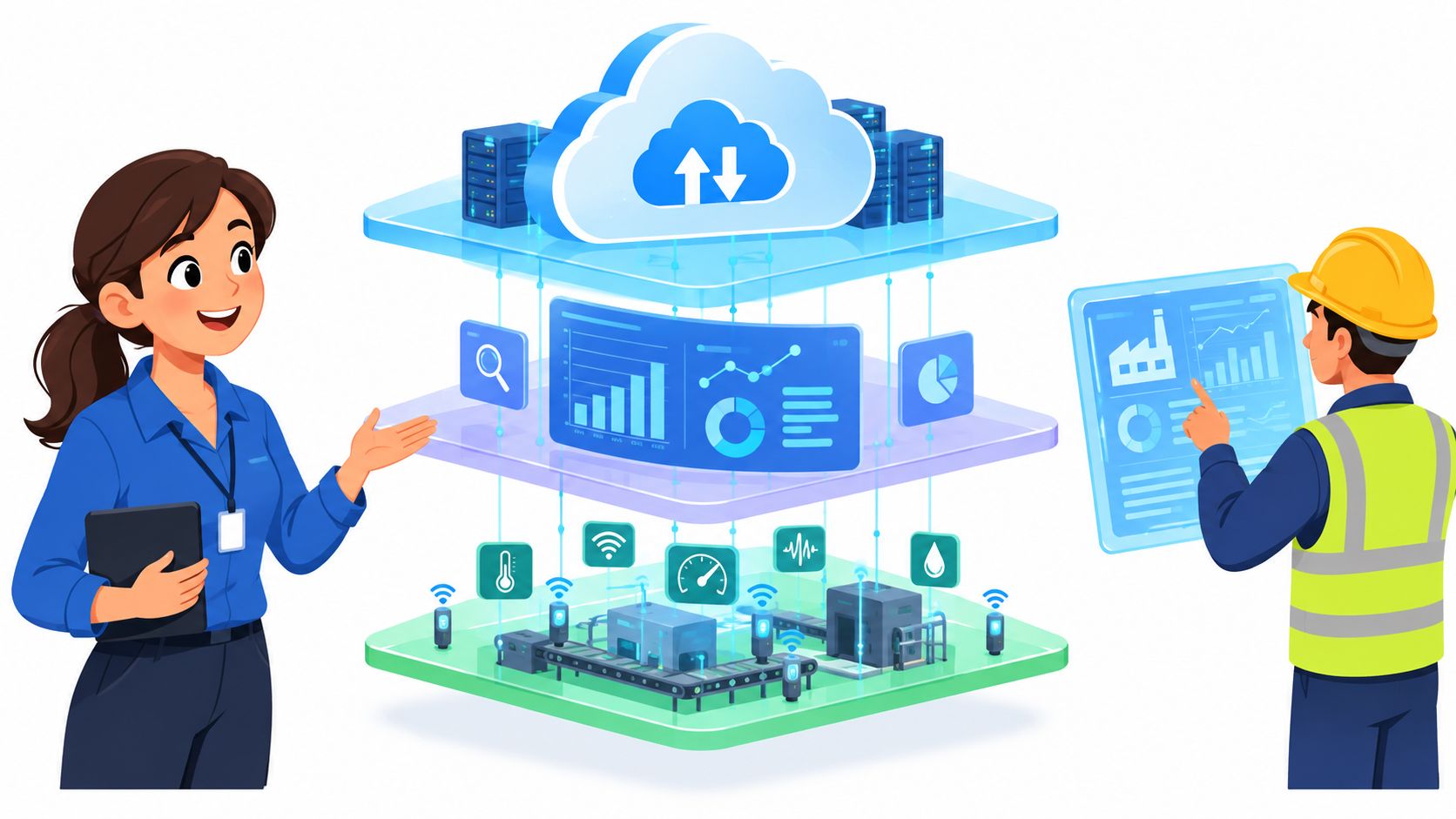
A practical maintenance use case illustrates the sequence. Sensors collect equipment data, connectivity moves it, cloud infrastructure stores it, analytics identify abnormal patterns, and a workflow routes the recommendation to a technician. Teams evaluating this path can use predictive maintenance guidance from Forge Reliability to frame the operational requirements before selecting a tool.
Legacy architecture deserves equal attention. Manufacturers rarely need to replace every system at once. An incremental approach can expose existing records through integration layers, establish common data definitions, and modernize components without putting production continuity at unnecessary risk. A useful reference for this work is legacy system modernization for manufacturing environments, particularly when older ERP and MES platforms still contain valuable operational knowledge.
Measurable Benefits and the KPIs That Matter
A transformation business case should connect each intervention to an operating metric, each metric to a decision, and each decision to financial or commercial value. That chain prevents attractive dashboards from replacing evidence.
Reported results show the possible range, not a guarantee for every plant. Deloitte's 2025 survey found average improvements of 10% to 20% in production output, 7% to 20% in employee productivity, and 10% to 15% in freed-up capacity after smart manufacturing implementation. It also reported that 92% of manufacturers believe smart manufacturing will be the main driver of competitiveness over the next three years, as documented in the Deloitte survey report.
McKinsey's Industry 4.0 value analysis provides another benchmark set, including 30% to 50% lower machine downtime, 10% to 30% higher throughput, 15% to 30% better labor productivity, and 85% more accurate forecasting across common digital manufacturing use cases. The analysis also cites a target of 10 percentage points higher overall equipment effectiveness and more than 30% lower unit costs.
Reported Outcomes from Digital Manufacturing Programs
| KPI | Reported Improvement Range |
|---|---|
| Production output | 10% to 20% |
| Employee productivity | 7% to 20% |
| Unlocked capacity | 10% to 15% |
| Machine downtime | 30% to 50% lower |
| Throughput | 10% to 30% higher |
| Labor productivity | 15% to 30% better |
| Forecasting accuracy | 85% more accurate |
| Overall equipment effectiveness | Target of 10 percentage points higher |
| Unit costs | More than 30% lower target |
A useful dashboard links these KPIs instead of celebrating one result alone. Overall equipment effectiveness combines equipment availability, performance, and quality. Unit costs test whether higher output creates economic value after implementation and operating costs. Capacity utilization shows whether the plant can meet more demand without proportional investment in equipment or headcount.
The same logic should reach beyond the factory floor. Higher throughput has limited value if quoting remains slow, sales teams lack reliable capacity information, or customer commitments cannot be supported. Pair operational KPIs with quote turnaround time, order conversion, forecast confidence, and revenue from available capacity. That connection makes the transformation case relevant to CRM, sales enablement, and top-line growth.
Why decision latency drives the result
Many gains come from acting sooner. Current visibility helps managers rebalance lines, address idle time, revise schedules, and route maintenance work before a small deviation becomes a larger constraint.
McKinsey described an Industrial IoT program in which a manufacturer gained the transparency needed to standardize operations across facilities, with productivity increasing by more than 10% in the first year, according to its Industrial IoT analysis. The practical lesson is to connect machine telemetry with MES or ERP records and quality information. Teams can then identify variation, compare plants, distribute proven settings, and give commercial teams a clearer view of what the operation can deliver.
From Pilot to Scale With a Practical Roadmap
A pilot earns funding by answering a business question, not by displaying an attractive software screen. Start by locating the constraint, confirming that the team can measure it, and defining the decision the new system should improve.
Start with one consequential bottleneck
Choose a production problem tied to machine uptime, throughput, quality, or coordination cost. A low-risk use case may produce a clean demonstration while leaving daily behavior unchanged. Set the baseline before implementation, identify who will act on the output, and specify the operational and commercial result the pilot must influence.
Keep the initial scope narrow, but design for expansion. Connect one line, maintenance workflow, or planning process while documenting the data model, integration pattern, ownership, and adoption requirements that other sites will need.
Expand by capability, not by enthusiasm
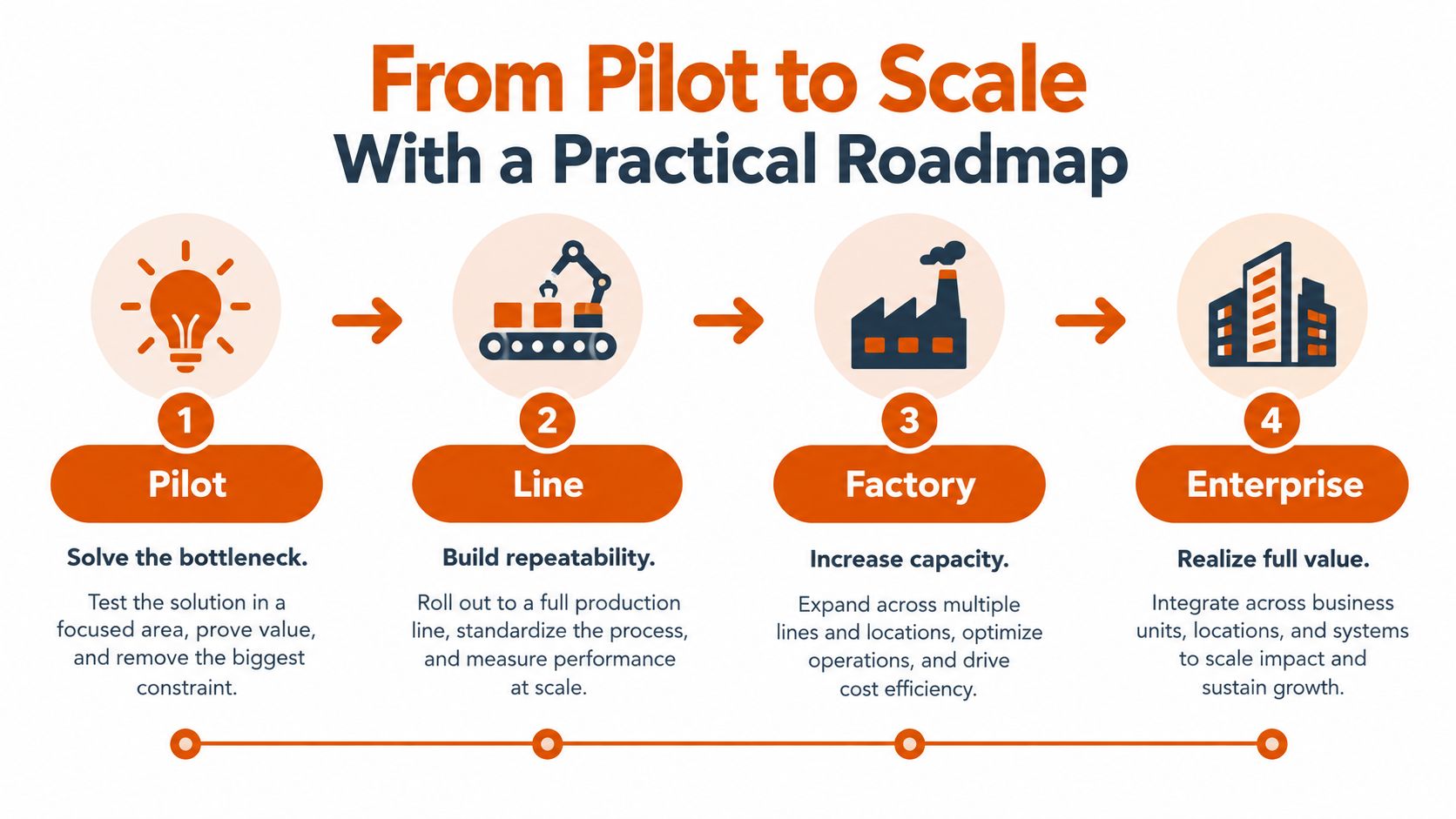
Scale through controlled stages:
- Line: Prove that the workflow improves the selected KPI and fits normal operator routines.
- Factory: Standardize definitions, permissions, data-quality checks, and management routines across related lines.
- Enterprise: Compare plants, identify repeatable practices, and distribute the architecture and governance model.
The food-manufacturing example in McKinsey's digital manufacturing case illustrates a network rollout. The company scaled digital solutions across more than 40 plants and transformed 20 factories in 12 months. The lesson is not speed alone. A reusable rollout model moves faster when teams establish interoperability and consistent master data early.
A first-site team can use this guide to digitising Australian factories to frame modernization work around plant conditions, processes, and implementation choices.
For AI-led pilots, the AI transformation in manufacturing roadmap connects experimentation with governance, workflow ownership, and operating-model change. Those controls also matter commercially: sales and quoting teams need dependable capacity and lead-time data before they promise delivery dates or pursue new demand.
A pilot that cannot explain its path to scale remains a prototype. Governance keeps the program moving between phases. Assign an executive sponsor, plant owner, data steward, and frontline adoption lead. Review KPI movement, data quality, workflow usage, and unresolved integration issues together. Approve the next rollout only when the operating team can demonstrate that the new decision process works in production.
Connecting Transformation to Revenue Growth
Manufacturing transformation is still framed too narrowly as a cost and efficiency program. That leaves a commercial gap. A factory can produce more efficiently while sales teams continue quoting slowly, promising cautiously, and searching across systems for inventory or lead-time information.
The same connected data that helps an operations manager manage a constraint can improve the customer journey. A CRM integrated with production and inventory information can give sales teams a more credible view of availability and delivery commitments. CPQ can structure complex product configuration and pricing logic. AI can help sellers retrieve technical information, prepare account conversations, and route customer requests without forcing every question through an engineer.
The commercial workflow is part of the factory system
Consider a made-to-order manufacturer. Sales receives a request with unusual specifications. Engineering checks feasibility. Operations checks capacity. Finance reviews pricing. The customer waits while each team assembles its own answer. If the company only funds shop-floor analytics, this commercial bottleneck remains untouched.
A connected transformation can make the workflow more explicit:
- CRM captures the customer and opportunity context so commercial teams work from one account record.
- CPQ applies configuration rules and reduces avoidable back-and-forth on complex products.
- ERP and manufacturing data inform commitments so sales conversations reflect actual capacity and lead times.
- AI supports enablement and service workflows while keeping approvals with the appropriate technical and commercial owners.
The impact opportunity is faster quoting, clearer promises, stronger sales enablement, and a better customer experience. Those outcomes need their own baselines. Measure quote cycle time, handoffs, revision volume, response quality, and the percentage of opportunities that stall because teams lack usable production information.
Product complexity and comfort with current systems can slow adoption of commercial tools. A sales team won't embrace CPQ because leadership purchased licenses. It will use CPQ when the configuration logic is trustworthy, the workflow fits how deals are sold, and the system removes work rather than adding another form.
Manufacturers exploring adjacent production capabilities can also review how 3D printing transforms production, especially where customization, prototyping, or supply-chain flexibility affects the commercial promise.
Growth leaders should own this part of the agenda. The CRM approach for manufacturing companies provides a useful lens for connecting customer records, sales processes, and operational information instead of treating CRM as a separate front-office project.
Why Programs Fail and How to Avoid the Traps
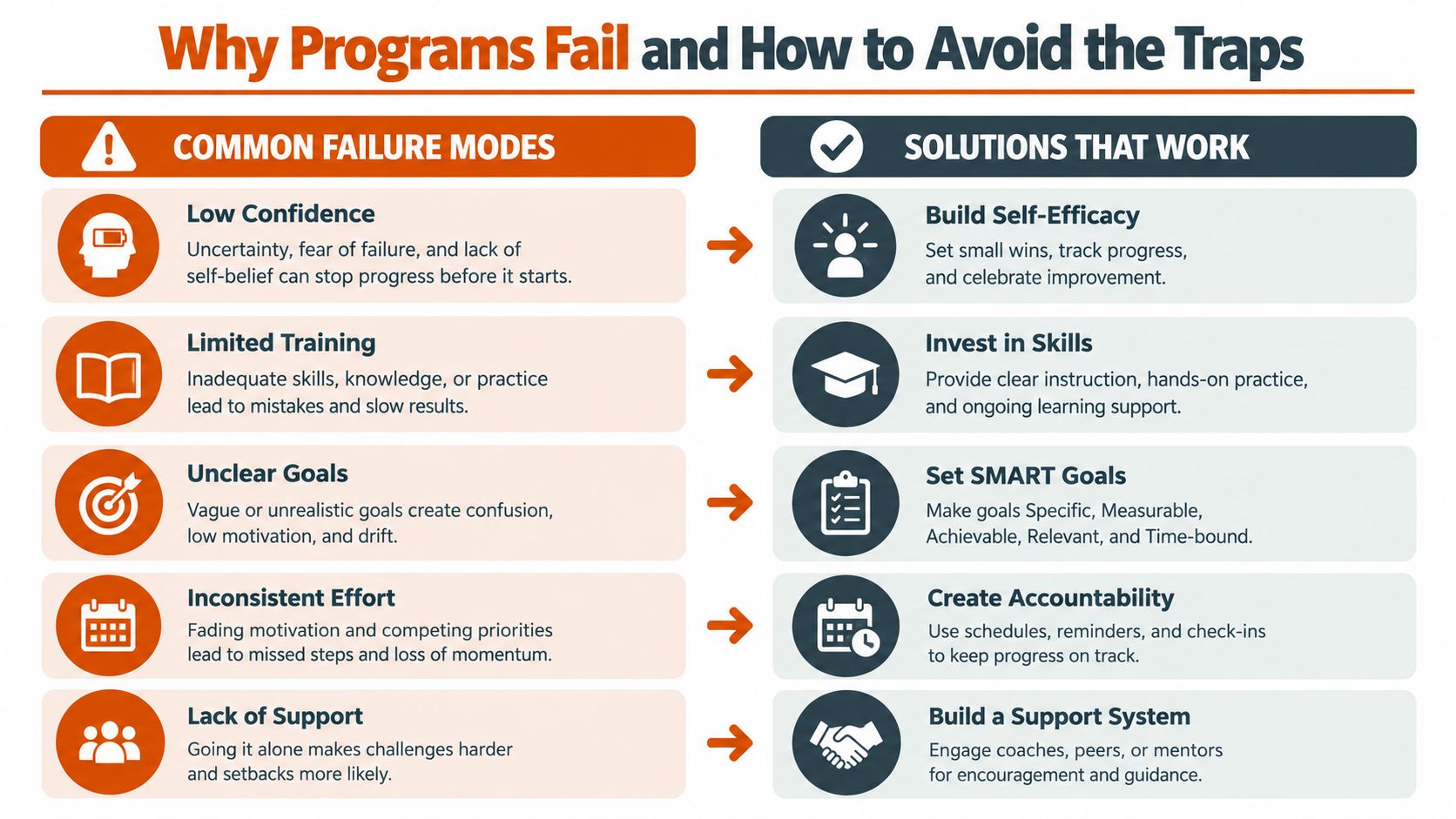
Transformation programs rarely fail because a sensor, cloud platform, or analytics model is incapable by nature. They fail because leaders introduce technology without preparing the people, data, workflows, and governance that make the technology useful.
PwC and the Manufacturing Institute's Q3 2025 survey found that factory-floor AI adoption depends heavily on frontline leadership readiness. Organizations reported low confidence in frontline leaders' ability to guide AI-driven change, alongside limited training and data readiness, as described in PwC's manufacturing leadership analysis.
The predictable traps
Low frontline confidence. Supervisors may not know how to explain an AI recommendation, challenge a poor output, or redesign a shift routine around new information. Give frontline leaders role-specific training, escalation paths, and time to practice before deployment becomes a performance expectation.
Limited training and data readiness. A model can't compensate for inconsistent asset names, missing events, or unclear ownership. Establish data stewards and quality checks while the use case is being designed, not after the dashboard fails to gain trust.
Fragmented systems. A successful pilot can become a dead end when its data pipeline only works for one machine or plant. Set architecture standards, integration patterns, and master-data rules during the pilot. The first site should be a template for the next site.
Efficiency-only framing. If the program only targets labor or downtime, commercial teams may see no reason to participate. Add customer-facing measures, such as quote responsiveness and commitment accuracy, where operational data can improve the revenue process.
A pilot reaches scale when the organization can repeat the decision, not merely reinstall the software.
The most common form of pilot purgatory is an impressive demonstration with no operating owner. Before funding the next phase, name who acts on the output, what happens when the recommendation conflicts with experience, how exceptions are recorded, and which executive reviews adoption. These are planning questions. Waiting for technology to solve them is how programs stall.
Executive Checklist and ROI Framing
Before approving a transformation program, the executive team should be able to answer five questions without relying on a vendor presentation.
- Which bottleneck comes first? Name the line, workflow, asset class, or commercial handoff where the pilot will create value.
- What is the baseline? Record the current KPI, the measurement method, the data owner, and the period used for comparison.
- What makes scale possible? Confirm the integration pattern, data definitions, architecture standards, security responsibilities, and master-data rules.
- Who owns adoption? Assign responsibility to a plant leader, frontline manager, process owner, and executive sponsor. Technology teams can enable the change, but operating teams must use it.
- Which revenue outcome is included? Add quoting speed, sales visibility, lead-time confidence, customer response, or another commercial measure alongside production and maintenance KPIs.
- What decision will improve? Specify whether the system will change scheduling, maintenance timing, quality intervention, inventory planning, pricing, or customer communication.
- What stops the rollout? Define the evidence required to move from pilot to line, factory, or enterprise. A timeline alone isn't a scale criterion.
Use reported benchmark ranges as planning assumptions, not guarantees. Deloitte's reported output, productivity, and capacity ranges, along with McKinsey's reported downtime, throughput, labor productivity, forecasting, equipment effectiveness, and unit-cost benchmarks, can help frame scenarios. They shouldn't replace a plant-specific baseline or a sensitivity analysis.
ROI becomes credible when it follows an operating lever. If a pilot targets machine uptime, estimate the value of recovered production time and the cost of implementation. If it targets quoting, connect faster response to opportunity progression, engineering effort, and customer commitments. If it targets capacity, identify whether the business can fulfill additional demand without a proportional capital or labor increase.
The next step is a growth audit and AI strategy session that maps operational constraints, commercial friction, data readiness, and ownership into a sequenced roadmap. The objective isn't to collect more tools. It's to decide which intervention should happen first, what evidence will justify scale, and who remains accountable after launch.
Prometheus Agency helps growth leaders connect AI enablement, CRM implementation, and go-to-market strategy to the operational systems that support manufacturing revenue. Visit Prometheus Agency to start a complimentary Growth Audit and AI strategy session, then turn the findings into a roadmap with clear timelines and accountability.