The most popular advice about AI supply chain planning is wrong. It starts with the model, the forecast, or the vendor demo. A manufacturer doesn't create value because an algorithm predicts demand more elegantly. Value appears when someone makes a better purchasing, production, allocation, or service decision, then executes it inside the systems that run the business.
That distinction matters in 2026. AI planning is moving into the mainstream, but adoption isn't the same as maturity. The organizations that win won't be the ones with the most impressive model architecture. They'll be the ones that define decision rights, prepare only the data that matters, and put hard controls around automation.
Why AI Supply Chain Planning Is Really a Decision Problem
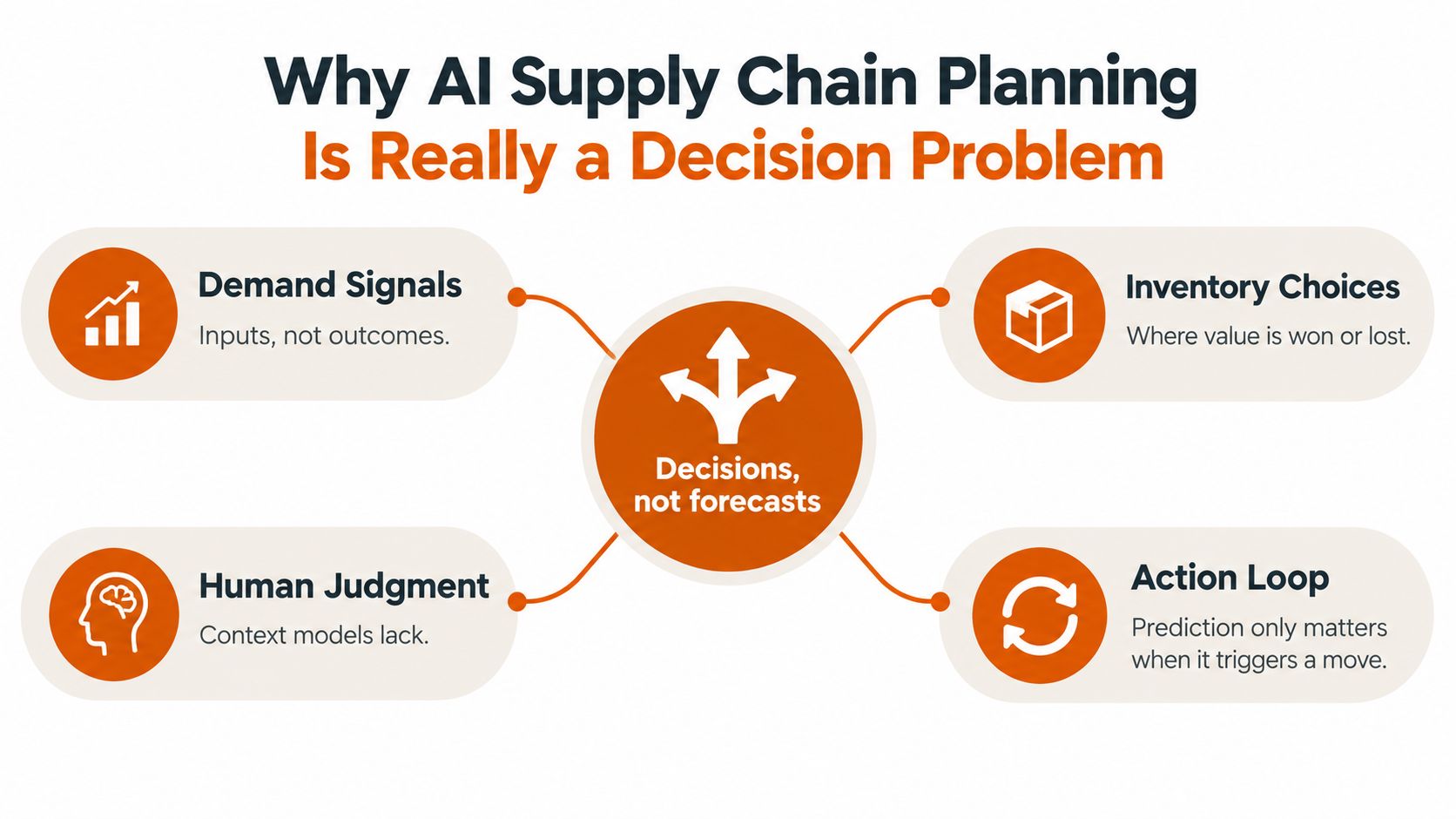
AI supply chain planning is usually sold as a forecasting upgrade. Improve the demand signal, calculate smarter safety stock, display the result in a dashboard, and the business supposedly becomes more responsive. That logic stops too early. A forecast is an input to a decision, not the decision itself.
The questions worth asking are operational. Should the system change a reorder recommendation automatically? Should it suggest a production reschedule? Who approves a supplier switch when lead times change? What happens when a customer allocation decision protects one account but disappoints another? Those questions belong in the planning operating model, not in a model-selection spreadsheet.
Adoption doesn't equal operating maturity
The gap between experimentation and value is substantial. Approximately 44% of companies report supply-chain AI adoption, yet fewer than 25% demonstrate AI maturity at scale and only about 30% report measurable value from planning use cases, according to BCG's analysis of AI's new mandate in supply chains.
That gap exposes the weakness in the forecast-first approach. A model can improve a forecast and still fail to change inventory, service, or production outcomes if planners don't trust it, if recommendations don't reach the ERP, or if nobody owns the final decision. Operations leaders are far more comfortable with AI supporting planning and forecasting than with agents executing end-to-end processes. Only 37% report comfort with the latter, according to the same BCG source.
A sensible authority model looks like this:
- AI observes: It gathers demand signals, inventory positions, customer commitments, supplier status, and production constraints.
- AI recommends: It ranks exceptions, refreshes forecasts, proposes replenishment, and presents alternative scenarios.
- Humans approve: Planners and functional leaders make decisions where commercial context, risk, or accountability matters.
- Systems execute: Approved actions move through controlled ERP, WMS, and CRM workflows with an audit trail.
Practical rule: If nobody can name the person accountable for approving an AI recommendation, the process isn't ready for automation.
This also changes how you evaluate adjacent operational information. A manufacturer coordinating international shipments may need context on yard services for exporters, because the planning decision doesn't end at the purchase order. Physical handoffs, storage, loading, and shipment readiness can determine whether a theoretically optimal plan works in practice.
AI planning should therefore be treated as an operating-model transformation across ERP, CRM, S&OP, suppliers, and planners. Choose the model after you've decided what the model is allowed to do.
Assessing Data Readiness Before You Spend a Dollar on Models
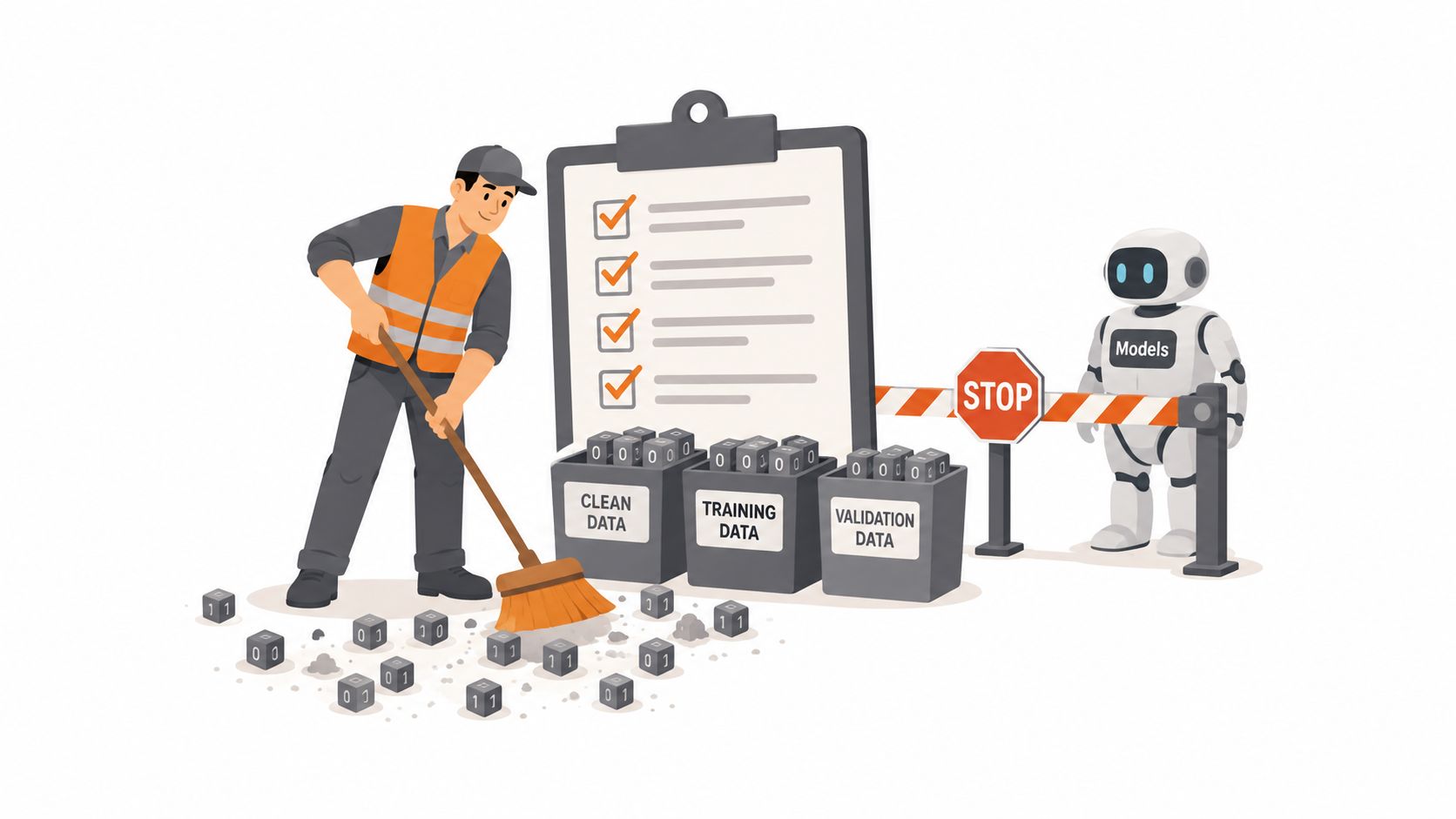
Data readiness isn't a vague prerequisite. It's a business program with a defined scope, an economic test, and a stopping rule. The mistake is trying to clean every record in every system before selecting a pilot. That approach consumes time without proving that the target decision is worth improving.
Start with one decision. Shortage allocation, replenishment, and production sequencing are sensible candidates because each has a visible operational owner and measurable consequences. Don't begin with “build an AI control tower.” Begin with “improve this decision for these products, locations, and planners.”
Define the minimum viable data product
For a replenishment pilot, establish a minimum standard for:
- Item records: Stable SKU identifiers, units of measure, product status, and relevant product relationships.
- Location records: Plants, warehouses, customer destinations, and the keys used to reconcile them.
- Lead times: Supplier, manufacturing, transfer, and transportation assumptions, with ownership for updates.
- Inventory: On-hand, allocated, available, inbound, and constrained quantities.
- Orders: Historical demand, open customer orders, cancellations, returns, and order dates.
- Suppliers: Approved sources, minimum order rules, capacity limits, and current commercial status.
The point isn't perfect data. The point is knowing which defects can distort the selected decision. If a missing supplier lead time changes a reorder recommendation, quantify the operational cost of that error. If an unused descriptive field is inconsistent, ignore it for the pilot.
Only 51% of operations organizations establish a clean, structured data foundation before scaling digital initiatives, while 60% say poor data quality has affected value realization, according to PwC's digital trends survey for operations. Those findings argue for disciplined readiness work, not an open-ended data-cleaning campaign.
Use economics to decide when to stop
Create a defect register tied to the decision. Record the affected records, the likely recommendation error, the operational consequence, and the remediation effort. Then compare the cost of fixing the defect with the expected value from better service, lower working capital, reduced expedite activity, or less planner effort.
Pilot when the remaining defects are understood and controlled. Constrain the use case when the data supports only a narrower decision. Stop when remediation costs exceed the credible value of the pilot or when ownership for critical fields can't be established. A practical AI data-readiness framework should end with that decision, not with a promise to keep cleaning indefinitely.
Mapping AI Authority to Decision Risk
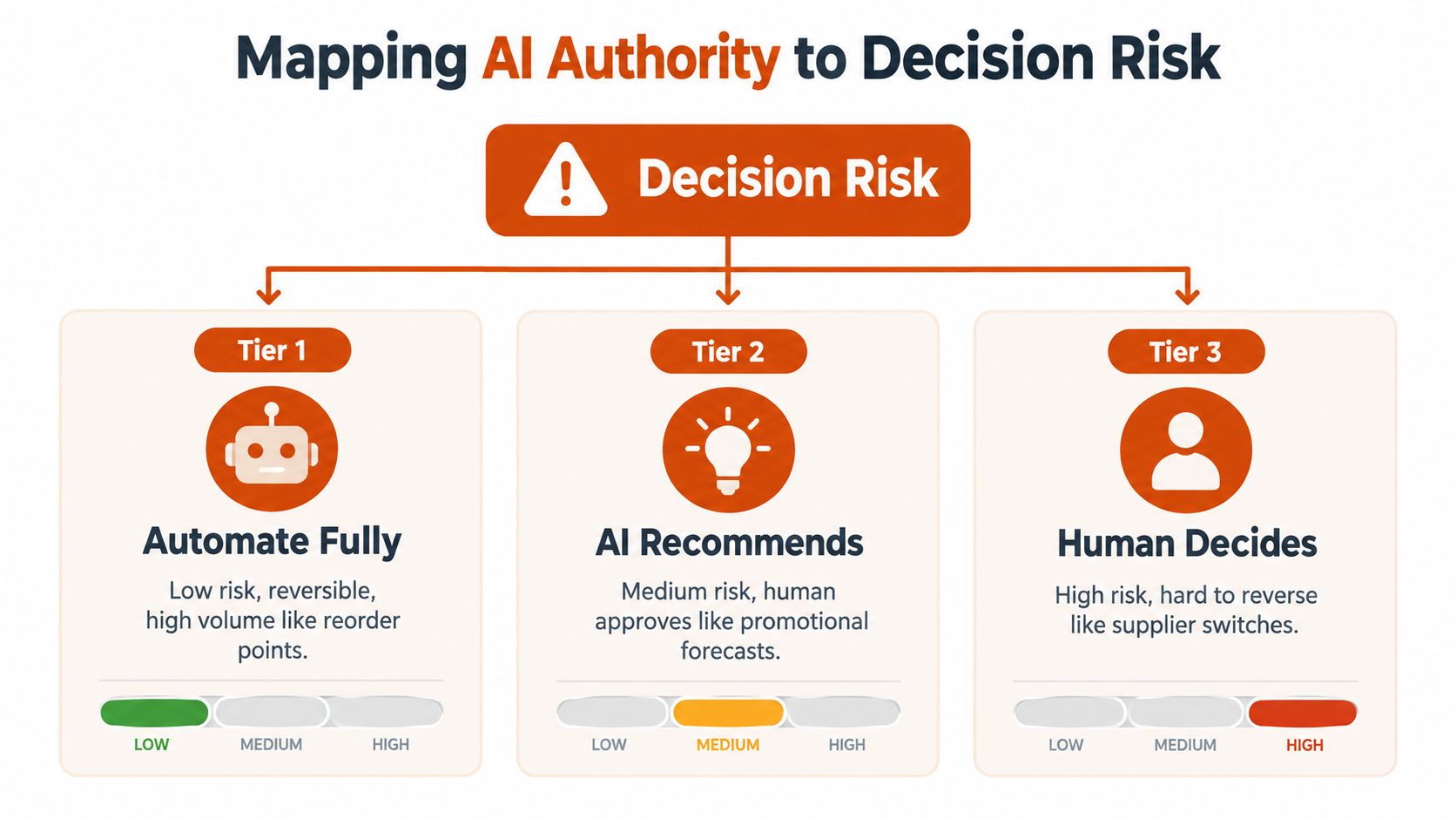
Automation should follow risk, not novelty. The more expensive, irreversible, or politically sensitive a decision becomes, the more authority should remain with a human. This is especially important in manufacturing, where a seemingly small planning change can affect supplier commitments, production sequence, customer service, and cash.
Use three authority levels. The labels should appear in the workflow, the approval rules, and the audit record. If the system can't explain why a recommendation crossed an authority threshold, it isn't governable.
Automate reversible decisions
Low-risk, high-volume actions make the best starting point. Let AI rank exceptions, refresh a forecast, or generate a replenishment recommendation when the action is reversible and policy boundaries are clear. Automatic execution can work for tightly bounded reorder-point changes where quantity, supplier, and timing rules are explicit.
The system should still record the input state, recommendation, rule applied, action taken, and outcome. Automation without traceability moves responsibility into a black box.
Recommend decisions with operational consequences
Supplier changes and production rescheduling belong in the recommendation tier for most manufacturers. AI can compare lead times, costs, capacity, customer priorities, and material availability, then draft a proposed action. A planner or supply manager approves it after checking information the system may not have, such as a supplier conversation or a strategic customer commitment.
The approval screen should show alternatives, not just one answer. It should also show what changed since the previous plan and which constraints drove the recommendation.
Keep high-risk trade-offs human-led
Inventory write-downs, customer-allocation trade-offs, major capacity shifts, and supplier switches with contractual implications should remain human decisions. AI can provide scenarios, surface affected orders, and calculate consequences. It shouldn't choose whose service level gets sacrificed.
Measure the program beyond forecast accuracy:
- Service level and fill rate: Did customers receive what the business promised?
- Working capital: Did inventory policy improve without creating shortages?
- Expedite costs: Did urgent freight and emergency purchasing decline?
- Planner workload: Did people spend less time assembling data and more time resolving exceptions?
- Decision latency: Did the organization respond faster to a material change?
- Override quality: Were overrides justified, accurate, and fed back into the process?
Build Versus Buy Versus Platform-Extend
Tool selection becomes easier when you stop asking which option has the most features. Compare each path against your existing ERP, APS, WMS, data ownership, governance needs, and ability to support implementation.
The market is already investing heavily in planning technology. McKinsey's 2024 Global Supply Chain Leader Survey found that roughly two-thirds of respondents were investing in advanced planning and scheduling systems, up 14 percentage points year over year, but only 10% had completed their deployments, as reported by Supply Chain Dive. That deployment gap should make every COO skeptical of large transformation promises.
| Dimension | Build Custom | Buy Best-of-Breed | Platform-Extend on ERP/APS |
|---|---|---|---|
| Integration | Highest burden. Your team owns connectors, mappings, monitoring, and change management. | Requires integration, but mature vendors may provide connectors and planning-specific data structures. | Usually the shortest path when master data and workflows already live in the ERP or APS. |
| Time-to-value | Slowest. You must build the product, decision logic, interfaces, and user experience. | Faster for a defined use case, provided the vendor fits your planning process. | Often fast for bounded recommendations, but platform constraints can limit the design. |
| Governance | Fully customizable, but you must create approval rules, audit trails, access controls, and model monitoring. | Evaluate governance as a product capability, not a sales promise. | Can inherit existing identity, permissions, and workflow controls, though extensions still need oversight. |
| Three-year total cost of ownership | Commonly underestimated because internal engineering, support, and model maintenance remain ongoing costs. | Licensing and integration costs are visible, but implementation and change management can be substantial. | May reduce duplicate technology, but extension fees, specialist skills, and platform dependency still matter. |
Choose the least ambitious path that proves value
Build custom only when the decision logic is a genuine competitive differentiator and your organization can support it after launch. For a middle-market manufacturer, that is rarely the right first move. A custom model doesn't remove the need for clean data, planner adoption, integration, or governance.
Buy best-of-breed when the planning problem is specialized, the current stack can't support it, and the vendor can demonstrate how recommendations enter daily work. Ask to see the exception queue, approval workflow, override history, and action handoff. Don't settle for a forecast chart.
Platform-extend when the ERP or APS already contains credible master data and core planning workflows. This path often makes sense for a focused pilot because it limits architectural sprawl. The trade-off is that you may accept less flexibility in exchange for a faster route to an operational test.
Integrating AI Planning With ERP, WMS, and CRM
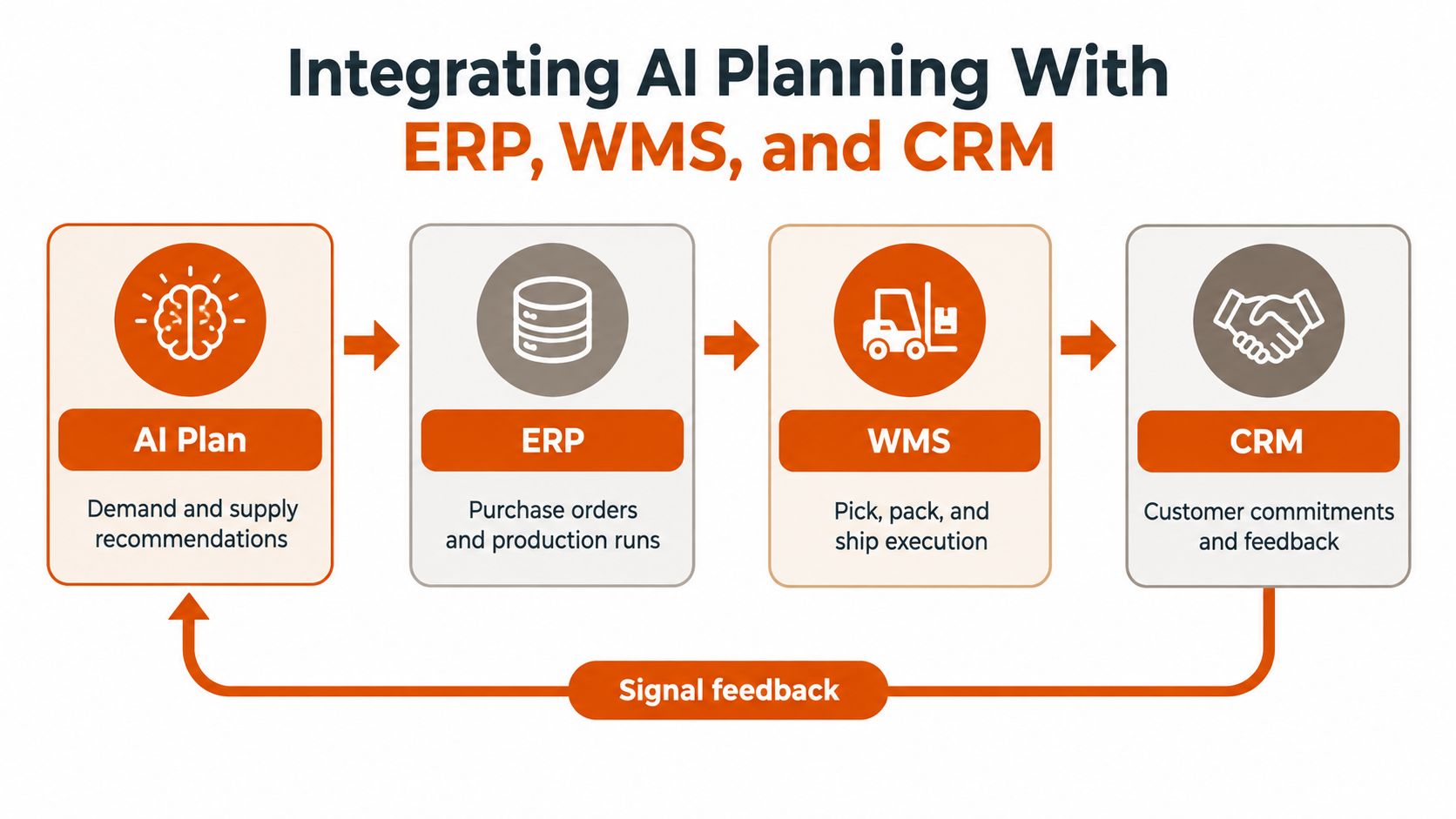
A planning model that doesn't change procurement, production, or shipment behavior is a dashboard. The integration pattern should be simple enough for planners to understand and controlled enough for IT and finance to trust.
The AI planning layer should read from source systems, create recommendations in a governed planning workspace, send approved actions back through supported interfaces, and record what happened. It shouldn't write directly into ERP tables just because a vendor demo made that look fast.
Build the planning loop
The ERP supplies orders, bills of material, purchasing records, production status, and master data. The WMS contributes inventory position, shipment progress, picking constraints, and execution feedback. The CRM adds quotes, opportunities, customer commitments, service cases, and other demand signals that may appear before an order reaches the ERP.
A workable loop has four handoffs:
- Read source data: Pull governed records using stable identifiers and documented ownership.
- Create recommendations: Generate demand, replenishment, production, or allocation proposals in the planning layer.
- Approve and execute: Send approved purchase orders, production changes, or allocation decisions through controlled workflows.
- Capture feedback: Log overrides, execution results, cancellations, shortages, and late commitments for model and process review.
That loop is more important than whether the forecasting component uses one model family or another. The model must receive the context needed for the decision and return an action that a person or system can execute.
Protect the seams between systems
Dual-key reconciliation is a common failure point. An item may have different identifiers in the ERP, WMS, and CRM, and a location may be named differently across plants and warehouses. Create a canonical mapping layer rather than letting each integration invent its own translation.
Master-data drift causes a quieter problem. A lead time changed in one system may remain unchanged in another, leaving planners to reconcile contradictory recommendations. Assign owners for critical fields, monitor changes, and show the source and timestamp beside each planning input.
Keep the human approval boundary visible. A system integration assessment should document data ownership, interface behavior, approval states, exception handling, and rollback procedures before production use.
The modernization pressure is real. In a 2022 McKinsey survey, 90% of supply-chain executives expected to overhaul their planning IT within five years and 23% had already implemented a new planning solution, according to McKinsey's supply-chain IT research. That doesn't justify bypassing controls. It makes disciplined integration more important.
A 12-Week Pilot Template With Decision Gates
A useful pilot has enough operational exposure to move a real KPI, but it stays narrow enough to finish. Don't pilot “AI for supply chain.” Pilot one decision, one product or location scope, one accountable owner, and one approval workflow.
Weeks one through three establish the baseline
Choose the decision and document its current process. Identify who creates the plan, who reviews it, who approves changes, and which system executes the outcome. Capture the existing planner output before introducing AI so the pilot has a credible comparison.
Inventory the required data and classify defects by impact. Define the first KPI set:
- SKU-level forecast error: Use the same calculation throughout the pilot.
- Service level or fill rate: Connect the decision to customer experience.
- Working capital or inventory turns: Track the cash consequence, not just model performance.
- Planner hours per cycle: Measure time removed from manual preparation.
- Override rate: Treat repeated overrides as evidence about trust, context, or model quality.
The first gate is a written scope and baseline. If the team can't agree on the decision, owner, data minimum, and success measures, don't configure a model yet.
Weeks four through seven test recommendations in shadow mode
Configure the model and integration without changing live execution. Run recommendations beside the current planner process and compare the two. Have planners label recommendations as useful, unusable, or missing context, then investigate the reason rather than treating every override as resistance.
This phase should expose integration defects, timing problems, and policy conflicts. It should also identify which recommendations are safe to automate and which need approval.
The second gate is operational credibility. The recommendation must arrive when the planner works, use recognizable business terms, show its rationale, and provide a clear next action. A technically accurate output that arrives too late has no value.
Weeks eight through ten run controlled recommendations
Move into live recommendations with planner approval. Keep the authority boundary narrow. Record every recommendation, approval, rejection, modification, and execution result.
Don't declare success because the model wins one planning cycle. Look for consistent movement across the KPI set and examine exceptions. If service improves only because inventory rises sharply, the business case is incomplete. If planner time falls but overrides remain high, adoption risk remains.
Weeks eleven and twelve force a decision
Review outcomes with operations, finance, IT, sales, and the planners who used the system. Separate model problems from process problems. Then write one of three decisions: scale, redesign, or stop.
Early-adopting companies achieved logistics-cost improvements of 15%, inventory-level improvements of 35%, and service-level improvements of 65% compared with slower-moving competitors, according to McKinsey's analysis of autonomous planning for consumer-goods companies. Treat those figures as directional evidence of the opportunity, not as a guaranteed pilot target.
For implementation discipline, use an AI pilot-to-production playbook that makes the go/no-go criteria explicit.
Common Pitfalls and a 90-Day Starting Plan
Most failed AI planning initiatives don't fail because the algorithm is incapable. They fail because the business asks the model to solve unclear decisions, inconsistent data ownership, weak integration, and low planner trust.
Avoid these five traps:
- Treating AI as an IT project: Operations must own the decision, KPI, and authority rules. IT enables the workflow but can't define the commercial trade-off alone.
- Optimizing one forecast metric: Forecast error matters, but service, working capital, expedite cost, planner effort, and override quality determine whether the business benefits.
- Cleaning data everywhere: Remediate the records that affect the pilot decision. Don't spend months standardizing fields that the decision doesn't use.
- Skipping planner involvement: Planners know which exceptions carry hidden context. Exclude them and the system will earn rejection before it earns trust.
- Writing directly into execution systems: Keep approval states and audit trails between recommendation and ERP action. Speed without control creates operational exposure.
A practical 90-day sequence
Days one through thirty: Run a decision-rights workshop with the COO, supply planning, production, procurement, sales, finance, and IT. Select one decision, assign its owner, define the AI authority level, and document the escalation rules.
Days thirty-one through sixty: Produce the minimum data standard for the selected decision. Inventory item, location, lead-time, inventory, order, and supplier records. Quantify the most important defects, assign remediation owners, and decide whether to clean, constrain, or stop.
Days sixty-one through seventy-five: Write the pilot brief. Include the baseline, KPI definitions, integration path, approval workflow, risk controls, planner responsibilities, and go/no-go gate. Select the technology path only after these requirements are clear.
Days seventy-six through ninety: Recruit two or three planner champions, run shadow recommendations, review overrides, and prepare the steering-committee decision. Give the champions authority to challenge the workflow, not just train colleagues on a finished tool.
Manufacturers that need broader context can also review practical guidance on Indiana supply chain strategy, especially when planning decisions intersect with logistics, fulfillment, and regional operating constraints.
AI supply chain planning is now a mainstream planning priority, but the advantage still belongs to organizations that treat it as a program of decisions. Start with the decision your team makes repeatedly, define what AI can and can't do, and stop the pilot if the economics or data don't support it.
Prometheus Agency helps manufacturers and middle-market companies turn AI planning opportunities into governed pilots, integrated workflows, and accountable operating programs. If you need to define decision rights, assess data readiness, or connect planning recommendations to your existing systems, visit Prometheus Agency to discuss a practical next step.