
An AI maturity model isn't an abstract, theoretical exercise. For a middle-market company, it's a practical roadmap—the kind that guides you from scattered AI experiments to a fully integrated system that actually drives value. It’s built for businesses that are nimble enough to innovate but have the resources to invest, helping them sidestep common traps on the way to scalable, ROI-focused growth.
Why Middle Market AI Adoption Is at a Tipping Point
Middle-market companies are the economy's powerhouse, but many are in a tough spot with artificial intelligence. They see the glimmer of potential but don't have a clear, structured way to grab it. This is where "pilot purgatory" becomes a very real threat—a frustrating cycle of small-scale AI tests that look promising but never lead to meaningful, company-wide change.
Without a real strategy, money gets wasted, teams get burned out, and huge opportunities are missed.
Practical Example
A manufacturer might test a predictive maintenance tool on one machine, which is great, but without a blueprint, it never gets rolled out across the entire factory floor. Or a financial services firm could launch an AI chatbot that never properly connects with its main CRM, leaving customers with a clunky, disjointed experience. These are "random acts of AI" that fail to generate scalable value.
Moving Beyond Random Acts of AI
This is where an AI maturity model for middle market companies acts like a compass. It lays out a structured journey, helping leaders pinpoint exactly where they are and what, specifically, they need to do next. The framework changes the conversation from "what cool tech is out there?" to "what business problem can we solve?"
The whole point is to move from isolated AI projects to a unified strategy where technology serves clear business goals, turning your operational data into a real competitive edge.
This isn't about chasing every shiny new tool. It’s about deliberate, intentional progress. Think about it like this: you can either buy a few cool gadgets for your house, or you can design a fully integrated smart home where everything works together to make your life better. The second one requires a blueprint. For your business, the AI maturity model is that blueprint.
Impact Opportunity
The biggest opportunity here is for leaders to stop seeing AI as one massive, overwhelming technical beast and start seeing it as a manageable, step-by-step journey. By breaking it down into logical phases, the model gives executives the confidence to take that first step, knowing they’re on a proven path to making AI both scalable and profitable. This clarity transforms AI from a risky cost center into a strategic investment.
Key Takeaways
- A Structured Path Is a Must: Middle-market firms need a roadmap, not just a handful of AI tools. It’s the only way to avoid wasting time and money on pilots that go nowhere.
- Dodge 'Pilot Purgatory': An AI maturity model gives you the framework to graduate from isolated experiments to widespread, high-impact adoption.
- Focus on Business Outcomes: The model ties every tech decision directly to your strategic goals, making sure every AI initiative delivers real, measurable value.
Understanding the Five Stages of AI Maturity
Getting started with artificial intelligence isn't a single leap of faith; it's a journey. And for middle-market companies, knowing the route is the key to avoiding costly detours. An AI maturity model for the middle market breaks this journey into five clear, sequential stages. Think of it like building a house—you pour the foundation before you put up the walls, and you install the wiring before you can flip a switch on a fully integrated smart home system.
This progression gives you a blueprint. It helps you pinpoint exactly where your company stands today, what challenges are just around the corner, and what logical steps to take next. Each stage has its own distinct feel, goals, and common hurdles, making the path forward both predictable and manageable.
Stage 1: Initial
Every journey starts somewhere, and for AI, it’s the Initial stage. This is the "wild west" phase, where any AI use is chaotic and disconnected. You might have a few employees experimenting with public tools—maybe someone in marketing is tinkering with a generative AI for ad copy, or a person in finance wrote a simple automation script. But there’s no strategy, no oversight, and definitely no dedicated budget.
Data is all over the place, locked away in different departmental systems, making it impossible to do anything meaningful with it. Any progress is driven by individual curiosity, not a shared business goal. The dead giveaway for this stage? A total lack of executive awareness or sponsorship for AI.
Stage 2: Foundational
Moving into the Foundational stage is a huge step. This is where the organization wakes up to AI's potential and starts getting its house in order. The main goal here isn't to launch fancy AI projects but to build the solid infrastructure needed for everything that comes later.
This usually involves a few key moves:
- Centralizing Data: The company might kick off a project to create a single source of truth for customer data, pulling it from the CRM, ERP, and marketing platforms into one clean, accessible place.
- Forming a Core Team: Leadership might tap a small, cross-functional team or name an "AI champion" to start exploring real use cases and sketching out a basic strategy.
- Securing Executive Buy-in: The conversation around AI moves out of the shadows and into the boardroom, with formal discussions about how it can actually support business goals.
The biggest challenge at this stage is just getting started—overcoming inertia and securing the resources to lay this critical groundwork.
The focus here isn't on complex algorithms. It's on creating the clean data and organizational alignment needed for future success. It’s all about pouring the concrete foundation before you even think about putting up the walls.
Stage 3: Tactical
Once that foundation is solid, the company enters the Tactical stage. Now, AI gets put to work solving specific, well-defined problems within individual departments. The focus shifts from building infrastructure to getting tangible, function-level results.
Practical Example
- The sales team might plug an AI-powered lead scoring tool into their CRM to help them chase the most promising prospects.
- The operations team could use a predictive model to get a better handle on demand forecasting and stop carrying so much excess inventory.
- Marketing might use an AI tool to automatically optimize ad spend across different channels, squeezing more ROI out of their budget.
These projects are usually funded and managed within departmental budgets and are measured by specific KPIs, like "leads converted" or "inventory carrying costs." The main risk here is creating new silos, so it's important to make sure learnings from one department are shared with others.
Stage 4: Strategic
The Strategic stage is where things get really interesting. AI starts connecting the dots between different parts of the business. The goal is no longer just solving one department's problem but optimizing processes that cut across the entire organization. AI is no longer just a handy tool; it's becoming a core part of how the company operates and competes.
An AI maturity model for middle market firms is especially relevant here because these companies are often nimble enough to make these cross-functional connections faster than their enterprise-sized cousins. Companies at this stage have a centralized AI strategy, a dedicated budget, and clear rules for governance. You’ll often see an executive, like a Chief Data Officer, who owns the AI roadmap and makes sure it’s tightly aligned with company-wide goals.
Stage 5: Transformational
Finally, we arrive at the Transformational stage. This is the pinnacle of AI maturity. Here, AI is completely woven into the company's DNA, driving constant improvement, sparking innovation, and even creating new lines of business. It informs every big strategic decision and is a seamless part of how people work every day.
A company at this level doesn't just use AI to do old things better; it uses AI to do brand new things.
Practical Example
A manufacturing firm using a digital twin of its entire supply chain to simulate and head off disruptions before they happen. Or a retail company using AI-driven personalization to create entirely new, curated shopping experiences that generate new revenue streams. That kind of proactive, intelligent operation is the hallmark of true AI maturity.
The Five Stages of the Middle Market AI Maturity Model
| Stage | Primary Focus | Key Activities | Main Challenge |
|---|---|---|---|
| Stage 1: Initial | Experimentation | Ad-hoc, individual use of public AI tools. | Lack of awareness and strategy. |
| Stage 2: Foundational | Infrastructure | Centralizing data, forming a team, getting buy-in. | Overcoming inertia and resource constraints. |
| Stage 3: Tactical | Departmental ROI | Solving specific business problems with AI tools. | Preventing new data and knowledge silos. |
| Stage 4: Strategic | Cross-Functional Optimization | Integrating AI into core business processes. | Aligning AI initiatives with company-wide goals. |
| Stage 5: Transformational | Business Reinvention | Using AI to drive innovation and new revenue. | Maintaining momentum and a culture of innovation. |
Each step is a prerequisite for the next, ensuring that your investments in technology and people compound over time.
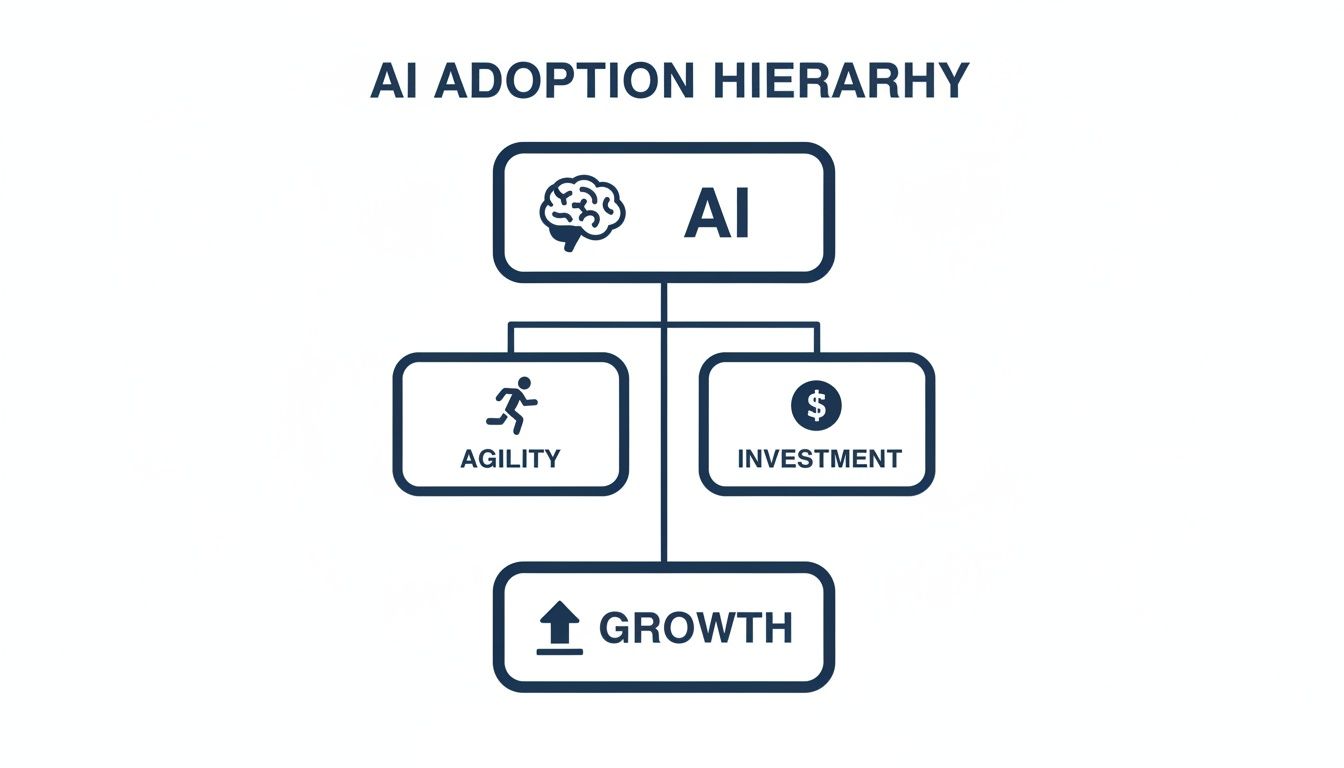
This hierarchy shows that adopting AI isn't just about a tech upgrade. It's a catalyst that connects smart investment directly to greater business agility and real, measurable growth.
Impact Opportunity
For middle-market leaders, this five-stage model takes the mystery out of the AI journey. It gives you a common language and a clear map to figure out where you are, and then build a pragmatic, step-by-step plan to get where you want to go. This structured approach enables you to prove value at each stage, building the internal support and momentum needed for true transformation.
Key Takeaways
- Sequential Progress: Each stage builds on the last. You can't achieve strategic, cross-functional AI (Stage 4) without first establishing a solid data foundation (Stage 2).
- Focus on the Goal of Each Stage: Don't try to reinvent your business (Stage 5) when you should be focusing on departmental wins (Stage 3). Mastering one stage at a time prevents overwhelm and ensures success.
- It's a Business Journey, Not a Tech Project: The model is centered on business outcomes, from getting buy-in to optimizing processes, ensuring technology serves strategy.
How to Figure Out Where Your Company Really Is with AI
Before you can build a roadmap to anywhere, you need to know your starting point. Pinpointing your organization's exact position on the AI maturity spectrum is that critical first step. Without an honest, data-backed baseline, any plan you make is just a shot in the dark.
A structured self-assessment is the fastest way to get the clarity you need to move forward with real confidence.
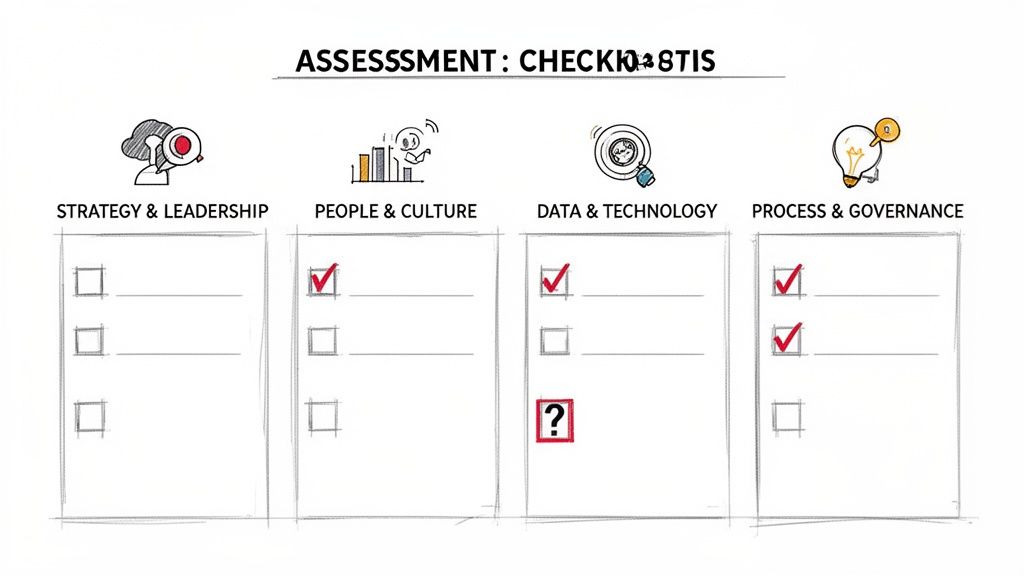
The idea is to look at your company through four different lenses. Each one—Strategy, People, Data, and Process—is a foundational pillar of AI readiness. Your answers will immediately show you where you’re strong and, more importantly, where the most urgent gaps are. This isn’t a theoretical exercise; it’s a practical tool built for middle-market leaders.
Strategy and Leadership
A real AI journey always starts at the top. If the executive team isn’t bought in, even the most brilliant technical projects will fizzle out. This pillar digs into whether AI is treated like a core strategic asset or just another IT project.
Ask your leadership team these direct questions:
- Executive Sponsorship: Is there a specific executive who truly owns the success of our AI initiatives?
- Business Alignment: Can we clearly explain how AI will help us hit our main business goals, like grabbing more market share or making operations more efficient?
- Dedicated Budget: Have we actually set aside a budget for AI pilots and implementation, or are we just funding things ad-hoc?
- Competitive Awareness: Do we have a clue what our competitors are doing with AI?
Answering "no" to these questions is a big tell. It usually means a company is stuck in the Initial (Stage 1) or early Foundational (Stage 2) phase. Getting these things right is a hallmark of more mature organizations.
People and Culture
Let's be clear: technology doesn't create value on its own—people do. Your company culture and your team's skills are maybe the biggest predictors of AI success. A culture that fights change or a team that lacks basic data skills will always struggle to get traction.
Take a hard look at your team's readiness:
- AI Literacy: Do our employees have a basic grasp of what AI is and how it could actually help them in their day-to-day jobs?
- Data Skills: Do we have people who can look at data and pull out insights, even if they don't have "data scientist" in their title?
- Cross-Functional Collaboration: Do our teams (like sales, marketing, and ops) ever actually work together on data-driven projects?
- Appetite for Change: Is our culture generally open to trying new tools and processes, or is there a collective groan every time something new is introduced?
For a much deeper dive into your team's readiness, you can measure your company's potential with a comprehensive AI Quotient assessment.
Data and Technology
Data is the fuel for any AI engine. Period. Without good, accessible data and the right tech to support it, your AI models are dead on arrival. This pillar is all about the health of your most critical digital assets.
It’s time to evaluate your technical foundation:
- Data Accessibility: Is our most valuable data—customer, sales, operations—sitting in one place and easy to get to? Or is it locked away in a thousand different spreadsheets and ancient systems?
- Data Quality: Do we actually trust our data? Or are we constantly working around known errors and missing information?
- Core Systems: Are our main systems, like our CRM and ERP, modern enough to plug into AI tools, or are they relics from another era?
- Analytics Tools: Do we have any business intelligence (BI) tools that let us see and understand what our data is telling us?
For most middle-market firms, this is where the biggest problems live, trapping them firmly in the Foundational stage.
An honest "no" to the data accessibility question is one of the most common blockers for middle-market companies. Solving the data silo problem is often the single most important project to unlock future AI capabilities.
Process and Governance
Finally, you need some rules of the road. Having clear processes for how AI is developed and used is what allows you to scale up without chaos. This pillar looks at the operational guardrails you need to manage AI projects and keep risk in check.
Review your operational maturity:
- Project Management: Do we have a real process for finding, prioritizing, and managing AI pilot projects?
- Performance Measurement: Do we even know how to measure the ROI of an AI initiative? Have we defined what success looks like?
- Data Governance: Are there clear rules about who can access data and how it can be used?
- Ethical Guidelines: Have we ever had a conversation about the ethical side of using AI, especially with customer data?
Weaknesses here don’t just cause headaches; they become serious liabilities in the Tactical (Stage 3) and Strategic (Stage 4) phases, where bad governance leads to failed projects and massive risk.
Key Takeaways
- Assessment Is Action: A structured self-assessment isn't just navel-gazing. It's the first concrete step toward building an AI strategy that actually works.
- Focus on the Four Pillars: Looking at your company through the lenses of Strategy, People, Data, and Process gives you the full, unvarnished picture.
- Honesty Reveals Gaps: Be brutally honest here. Finding weaknesses isn't a failure—it’s the starting point for a smart, targeted plan.
Impact Opportunity
By walking through this assessment, you stop having vague, "what if" conversations about AI and start working from a concrete, data-backed understanding of where you are today. This gives you an objective baseline, shines a spotlight on your most critical gaps, and naturally leads to a prioritized roadmap. That clarity enables leaders to put money and people where they’ll have the biggest impact, setting the stage for real, scalable AI adoption.
Building a Practical AI Roadmap That Delivers Quick Wins
An assessment is only useful if it leads to action. Once you know where your company stands on the AI maturity spectrum, the real work begins: turning that insight into a practical, prioritized roadmap.
For middle-market companies, this isn’t about a massive, multi-year overhaul. The goal is to generate tangible ROI quickly. This builds momentum and gets everyone, especially leadership, excited for the long haul.
The best way to do this is with a "crawl, walk, run" methodology. This approach intentionally sidesteps big, risky "big bang" projects that burn through resources and fizzle out if they don't deliver immediate, mind-blowing results. Instead, you shift focus to a handful of high-impact, low-complexity pilot projects.
Identifying High-Impact Pilot Projects
The sweet spot for a pilot project is where a real business headache meets technical feasibility. You're looking to solve a nagging problem for a specific team without having to rip and replace your existing systems. The idea is to score a quick win that makes a visible difference.
Practical Examples
- Sales Forecasting: Ditch the manual spreadsheets and guesswork. Use an AI tool that plugs into your CRM to analyze historical data and give you far more accurate sales forecasts. This has an immediate impact on how you plan revenue and allocate resources.
- Lead Qualification: Automate the tedious work of scoring and qualifying new leads. An AI model can instantly analyze incoming leads based on company details and behavior, freeing up your sales team to focus their energy on prospects who are actually ready to talk.
It’s always a smart move to review successful intelligent automation use cases to see what's working for others. These examples give you proven templates for applying AI to common business challenges, helping you de-risk your first few projects.
The 90-Day Pilot Plan Template
To keep your first project sharp and accountable, box it into a 90-day window. This simple constraint forces clarity and kills scope creep before it starts. The plan itself should be a one-pager that anyone in the company can look at and immediately understand.
A successful pilot project is a powerful storytelling tool. It turns abstract conversations about AI into a concrete success story with real numbers, making it much easier to get executive support for future, more ambitious initiatives.
Your plan needs to nail down three core things:
- Define the Business Problem: Be surgically precise. Don't just say "improve sales." Get specific about the bottleneck: "Our sales team spends too much time chasing low-quality leads, which slows down our response time to high-value prospects."
- Set Measurable KPIs: How will you know if you won? Define clear, numbers-driven targets. For the lead qualification example, a great KPI would be: "Increase the number of marketing-qualified leads (MQLs) converted to sales-qualified leads (SQLs) by 20% within 90 days."
- Assign Clear Ownership: Who’s on the hook? Name a single project owner and list the key people from sales, marketing, and IT who need to be involved. This creates accountability right from the start.
The numbers back this up. Middle-market businesses are the engine of the economy, but they're at a critical AI inflection point. While 92% plan to invest in GenAI and see a 3.7x ROI per dollar spent, the maturity gaps are real—a staggering 95% of pilots fail without a tailored framework.
This structured, pilot-first approach is a cornerstone of any successful AI enablement strategy. It’s how you systematically prove value while building your team’s confidence and skills.
Impact Opportunity
Ultimately, a well-executed pilot roadmap is about de-risking AI for your leadership team. When you can show a clear return on a small, contained project, you prove that AI isn't just another cost center—it's a powerful tool for solving real business problems. That success builds the political and financial capital you need to climb the ladder of the AI maturity model, moving from small tactical wins to true strategic transformation.
Key Takeaways
- Start Small to Win Big: Use a "crawl, walk, run" strategy. Focus on high-impact, low-complexity pilots that can deliver measurable results in 90 days or less.
- Define and Measure Everything: A great pilot needs a crystal-clear business problem, specific KPIs, and unambiguous ownership to keep everyone focused and accountable.
- Prove Value to Secure Buy-In: Treat successful pilots like internal case studies. Use them to show tangible ROI, making it much easier to get the budget and support for bigger AI initiatives down the road.
Common Gaps and Pitfalls Middle Market Firms Face
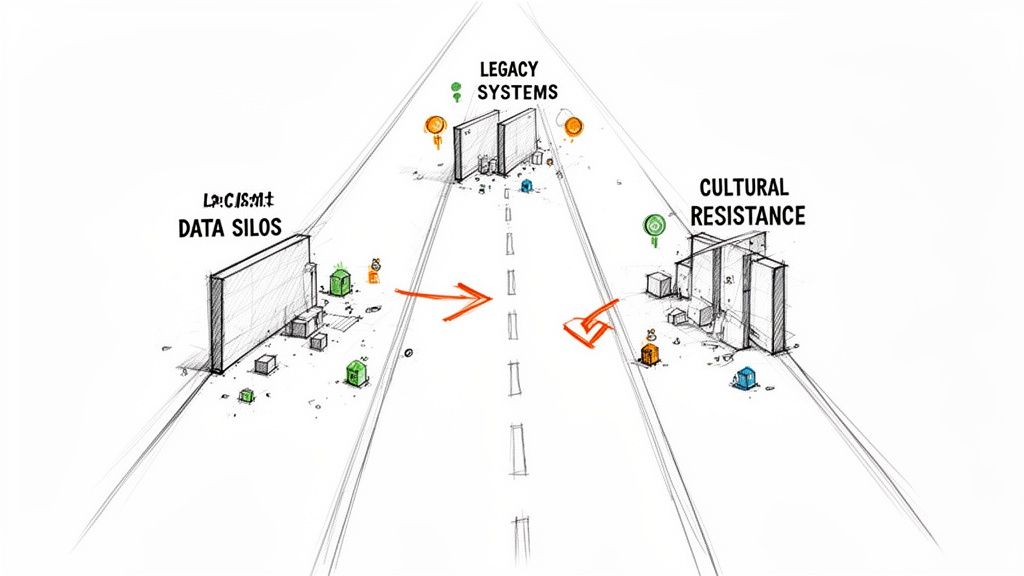
Knowing where you stand with AI is a great first step, but the road to real growth is often littered with predictable roadblocks. For middle-market companies, these challenges aren't just about technology—they're deeply tangled up in your data, your team's skills, and your company culture. The good news? When you know what to look for, you can steer right around them.
The gap between getting AI right and getting stuck is massive. High-maturity AI adopters in the middle market are seeing 3x the ROI compared to those just dipping their toes in. And while 78% of organizations say they use AI in some capacity, many mid-market firms find themselves in 'pilot purgatory'—unable to get their promising experiments to scale across the business.
The Data Silo Dilemma
One of the most common and crippling issues is fragmented data. Think about it: customer info is stuck in the CRM, inventory numbers are locked away in the ERP, and marketing analytics live on their own little island. When your data doesn't talk, you can't get a complete picture of the business. And that complete picture is the fuel for any meaningful AI project.
Practical Example
A regional distributor wants to use AI to predict inventory needs. But their sales data, supplier records, and warehouse levels are all in separate, disconnected systems. Any attempt to build an accurate forecasting model is dead on arrival because the AI can't see the whole story. The fix isn't a massive, multi-year data overhaul. Start small. Pick one high-value area—like customer data—and launch a focused project to unify it. You'll score a quick win for sales and marketing while building the skills and confidence for bigger data initiatives down the road.
The In-House Expertise Gap
Let's be real—most middle-market companies don't have a team of data scientists on the payroll. This is a huge hurdle. Without the right people, it's tough to evaluate AI tools, manage an implementation, or even understand if a pilot project was successful.
This often leads to leaning too heavily on vendors who don't truly get your business, resulting in clunky, ill-fitting solutions. This skills gap can kill momentum before you even get started. It’s why having a clear AI maturity model for the middle market is so crucial—it shines a light on these talent shortfalls early on. We talk more about how AI-enabled leaders are growing their teams differently in a related post.
The smart move is to grow your own talent while finding the right partners. Look for analytically-minded people on your team and invest in their training. At the same time, work with an AI enablement firm that can guide your strategy, run the first few projects, and help upskill your people for the long haul.
Cultural Resistance to Change
Technology is only half the equation. The other half is people. A culture that resists change can quietly sink even the most brilliant AI plan. Employees might worry AI is coming for their jobs, distrust the recommendations it makes, or simply dig in their heels against learning a new process.
Cultural adoption isn't something that just happens; it's a project in itself. Without a deliberate plan to win hearts and minds, the best AI tool in the world will just gather digital dust.
The best way to get ahead of this is to bring influential people into the process early. Create a small group of "AI Champions" with respected employees from different departments. They become your advocates, helping explain the benefits to their colleagues, testing new tools, and providing honest feedback. They turn skepticism into genuine engagement.
Impact Opportunity
By understanding these common traps—siloed data, talent gaps, and cultural resistance—you can stop reacting to problems and start planning for them. Instead of getting blindsided, you can build a roadmap that tackles these issues head-on. This foresight dramatically improves your chances of success, ensuring your AI investments deliver real business value and build unstoppable momentum.
Key Takeaways
- Anticipate the Hurdles: The biggest obstacles for mid-market firms are almost always data silos, a lack of in-house AI skills, and a culture that's wary of change.
- Solve Data Silos Incrementally: Don't try to fix everything at once. Start with one high-impact data project to prove the value and build from there.
- Build Your Champions: The best way to beat cultural resistance is from the inside. Create an "AI Champions" program to build buy-in and drive adoption from the ground up.
Wrapping Up: Your Path to AI-Driven Growth
Getting started with AI isn't about a single, massive project. It's a strategic journey. For middle-market companies, the smartest move is to start now with a practical approach that racks up tangible business wins, rather than getting lost chasing abstract tech trends. This whole process is designed to build a more resilient, efficient, and competitive business from the inside out.
The journey really boils down to three key steps. First, get everyone on the same page by understanding the five stages of the AI maturity model for middle market companies—this creates a shared language and a clear vision. Next, take an honest look in the mirror with a self-assessment to get a data-backed snapshot of where you are and what your biggest gaps are.
With that assessment in hand, you can build a prioritized roadmap that focuses on quick, measurable victories.
Starting the Right Conversation
The real goal here isn't just to plug in new tools. It's about building a culture where data drives decisions. Use this framework to spark internal conversations, challenge old ways of thinking, and take that first real step toward scalable, AI-driven growth. When you focus on solving actual business problems, you create momentum that can reshape your entire operation.
The most successful AI adoptions aren't led by the tech team—they're led by the business. This framework ensures every AI initiative is tied directly to a strategic outcome, so your investments generate real value and build sustainable momentum.
And to really make AI work for you, connecting your internal improvements to how you show up in the market is key. A definitive guide to AI search engine optimization is a must-read for any middle-market firm looking to turn operational efficiency into a powerful growth engine.
The Real Opportunity
Think of this maturity model as a catalyst for change. It gives you the structure to move from scattered, one-off experiments to a unified strategy. It enables your teams, de-risks the investment for leadership, and builds a powerful foundation for growth that lasts.
Common Questions About AI in the Middle Market
Even with a clear plan, leaders in the middle market have practical questions about where to begin with AI. Getting these answers right is what turns a good idea into a real-world win. Here are the straight answers to the questions we hear most often.
What’s a Realistic Budget for a First AI Pilot Project?
There's no one-size-fits-all answer, but a first AI pilot project should realistically land somewhere between $25,000 and $75,000. That range is the sweet spot for a focused, 90-day sprint designed to prove its worth without asking for a massive capital investment.
A few things will push you to the lower or higher end of that range:
- Data Readiness: If your data is organized and easy to access, you'll stay on the lower end. If it's a mess and needs a lot of cleanup, budget for the higher end.
- Tools: Using off-the-shelf AI that plugs into your existing CRM or ERP is always going to be cheaper than building a custom model from the ground up.
- Talent: The budget needs to cover either your internal team's time or the cost of bringing in a partner to guide the project.
Remember, the goal of a pilot isn’t to boil the ocean. It's to score a quick, measurable victory that makes everyone eager to fund the next step.
How Do We Measure ROI If It’s Not Just About Cutting Costs?
This is a big one. The most valuable AI applications often don't show up as a line-item cost saving—they create efficiency and open doors for growth. To measure this "soft" ROI, you have to look at the operational metrics that feed directly into revenue and customer happiness.
Instead of focusing only on the bottom line, track improvements in your key performance indicators (KPIs).
The Real Impact: Tracking operational KPIs tells a clear, data-driven story of AI's value. A 69% faster lead-to-appointment time is a powerful metric. It shows exactly how AI is speeding up the sales cycle and creating more revenue opportunities, even if it doesn't slash a specific cost.
Practical Examples
- Lead Response Time: Measure how long it takes your sales team to follow up with a hot lead before and after you implement an AI qualification tool.
- Customer Satisfaction: Track your Net Promoter Score (NPS) or customer churn after deploying an AI chatbot to handle initial support questions.
- Inventory Turn: For a distributor or manufacturer, measure how much faster you turn over inventory after implementing an AI-powered demand forecasting tool.
We Don’t Have Data Scientists. Can We Still Pull This Off?
Absolutely. The idea that you need a team of PhDs to get started with AI is a myth, and it’s holding too many companies back. Today, success is less about hiring niche, expensive talent and more about having the right strategy and tools.
Modern AI platforms are built for business users, not data scientists. Many of the most powerful AI features are already baked into the software you use every day, like your CRM.
Plus, a good strategic partner can fill that talent gap for you. An AI enablement firm can lay out the initial strategy, run the first few pilot projects, and help train your existing team, building your internal muscle for the long run. It's a way to get moving fast without the massive upfront cost of hiring.
At Prometheus Agency, we specialize in building practical, ROI-driven AI roadmaps for middle-market leaders. We help turn the technology you already own into a system for scalable growth, starting with a complimentary Growth Audit and AI strategy session. Learn more about how we can help you win with AI.