An AI maturity model for enterprise is less of a textbook concept and more of a strategic blueprint. It's a framework that honestly assesses where your organization stands with AI right now and then draws a clear, practical roadmap for getting where you want to go. Think of it as a GPS for your AI journey—it shows your current location and plots the most efficient route to full-scale adoption that actually drives business results.
This model is all about turning vague AI ambitions into a concrete, step-by-step plan.
Key Takeaways
- Blueprint, Not Theory: An AI maturity model is a practical roadmap for turning AI ambitions into a step-by-step, actionable plan.
- Strategic Alignment: It ensures every AI initiative is directly linked to core business objectives, preventing random, disconnected projects.
- Foundation for Growth: The model forces a focus on foundational elements like data quality, team skills, and governance before attempting to scale complex solutions.
Why an AI Maturity Model Is Your Strategic GPS
Trying to roll out AI without a clear strategy is like wandering through a new city without a map. You might stumble upon a few interesting sights, but you’ll probably get lost, burn through your budget, and never reach your real destination. An AI maturity model for enterprise brings the structure you need to avoid that chaos, ensuring every AI project has a purpose and lines up with your bigger business goals.
Here’s another way to look at it: a construction crew would never start building a skyscraper without a detailed blueprint. That plan outlines every single phase, from pouring the foundation to installing the final windows. An AI maturity model does the same for your organization’s AI capabilities, making sure you build a solid foundation before trying to scale up to more complex and ambitious projects.
Turning Ambition into Action
So many leaders feel the pressure to "do AI" right now, but that urgency often leads to scattered, one-off projects that don't deliver any real, lasting value. The result? Wasted money and a team that’s growing more skeptical by the day.
A maturity model cuts through that noise by forcing you to focus on the core essentials first. It helps you answer the tough, practical questions:
- Is our data infrastructure actually ready for this?
- Do our teams have the right skills to manage these new AI tools?
- Have we set up clear governance and ethical guardrails?
- How are we going to measure whether any of this is working?
By tackling these questions systematically, you build a stable foundation for growth. This structured approach helps you sidestep common pitfalls, like sinking money into fancy tech before your data is clean or launching a dozen pilot programs with no clear path to scale.
A recent MIT CISR survey of 152 enterprises found that the jump from stage 2 (running pilots) to stage 3 (scaling AI) delivered the biggest boost to financial performance. This single step catapulted companies far above their industry averages, proving that structured scaling is where the real value gets unlocked.
Impact Opportunity
Without a model, you’re just doing "AI for AI's sake." With one, you're building a system where technology serves a clear business strategy. This methodical approach ensures that as your AI sophistication grows, so does its contribution to your bottom line—from cutting down on tedious manual work to finding new ways to accelerate revenue. The goal is to move from isolated experiments to an integrated, company-wide capability that provides a sustainable competitive advantage.
Practical Examples
- Before Model: A company buys a generative AI tool for marketing, a chatbot for service, and a forecasting tool for finance, with no coordination. Budgets are wasted, systems don't talk to each other, and no one can measure the overall impact.
- After Model: The company first assesses its data quality (a foundational step). It then pilots an AI-powered CRM add-on for the sales team, with a clear goal to increase lead conversion by 15%. Success here justifies scaling the technology to other departments.
The Five Stages of AI Maturity Explained
Think of your company's AI journey like learning a new skill. You don't go from novice to expert overnight. The AI maturity model for enterprise maps out this path, breaking it down into distinct stages, each with its own challenges, wins, and opportunities. It’s a progressive climb, not a single leap.
To make this real, we'll follow a mid-market manufacturing company as it moves from disconnected AI experiments to a fully baked, AI-driven strategy. This story will help you figure out exactly where you are on the map.
This model shows the core journey from one-off ideas to simplified operations, and finally, to genuine business transformation.
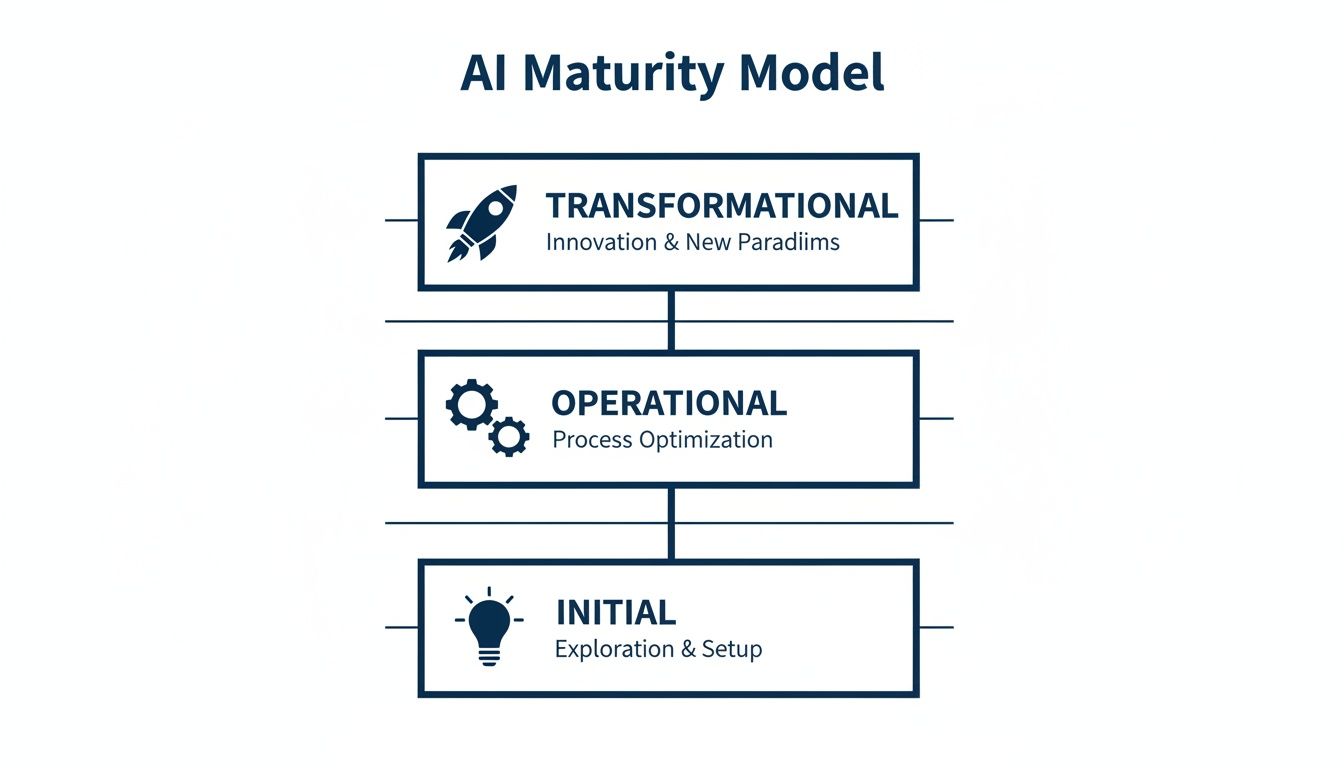
The big takeaway here? Each stage is built on the one before it. A solid foundation is everything.
Stage 1: Initial
Every AI journey starts at the Initial stage. This is the "wild west" of AI exploration—scattered, ad-hoc, and completely uncoordinated. There's no grand strategy. Instead, you have curious individuals or siloed teams running their own small-scale tests.
You'll typically see:
- Random experiments with off-the-shelf AI tools.
- Lots of talk about AI's potential, but no real action plans.
- A few passionate "AI champions" driving things, but no structured teams.
Practical Example: Our manufacturing company is right here. The customer service team is tinkering with a basic chatbot to handle simple FAQs. Over in marketing, someone is playing with a generative AI tool for social media posts. The efforts are completely disconnected, nobody is measuring the results, and leadership has no idea it's even happening. The biggest roadblock at this stage is the total lack of a unified vision.
Stage 2: Foundational
As a company enters the Foundational stage, the lightbulb goes on. Leadership finally recognizes that AI could be a strategic asset. The random experiments start giving way to a more structured, deliberate approach focused on building the core capabilities needed for real success.
This stage is all about:
- Putting together a cross-functional AI task force or a starter Center of Excellence (CoE).
- Taking a hard look at data quality and infrastructure readiness.
- Getting an actual budget for a few targeted, high-potential pilot projects.
Practical Example: Back at our manufacturer, the COO has caught wind of the separate AI tests. Seeing the potential, she greenlights a formal pilot project and assembles a team from IT, operations, and customer service. Their goal? Build a smarter chatbot that plugs into the order tracking system, all backed by a solid business case and clear metrics for success.
Stage 3: Operational
By the Operational stage, AI is no longer just a cool experiment—it's a working part of the business. Successful pilots have been scaled up and woven into daily workflows, delivering real, measurable results. Governance and best practices are now in place.
An organization at this level has moved past if and when with AI and is now focused on how to expand its use. They have proven ROI from early projects and are working to replicate that success in other areas of the business.
Practical Example: Our manufacturing company’s new chatbot is a hit. It's handling 30% of customer queries, freeing up service agents for more complex issues. They’ve also set up MLOps pipelines to manage the model and a data governance council to keep their data clean. The conversation has shifted to: "Where can we do this next?"
Stage 4: Accelerated
The Accelerated stage is where AI adoption goes enterprise-wide. AI is now a core part of the business strategy, not just an IT project. The company has a mature AI CoE, a culture that runs on data, and a system for constantly finding and prioritizing new AI opportunities.
Key signs of this stage include:
- AI is embedded across multiple departments, from the factory floor to the sales team.
- A clear AI roadmap exists that aligns directly with long-term business goals.
- Employees at all levels are getting training to become more AI-literate.
Practical Example: Our manufacturer is now firing on all cylinders. The operations team uses a predictive maintenance system that has cut equipment downtime by 15%. Sales uses an AI-powered CRM to score leads, and the supply chain team uses AI to optimize logistics, slashing shipping costs by 10%.
Stage 5: Transformational
Finally, at the Transformational stage, AI is simply part of the company’s DNA. It’s what drives innovation, creates new business models, and cements the company’s status as an industry leader. Here, AI isn’t just a tool; it’s a strategic partner that helps anticipate market shifts and create a lasting competitive edge.
Practical Example: At this peak, our manufacturer is using a sophisticated AI system to model its entire supply chain in real time. This system autonomously tweaks production schedules, predicts demand with stunning accuracy, and even suggests new product ideas based on analyzing customer feedback. AI is no longer just helping them do business—it's helping them redefine it.
Impact Opportunity
The single most valuable thing you can do is figure out where your company is right now. An honest assessment of your current stage in this AI maturity model for enterprise turns a massive, intimidating goal into a series of clear, manageable steps. Each step is designed to unlock more value and move you closer to genuine transformation, shifting AI from a cost center to a strategic revenue driver.
Key Takeaways
- It’s a Step-by-Step Process: Each stage builds on the last. You can't skip ahead—trying to scale AI without a solid data foundation is a recipe for failure.
- Strategy is Everything: Getting past the first stage requires a deliberate, top-down strategy tied to clear business goals.
- The Payoff Grows Over Time: The biggest ROI comes in the later stages, but you only get there by putting in the work during the early foundational phases.
How to Assess Your AI Readiness Across Core Dimensions
Moving from a theoretical model to a real-world assessment is where the rubber meets the road. To build a realistic AI roadmap, you first need an honest look in the mirror. And this isn't just about your tech stack; it’s a complete evaluation of your organization's very DNA.
To get a clear picture, we need to break down "maturity" into something tangible. Let's look at the six core dimensions that support any successful AI initiative. Think of them as pillars holding up your entire AI structure—if one is shaky, the whole thing is at risk.
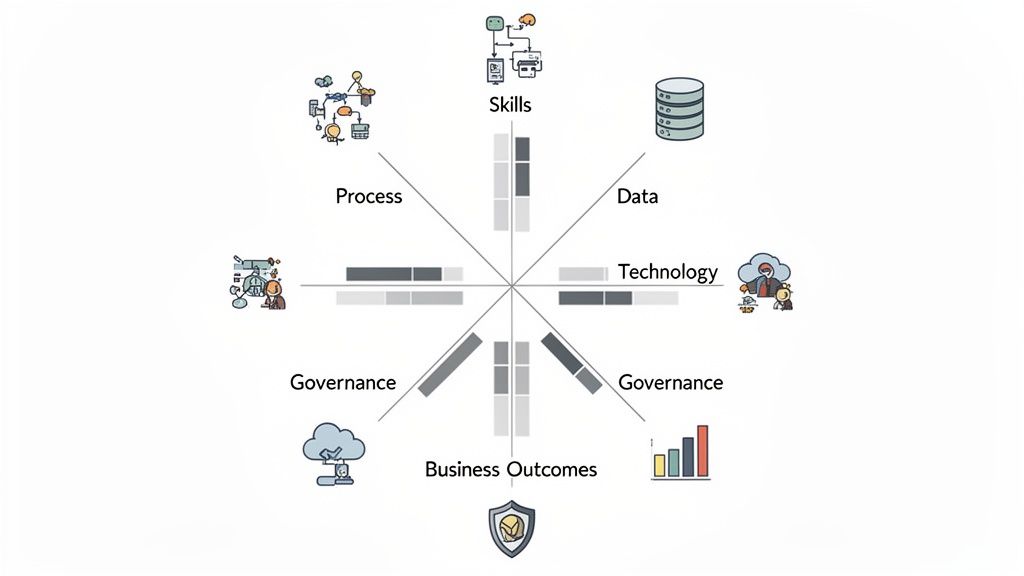
This multi-faceted snapshot will show you exactly where you're strong and, more importantly, where the critical gaps are.
Dimension 1: People and Culture
Let's get one thing straight: AI success is a human endeavor. Without the right skills, mindset, and cultural buy-in, the most sophisticated tech in the world will just gather digital dust. This isn't just about hiring data scientists; it's about the entire organization's comfort level with data-driven thinking and its readiness for change.
Practical Example: A company invests in an AI sales forecasting tool, but the sales team resists using it, trusting their "gut" instead. The tool fails not because of the technology, but because the culture wasn't ready to embrace data-driven decision-making. A successful rollout would have included training and demonstrating how the tool helps them meet quotas, not replace them.
Dimension 2: Process and Workflow
AI isn’t magic pixie dust you can sprinkle over broken processes. It creates value when it’s woven into the fabric of your daily operations—or used to design entirely new, smarter ones. Layering AI onto chaotic or inefficient workflows is a fast track to disappointment.
Practical Example: A logistics firm tries to use an AI route-optimization tool, but their manual, paper-based dispatch process is too slow and inconsistent to provide the real-time data the AI needs. The project stalls. The first step should have been to digitize the dispatch process, creating a clean workflow for the AI to enhance.
Dimension 3: Data and Analytics
Data is the fuel for any AI engine. Period. Without high-quality, accessible, and relevant data, your AI ambitions will stall before they even get started. For many companies, this is the biggest hurdle, forcing a reckoning with years of neglected data management.
"No AI without data." This mantra is a powerful reminder that a solid data foundation isn't just nice to have—it's an absolute prerequisite for getting anywhere meaningful with AI.
Practical Example: An e-commerce company wants to build a product recommendation engine. However, their customer data is split across three different systems (website, CRM, and billing), with no unified customer view. The AI model produces poor recommendations because it can't see a customer's full purchase history. The necessary first step is a data consolidation project.
Dimension 4: Technology and Infrastructure
While strategy always comes before tools, you can't scale AI without the right tech horsepower. This dimension looks at your IT infrastructure—from data storage and compute power to the MLOps pipelines needed to build and deploy models efficiently.
In fact, a recent S&P Global Market Intelligence report found that by 2025, an estimated 80% of organizations will reach advanced AI maturity. What's driving this? Heavy investment in the cloud, with the most mature companies dedicating over 41% of their IT budgets to it.
Practical Example: A company’s data science team builds a successful AI model on their laptops, but the on-premise IT infrastructure lacks the GPU capacity to run it at scale. The model can't be deployed to serve live customer requests, making it a failed experiment. A cloud-based, scalable infrastructure would have been required for production.
Dimension 5: Governance and Ethics
As AI gets more powerful, the need for guardrails becomes non-negotiable. This dimension is about the frameworks you have in place to manage risk, ensure compliance, and build trust. Skimping on governance can lead to catastrophic reputational, legal, and financial damage.
For a deeper dive, check out this excellent resource on Navigating AI Ethics, EPPA Compliance, and Risk Management in Human Resources.
Practical Example: A bank deploys an AI model for loan approvals that inadvertently discriminates against applicants from certain zip codes, creating a major compliance and PR crisis. A proper governance framework would have included pre-deployment bias testing and a human-in-the-loop review process for flagged decisions.
Dimension 6: Business Outcomes
At the end of the day, AI has to deliver real business value. This final dimension ensures your AI strategy is firmly tethered to what matters most to the company—and that you have a clear way to measure the return on your investment.
Practical Example: A marketing team uses a generative AI tool to create blog posts and reports that "engagement seems higher." Without specific KPIs like "increase organic traffic by 20%" or "reduce content creation time by 50%," they cannot prove the tool's value to leadership and struggle to justify the subscription renewal.
AI Maturity Assessment Scorecard
| Dimension | Level 1 (Initial) | Level 3 (Operational) | Level 5 (Transformational) |
|---|---|---|---|
| People | AI skills are rare; culture is resistant to change. | Pockets of AI talent exist; some teams are open to data-driven work. | AI literacy is widespread; culture embraces data and experimentation. |
| Process | Workflows are ad-hoc, manual, and undocumented. | Key processes are documented and partially automated. | Processes are fully optimized, automated, and continuously improved by AI. |
| Data | Data is siloed, inconsistent, and inaccessible. | Data is centralized but quality varies; basic governance is in place. | Data is a strategic asset: high-quality, accessible, and well-governed. |
| Technology | Infrastructure is legacy, on-premise, and not scalable. | A mix of cloud and on-prem; some AI/ML tools are used. | A modern, scalable cloud-native stack with integrated MLOps. |
| Governance | No formal AI risk management or ethical guidelines. | Basic risk policies exist; governance is reactive. | Proactive governance with clear ethical principles and automated controls. |
| Outcomes | AI projects are experiments with no clear business link. | AI initiatives are tied to departmental KPIs. | AI is core to business strategy and drives measurable enterprise-wide value. |
Impact Opportunity
Using these six dimensions to honestly assess your organization provides a 360-degree view of your AI readiness. It moves the conversation beyond just technology and forces a realistic look at the people, processes, and data foundations that are essential for success. This clarity is the first step in building a roadmap that addresses your true weaknesses and doubles down on your strengths.
Building Your Actionable AI Roadmap
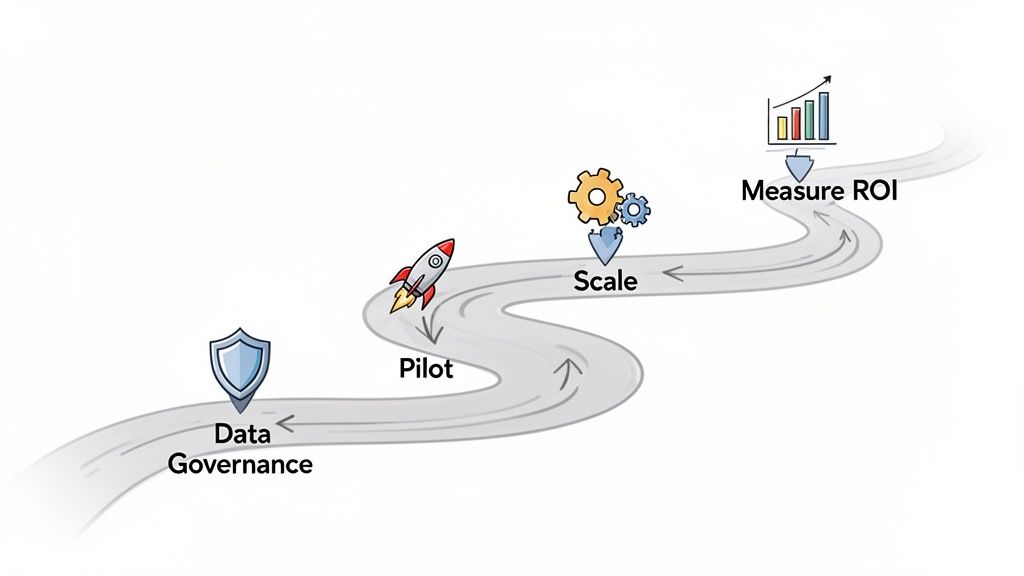
An assessment is just the starting point. Knowing where you are on the AI maturity map is only useful if it helps you plot a course forward. The real work begins when you translate those results into a practical, prioritized, and actionable AI roadmap that guides your every move.
Think of this roadmap as a living document, not something you create once and file away. It’s the bridge between knowing where you are today and getting to where you want to be, making sure every capability you build stacks logically on the last one.
From Assessment to Action
Your assessment results are a diagnostic report. Now, it's time to write the prescription. The initiatives you prioritize will depend entirely on your current stage in the AI maturity model for enterprise. A one-size-fits-all approach just doesn’t work here; your roadmap has to reflect your unique starting line.
Practical Examples
- Foundational Stage Initiative: A mid-market distributor realizes its biggest weakness is messy data (Dimension 3 Data). Their first roadmap item isn't buying a flashy AI platform. It's launching a "Data Governance Taskforce" and implementing a master data management (MDM) system. The goal? Create a single source of truth for product and customer data, which lays the groundwork for a future AI-powered inventory forecasting pilot.
- Operational Stage Initiative: A B2B software company has already seen success with an AI chatbot, cutting support tickets by 25%. Now in the Operational stage, their roadmap is all about scaling that win. The next initiative is to integrate the chatbot with their CRM to send proactive support alerts to high-value customers, with a clear goal of boosting retention by 5%.
Aligning Initiatives with Business Goals
Every single item on your AI roadmap must answer one question: "How does this help the business win?" Without a clear line to a business goal, an AI project is just an expensive science experiment. This discipline is what separates companies that get real ROI from those that just burn cash.
Projections show enterprise spending on generative AI will soar to $37 billion in 2025—that's a staggering 3.2x jump from 2024. But here's the kicker: 39% of AI projects still fail. The best-performing organizations get that failure rate down to 29% by ruthlessly tying projects to outcomes.
The most effective AI roadmaps don't start with technology. They start with a business problem—like high customer churn, inefficient lead qualification, or rising operational costs—and work backward to identify the right AI solution.
As you map out your AI adoption journey, checking out significant AI sales tools is a smart move. It helps you find solutions that can truly reshape your sales motion and speed up your progress through the maturity model.
Structuring Your Roadmap
A simple but incredibly effective way to structure your roadmap is a timeline broken down by quarters. For each quarter, you'll list the key initiatives, the business goals they support, the maturity dimensions they improve, and the KPIs you’ll use to measure success.
Sample Roadmap Template Snippet (Q1-Q2)
| Quarter | Initiative | Business Goal | Maturity Dimension | Success KPI |
|---|---|---|---|---|
| Q1 | Establish AI Governance Council | Mitigate risk and ensure compliance | Governance, People | AI principles documented and approved |
| Q1 | Launch Sales Data Cleansing Project | Improve lead scoring accuracy | Data | 95% contact data accuracy in CRM |
| Q2 | Pilot AI Lead Scoring Tool | Increase qualified leads for sales | Business Outcomes, Process | 20% lift in marketing qualified leads (MQLs) |
| Q2 | AI Literacy Training for Leadership | Secure long-term executive buy-in | People | 100% of executive team completes training |
This structured approach creates much-needed clarity and accountability.
Key Takeaways
- Stage-Specific Priorities: Your roadmap has to be tailored to your current maturity level. Don't try to run before you can walk.
- Business Outcomes First: Tie every single initiative to a measurable business goal, whether it's cutting costs or growing revenue.
- Focus on Gaps: Prioritize projects that shore up the weakest areas you identified in your assessment.
Impact Opportunity
Building a clear, prioritized roadmap turns your AI strategy from a random list of projects into a cohesive plan for creating real value. It ensures every dollar and every hour you spend on AI pushes the business forward, delivering measurable returns instead of just deploying cool tech for its own sake. This focused approach is the fastest way to accelerate your journey through the AI maturity model for enterprise.
Common Pitfalls That Derail AI Transformation
Embarking on an AI transformation without understanding the common roadblocks is like setting sail into a storm without a map. Moving up the AI maturity model for enterprise means learning how to sidestep the predictable traps that have stalled countless initiatives before yours.
Knowing what not to do is just as important as knowing what to do.
Pitfall 1: Focusing on Technology Before Strategy
The single most common mistake is buying a shiny, expensive AI platform without having a clear business problem to solve. Technology should always be the answer to a question, not the starting point. This "tool-first" approach almost always leads to a solution in search of a problem.
Practical Example: A retail company invested $2 million in a advanced AI analytics platform, hoping it would magically reveal significant insights. But with no strategy, their teams didn't know what questions to ask or what data to feed it. The platform became a very expensive piece of "shelfware." The fix? Start with your business goals, not the tech.
Pitfall 2: Neglecting Data Readiness
You can have the most sophisticated AI model on the planet, but if you feed it garbage, you'll get garbage results. Many leaders dramatically underestimate the time and effort required to clean, organize, and govern their data. They jump straight to building models, only to find their data foundation is built on sand.
Practical Example: A financial services firm tried to build an AI-powered fraud detection model. Their customer data was a mess—spread across a dozen disconnected legacy systems, riddled with duplicates and errors. The project was scrapped after six months because the data was simply unusable. Make data readiness your first real priority.
Pitfall 3: Failing to Secure Executive Buy-In
AI projects demand serious investment, cross-functional collaboration, and a healthy dose of patience. Without a committed executive sponsor championing the cause from the top, initiatives lose steam, struggle for resources, and get pushed to the back burner the moment a new fire drill starts.
"A lack of shared goals and siloed pilots with no path to scale are common roadblocks preventing organizations from realizing widespread and sustainable impact."
Practical Example: A marketing team launched an AI content generation pilot that showed fantastic early results. But without buy-in from the C-suite, they couldn't get the budget to scale the tool across the company. The initiative fizzled out, and all those initial gains were lost.
Pitfall 4: Forgetting to Define Success Metrics
"We'll know it's working when we see it" is not a strategy. It's a recipe for failure. If you don't define clear, measurable Key Performance Indicators (KPIs) from day one, you have no way to prove the value of your AI investment. This makes it impossible to justify more funding or scale successful projects.
Practical Example: A logistics company automated its warehouse scheduling with an AI tool but never set any baseline metrics. The team felt like things were more efficient, but they had no hard data to prove it. When budget cuts came, the "unproven" AI project was the first on the chopping block. Before you start, define if success is a 15% cost reduction or a 20% increase in output.
Impact Opportunity
Avoiding these pitfalls saves more than just money—it saves time, protects your team's morale, and builds real momentum for your AI transformation. By learning from these common missteps, you can navigate your own journey more effectively and ensure your AI initiatives deliver sustainable business value, preventing them from becoming another statistic in the long list of failed IT projects.
Key Takeaways
- Strategy First: Always start with a business problem, not a piece of technology.
- Data is the Foundation: Your AI is only as good as your data. Prioritize cleansing and governance above all else.
- Leadership Matters: Find a passionate executive sponsor to champion your project and ensure its survival.
- Measure Everything: Define specific, measurable KPIs upfront to prove your work's value and justify future investment.
So, What's the Takeaway?
An enterprise AI maturity model isn't just some consultant's checklist; it's the strategic backbone for building an intelligent revenue engine that actually works. Without it, you’re just running scattered AI experiments that look cool in a presentation but rarely deliver lasting business value.
Moving from a few isolated projects to genuine transformation doesn't happen by accident. It takes a deliberate, step-by-step approach.
A structured approach is the only way to get sustainable, AI-driven growth. It forces you to build a solid foundation—your data, your people, your processes—before you try to scale the complex stuff. This discipline prevents those costly flameouts and makes sure every dollar you spend is tied to an outcome you can measure.
Your Path Forward
The choice is pretty straightforward. You can keep launching disjointed AI projects that produce one-off wins, or you can adopt a real framework that builds a durable competitive advantage. This guide gives you the blueprint to see where you are, find the gaps, and build a roadmap that makes sense.
Your Next Move:
It's time to turn this knowledge into action. The logical next step is a comprehensive audit of your AI readiness. It will pinpoint exactly where you are on the maturity curve and shine a bright light on the highest-impact initiatives you should tackle right now. A professional Growth Audit can provide this clarity.
That’s how you move your strategy from a plan on paper to real, tangible progress.
Common Questions on AI Maturity Models
Putting an AI maturity model for your enterprise into practice always brings up a few key questions. It's one thing to have the framework, but another to see how it plays out on the ground. Getting these answers right helps leadership move forward with clarity, turning theory into a real action plan.
Let’s tackle some of the most common questions we hear from executives navigating their way through an AI transformation.
How Long Does It Take to Move Up a Stage?
There’s no magic number here. The time it takes to advance from one stage to the next depends entirely on your company's size, resources, culture, and—most importantly—how committed leadership is to making it happen.
Practical Example: For a mid-sized company looking to move from the 'Initial' to the 'Foundational' stage, you should realistically budget 6-9 months of focused work. That timeline gives you room for the essentials: setting up solid data governance, getting different teams on the same page, and launching your first meaningful pilot project. In contrast, a large, bureaucratic enterprise might take over a year to make the same move due to complex legacy systems and slower decision-making processes.
What’s the Single Biggest Factor for Success?
Without a doubt, the most critical factor is unwavering executive sponsorship and a clear strategic vision. You can have the best tech on the planet, but if leadership doesn't truly buy in—and can't tie AI directly to core business goals—your initiatives will stall out before they ever deliver real value.
When leadership champions AI as a business imperative, not just another tech project, it changes everything. That top-down support is what secures budgets, breaks down silos between departments, and gives AI projects the priority they need to actually succeed.
How Do We Measure the ROI of Getting More Mature?
Measuring the return on investment (ROI) from your AI maturity efforts comes down to one thing: connecting your progress to real business numbers. The goal is to stop tracking activities and start measuring impact.
As your organization gets more sophisticated with AI, the value it creates becomes more tangible and easier to see on the balance sheet.
Practical Examples:
- Cost Reduction: A company in the 'Operational' stage can measure the ROI of its predictive maintenance AI by tracking the decrease in unplanned equipment downtime and the corresponding reduction in emergency repair costs, aiming for a target of 15-20%.
- Revenue Growth: A firm at the 'Accelerated' stage can prove the value of its AI lead scoring system by measuring the increase in sales conversion rates. A successful project should show a clear lift, such as moving from a 3% to a 5% lead-to-close ratio.
- Efficiency Gains: An organization can quantify the impact of an AI-powered document processing tool by measuring the reduction in person-hours required for manual data entry, freeing up employees for higher-value work.
Key Takeaways
- Progress is Deliberate, Not Rushed: Plan for a 6-9 month timeline for early-stage moves. Focus on building a solid foundation, not just hitting a deadline.
- Leadership is Non-Negotiable: Your entire AI strategy rises or falls on the strength and consistency of your executive sponsors.
- Measure What Matters: To prove ROI, connect every step of your AI journey to concrete business KPIs like cost savings, revenue growth, and operational efficiency.