Construction labor productivity improved by only about 10% from 2000 to 2022, compared with roughly 90% in manufacturing. Most construction AI pilots fail for operational reasons, especially poor data and weak system integration, not because the underlying models are incapable.
That makes the right question less exciting and more useful. Don't ask which AI model your company should buy. Ask which repeatable construction workflow has reliable data, an accountable owner, and enough economic value to justify a controlled pilot. AI in construction creates value when it connects BIM, ERP, project management, CRM, IoT, and field data to decisions that teams already need to make.
Why Construction Needs AI Now
Construction does not need more standalone dashboards. It needs connected workflows that turn fragmented project information into faster, more reliable decisions. Labor productivity grew by approximately 1.0% per year over the two decades preceding McKinsey's 2024 report, compared with 2.8% for the global economy and 3.6% for manufacturing. (Construction Dive Network analysis)
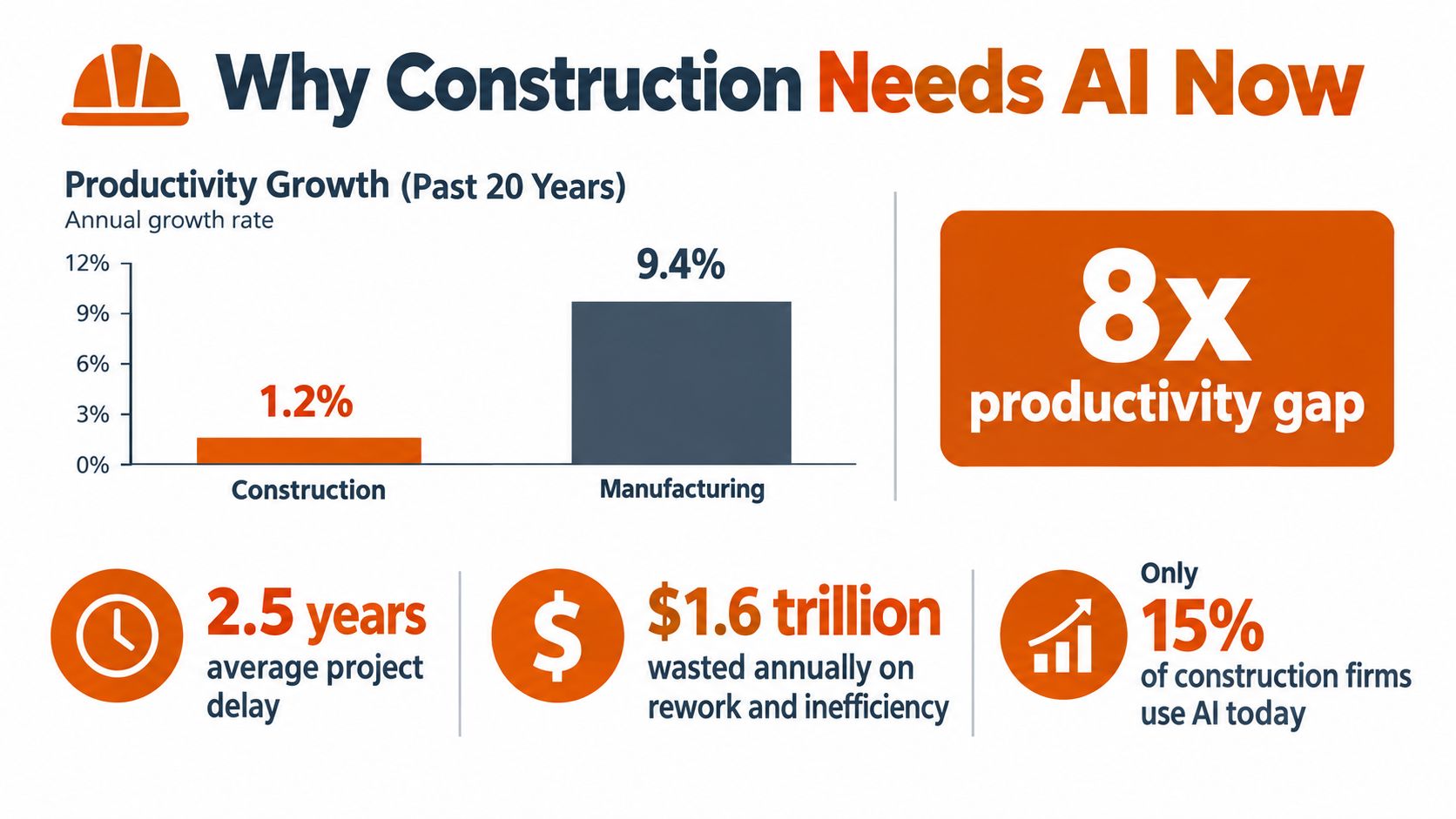
Those annual differences matter across a project lifecycle. A business improving at 3.6% per year builds operational capacity faster than one improving at 1.0%, while the gap continues to widen as projects, portfolios, and teams accumulate. Construction's challenge is therefore not a shortage of software. It is the slow movement of accurate information between owners, designers, general contractors, subcontractors, suppliers, and field teams.
The industry generates valuable signals across BIM, ERP, project management, CRM, IoT, and site systems. They often remain separated by inconsistent data, manual handoffs, and one-off delivery processes. AI can help classify documents, identify patterns, prioritize exceptions, and route decisions, but only when those systems and responsibilities are connected.
The Productivity Gap is an Operating Problem
Estimating, design analysis, document review, scheduling, safety monitoring, progress tracking, and compliance checks all contain repeatable information work. That makes them suitable for focused pilots with clear owners and measurable outcomes.
McKinsey-related analysis cited by Construction Dive Network estimates that 20% to 30% of construction work could be automated by 2030, depending on adoption speed and breadth. The projection supports targeted automation in planning, administration, inspection, and coordination. It does not justify treating skilled trades or site judgment as replaceable. (Construction Dive Network analysis)
Executive rule: Evaluate AI by hours saved, schedule reliability, rework reduction, estimating accuracy, and project margin. The number of tools deployed is not an outcome.
Start with a process that already performs poorly. Connect meeting minutes, RFIs, model revisions, and site reports to flag unresolved coordination issues. Use camera events to trigger supervisor review instead of assigning someone to watch footage manually. In each case, the model is only one component. The workflow, data quality, escalation path, and accountable owner determine whether the output changes project performance.
AI in construction should follow an operating constraint, not a technology trend. Define the financial or delivery problem first, then select the smallest intervention that can be tested against a baseline. A pilot that connects existing systems and changes a real decision is more valuable than a polished dashboard that creates another information silo.
Where the Industry Stands on Adoption
AI adoption in construction is an operating-readiness problem before it is a model-selection problem. The European baseline remains limited. Eurostat reported that 10.79% of European construction enterprises used AI, while AI use in other economic activities stayed below 25% and reached 24.82% in real estate activities. The European Commission also described construction as Europe's least digitalized industrial ecosystem, with only 55% of firms using advanced digital technologies, compared with a 76% average across other industrial ecosystems. (Eurostat and European Commission analysis)
The RICS 2025 global survey shows why adoption remains slow. Among more than 2,200 construction professionals, 45% of organizations had not implemented AI, 34% were still running early pilots, and only 1% had scaled AI across projects. The leading barriers were lack of skilled personnel at 46%, system-integration challenges at 37%, and poor data quality or availability at 30%. (RICS artificial intelligence in construction report)
Capability is the constraint
Construction businesses can buy capable models, computer-vision systems, document tools, and generative assistants. Those tools will not create value without consistent data, clear process ownership, and connections to the systems that run projects.
A readiness assessment should examine:
- Data ownership: Identify who controls BIM models, site imagery, RFIs, schedules, cost data, safety records, and supplier information.
- Workflow consistency: Check whether projects record the same event in comparable ways.
- Integration points: Map information flows between estimating, ERP, project management, document control, CRM, and field systems.
- Human accountability: Assign an owner who can approve alerts, resolve exceptions, and change the process.
- Access and safety controls: Define who can view worker, client, project, and commercial information.
Integration should be the default pilot criterion. A gate-access workflow illustrates why. An AI-ready gate access platform may capture useful site-entry information, but its value depends on connections to attendance, safety, security, and project operations. A standalone record feeds a dashboard. An integrated event can trigger a governed action.
Use an AI maturity model to classify whether the business is experimenting, operating repeatable pilots, or scaling governed capabilities. A company at the pilot stage should fund process discipline and integration work before purchasing an enterprise-wide model. That sequence puts AI inside existing BIM, ERP, CRM, and IoT workflows, where it can change a decision rather than create another information silo.
The Seven Use Cases Worth Piloting
The best first use case usually turns messy site information into a discrete event that someone already knows how to handle. A systematic review of 144 studies on deep-learning-enabled visual computing in construction found research concentrated in object detection at 33%, safety monitoring at 28%, damage detection at 22%, quality inspection at 9%, and productivity analysis at 8%. (Frontiers systematic review)
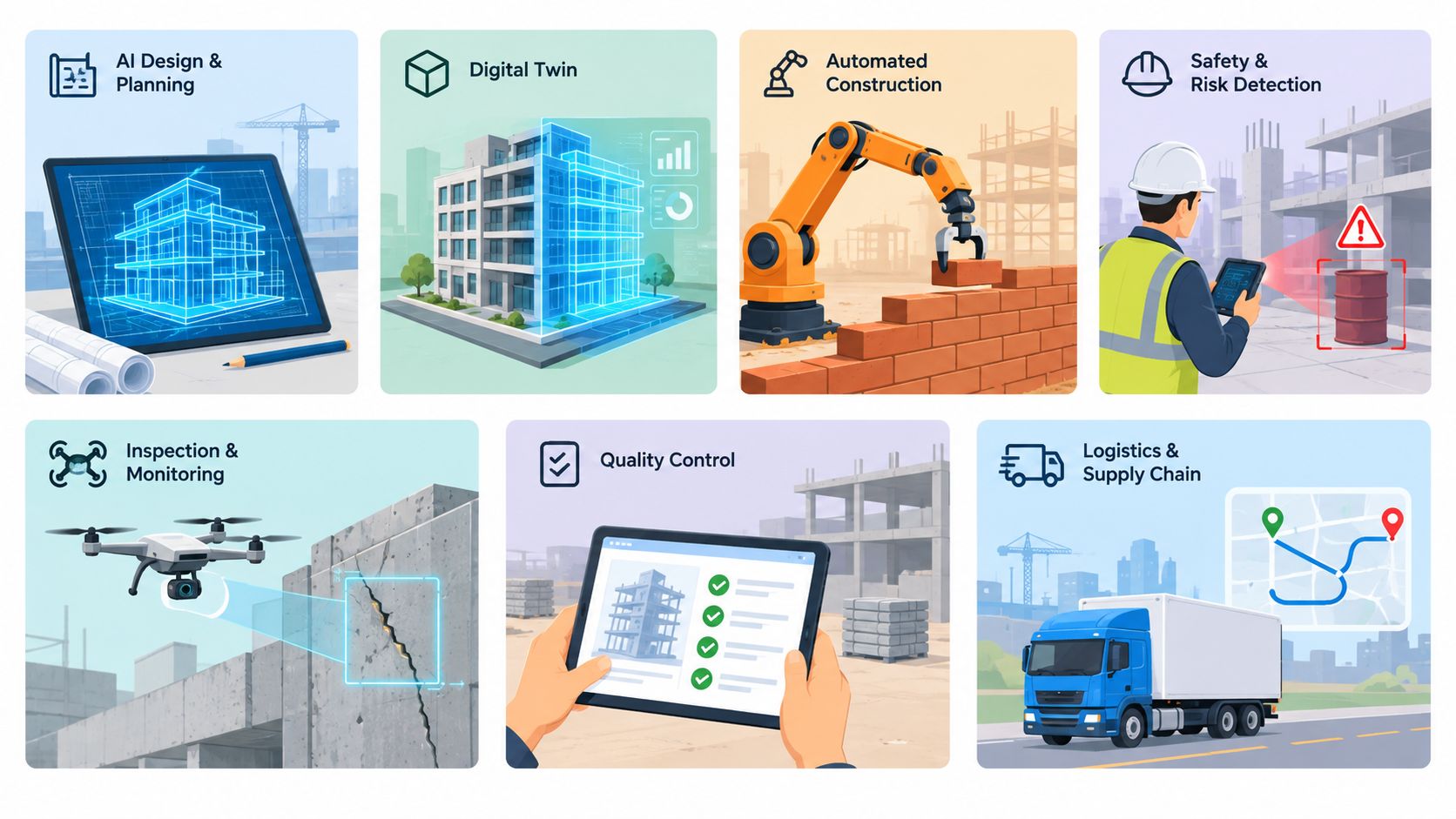
That distribution favors workflows with camera data, defined labels, and an existing escalation process. It doesn't mean other categories lack potential. It means their payback depends more heavily on clean historical data, instrumentation, and integration.
| Use case | Pilot readiness | What to test |
|---|---|---|
| Design optimization | Moderate | Compare design alternatives against cost, constructability, spatial, or sustainability constraints. |
| Planning and estimating | Moderate | Extract quantities, requirements, and risk signals from drawings, specifications, and historical project information. |
| Scheduling | Moderate | Identify dependencies, slippage patterns, and coordination risks from schedules, updates, and field records. |
| Safety monitoring | High for narrow visual workflows | Detect PPE issues, restricted-area entry, or unsafe equipment proximity, then route alerts for human review. |
| Predictive maintenance | Conditional | Combine equipment telemetry, service history, and operating conditions before predicting intervention needs. |
| Quality control | Moderate | Compare observed work with approved models, specifications, checklists, and inspection requirements. |
| Supply-chain optimization | Conditional | Connect procurement, delivery, inventory, supplier, and schedule data to surface material risks. |
Computer vision is the most credible starting point when the company can define what counts as a valid event. A missing helmet, damaged component, or detected object is easier to audit than a broad instruction such as “optimize the project.”
The following video provides a practical visual reference for how AI is being applied across construction workflows:
A pilot should connect detection to action. For example, the system might create a safety task only after a condition persists across multiple frames or a supervisor confirms it. That design reduces false alarms and preserves human judgment where the consequence of an incorrect alert is material.
The Data and Integration Architecture Behind Every Pilot
Treat AI as the inference layer on top of operational data. If that data is fragmented, poorly labeled, or disconnected from the workflows people already use, the pilot will stall no matter how impressive the model looks.
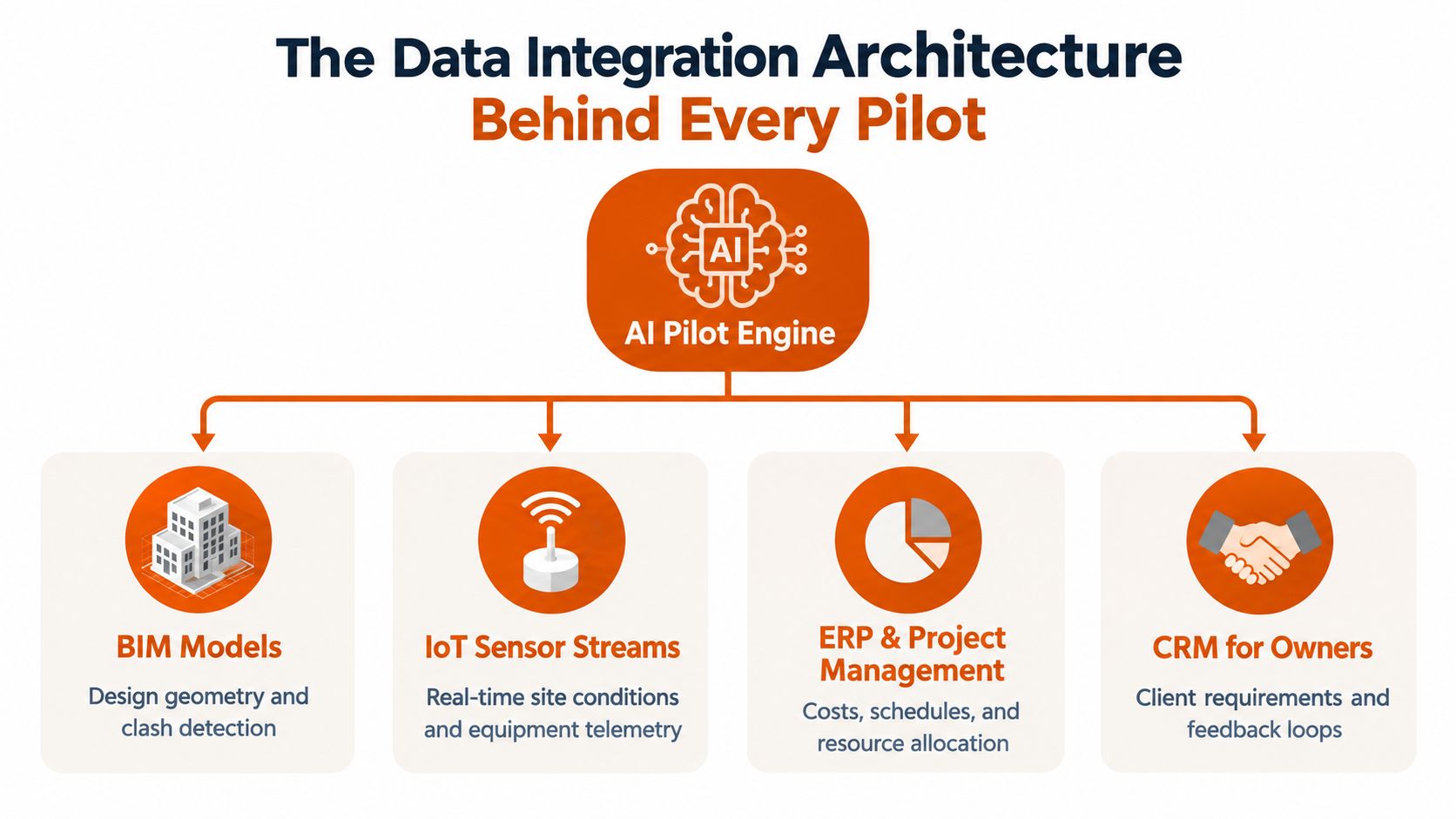
BIM should provide spatial and design truth. Models, revisions, component identifiers, and clash information give AI a structured view of what should exist and where. Stable identifiers matter. Without them, a vision system may detect a component yet fail to tie it to a schedule activity, inspection requirement, or responsible trade.
ERP and project-management systems should provide commercial and delivery truth. Cost codes, commitments, schedules, labor allocation, change orders, RFIs, and forecasts are the records that let a team judge whether an AI recommendation matters. A model that spots a risk but cannot connect it to cost, schedule, or ownership creates one more queue for the project team.
IoT and video create operational signals. Sensors can report equipment condition, environmental readings, or location events. Cameras can surface observations about objects, progress, activities, and hazards. To become usable records, those signals need timestamps, project identifiers, confidence scores, and retention rules that the business will follow.
CRM adds the relationship layer. Owner requirements, subcontractor relationships, communication history, and feedback loops often sit outside the core project system. Connecting that information to project outcomes helps teams see how commitments, questions, and changes affect delivery and client experience. A practical guide to AI integration with CRM is useful here because it frames the work as process design, not as a chatbot purchase.
Build the smallest useful architecture
Start with one operational question and wire only the systems required to answer it. If the question is whether installed components are tracking against the schedule, the pilot may need video, BIM, schedule activities, and a supervisor review queue. It probably does not need a full enterprise data lake, a new dashboard program, or a broad data modernization effort before anyone learns anything.
This is the core readiness test. Can the pilot connect a signal to a business decision, then route that decision to someone who can act?
Use architecture that supports auditability. Preserve timestamps, confidence values, project context, site conditions, and human validation so the team can review output by project, trade, camera angle, or operating condition. Construction executives should insist on this from day one. If a pilot cannot explain why it triggered an alert or recommendation, it is not ready for field use.
Integration capacity is often the bottleneck. Many firms can buy software faster than they can map identifiers across BIM, ERP, CRM, and field systems. When internal capacity is thin, companies may evaluate specialist teams, including Latin American developers with experience supporting custom data and application work. Cost matters, but workflow fit matters more. The partner still needs to understand construction operations, security, data ownership, and field adoption, or the pilot will remain a disconnected demo.
From Pilot to Scale in Five Stages
AI scale in construction is an operations problem first. The question is not which model is smartest. It is whether the pilot is wired into real workflows, creates a decision someone can act on, and survives the controls needed for field use.
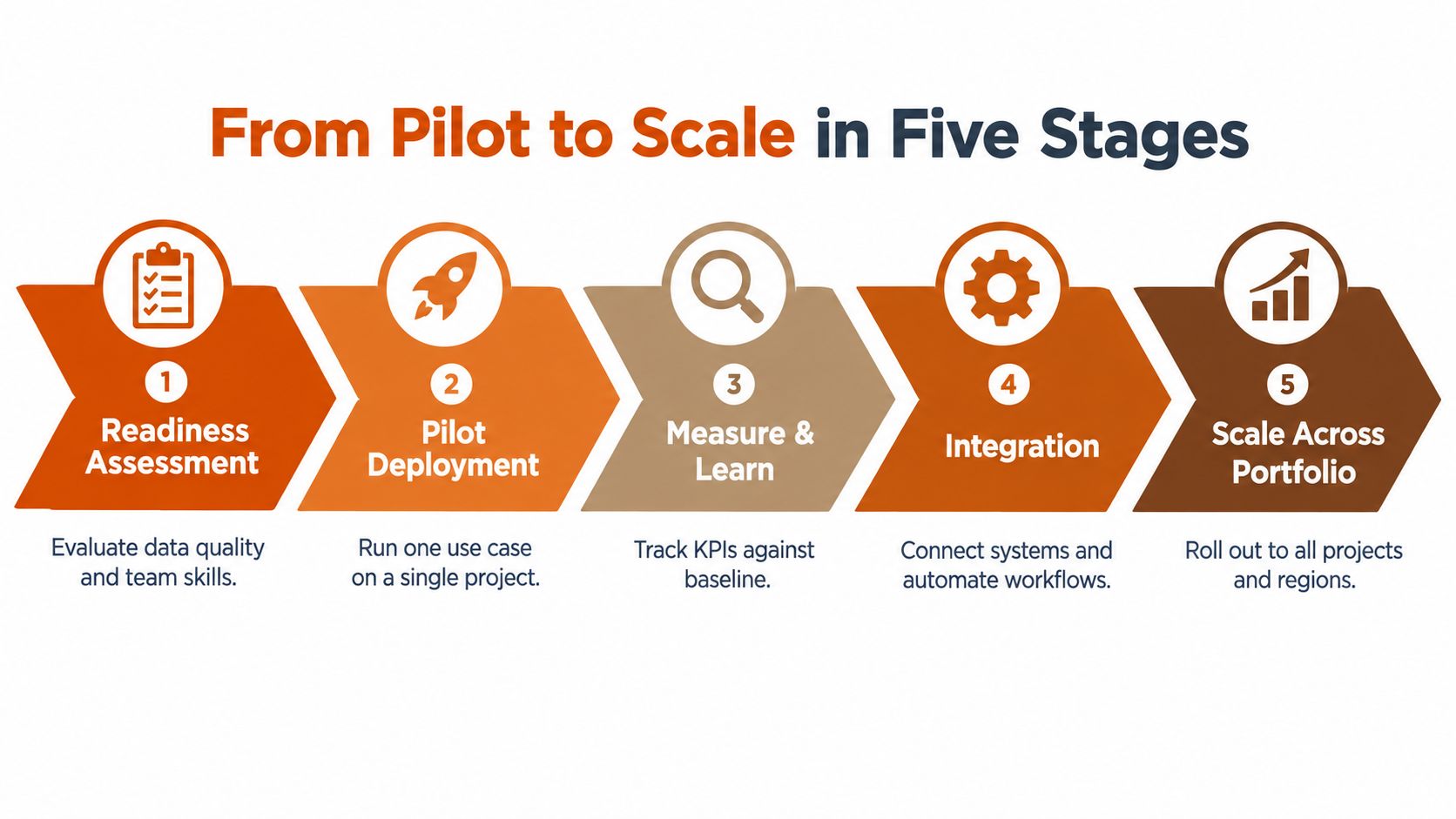
1. Assess readiness
Start with one workflow, one owner, and one baseline. The executive sponsor and operations lead should map the process, the systems it touches, the data quality, and the current performance gap.
The readiness test is direct. Can the team identify the input data, the decision to improve, the person who will act, and the current result? If they cannot, the pilot is premature.
Record the measures that show operational pain and follow-through, such as manual hours, time to answer project questions, unresolved RFIs, rework events, forecast variance, safety-alert response time, and cost-to-complete accuracy. Baselines matter because they show whether the pilot changes work or just adds another layer of reporting.
2. Select one economically material use case
Pick the workflow with the clearest business consequence and the least integration drag. The operations owner should rank candidates by value, data availability, adoption risk, and how much system wiring they require.
Do not start with an enterprise ambition. Start with one project or one repeatable process that can prove whether the team can move from signal to action. A narrow safety alert or document-routing workflow is easier to control than an autonomous scheduling system, and it teaches the organization more about readiness.
3. Run a scoped pilot
Run the pilot inside the existing workflow. Connect only the minimum systems needed, keep human approval in the loop, and define the response when the system is uncertain.
For visual safety detection, the escalation rule should require a condition to persist across multiple frames or receive supervisor confirmation before creating a verified task. Measure response time, avoided manual inspection, false alarms, and repeat-violation rates. The goal is not a polished demo. The goal is evidence that the workflow produces a reliable decision under field conditions.
4. Govern the move into production
Production starts when people can interpret the output and act on it without unacceptable safety, privacy, or commercial risk. The technology owner should document access controls, retention, audit trails, model performance, exception handling, and training requirements.
This is the point where many pilots fail. The model may be accurate, but if crews, supervisors, or project controls cannot use the output with confidence, the system is not ready. Companies can use an AI pilot to production framework to define the handoff from experiment to repeatable operating capability.
5. Scale across the portfolio
Scale only after the pilot has shown stable results and the organization can repeat the operating model. The transformation sponsor should standardize data definitions, integration patterns, user training, and ROI reporting before expanding to other projects or regions.
That discipline matters. Once a pilot works, the hard part is not the model. It is making sure every new site can use the same definitions, the same controls, and the same decision path without rebuilding the workflow each time. Scale follows readiness, not enthusiasm.
Three Practical Examples You Can Learn From
Safety monitoring at The Boldt Company
A cited case involving The Boldt Company reported a 75% reduction in workers' compensation expenses after the company implemented an AI safety-monitoring platform that used site cameras to identify hazards and route alerts to supervisors. (Reported Boldt Company case)
Safety monitoring works best when the system watches defined conditions, sends alerts to the right person, and supports intervention before an incident. A serious pilot should test alert thresholds, false positives, worker privacy, camera placement, and response time.
Component-level productivity measurement
Computer vision can move productivity measurement from periodic manual sampling toward continuous analysis of installation activity. The vision framework cited earlier in the architecture section showed that this approach can recognize construction activity quickly and estimate component-level progress for elements such as columns, beams, and slabs.
Start with production states that matter to the field, such as component started, component installed, inspection-ready, or obstructed. Then compare cycle times and observed progress with schedule assumptions. Supervisors can focus on stalled components and abnormal durations instead of reviewing footage by hand.
BIM and virtual-reality coordination
AI-enabled BIM and virtual-reality workflows help teams visualize designs, spot clashes among structural, mechanical, electrical, and architectural elements, and coordinate changes before work starts. (International Association for Automation and Robotics in Construction research)
A general contractor can combine model revisions, meeting minutes, RFIs, and site reports, then generate a ranked list of unresolved coordination issues with owners and due dates. The value is simple. Find conflicts earlier, when teams can still correct them before installation, procurement changes, or schedule disruption.
Across all three examples, the same rule applies. AI should support a standardized control process, not make an unsupported autonomous decision and leave field teams to absorb the consequences.
Risks, Ethics, and How to Pick the Right Partner
A construction AI program can create risk faster than it creates value if the company treats data collection as harmless and model output as objective.
Vision systems may perform differently across lighting conditions, camera angles, weather, PPE types, trades, and site layouts. Worker-monitoring programs can damage trust if employees don't understand what cameras capture, how long records are retained, who can access them, and whether the system is evaluating individuals or site conditions. IoT and BIM integrations also expand the attack surface, so cybersecurity and access control belong in the pilot design, not in a later procurement checklist.
Treat the partner as an operating partner
Most buyers evaluate AI vendors through demonstrations. That is the wrong test. A polished demo proves that a system can produce an output under selected conditions. It doesn't prove that the output fits your safety process, project controls, commercial systems, or workforce.
Shortlist partners that can:
- Diagnose readiness: They should inspect data quality, system boundaries, process variation, and ownership.
- Connect existing systems: They should explain how BIM, ERP, CRM, project management, document control, and field data will exchange information.
- Define escalation rules: They should specify when the system alerts, when it waits, and when a human must approve.
- Measure an operational outcome: They should accept KPIs such as response time, rework events, unresolved RFIs, forecast variance, or cost-to-complete accuracy.
- Support adoption: They should provide training, documentation, governance, and a path to production.
The partner must also understand that AI is not a substitute for professional judgment. It should surface evidence, prioritize work, and reduce repetitive information handling while accountable construction professionals retain authority over safety, quality, contractual, and delivery decisions.
The Executive Checklist Before You Approve AI Spend
Adjacent industries are treating AI as a standard business capability. A 2025 RSM survey found that 94% of 966 respondents across the United States and Canada said their organizations used AI tools in business practices, based on responses collected from February 21 through March 4, 2025. (RSM 2025 survey) Construction-specific evidence still places many firms at pre-adoption or early-pilot stages.
Before approving spend, confirm that you have:
- A named process owner and executive sponsor.
- A measurable baseline and target KPI.
- Reliable data with defined access and retention rules.
- A connection to existing BIM, ERP, CRM, project, or field systems.
- Human review and escalation rules.
- A training and adoption plan.
- A production decision gate tied to operational results.
The single question to answer is: Which process is standardized enough and economically material enough to justify adoption now?
Prometheus Agency helps construction companies assess AI readiness, prioritize practical use cases, connect existing systems, and move pilots into governed production workflows. Visit Prometheus Agency to request a complimentary Growth Audit and AI strategy session focused on turning your current technology stack into measurable operating improvement.