Most advice about AI governance consulting starts in the wrong place. It tells leaders to write a policy, form a committee, and wait for legal approval. That approach produces tidy paperwork while employees build agents in sales, vendors update models without notice, and product teams discover approval requirements only after a launch is blocked.
Governance should function as the operating system inside your revenue stack. It should decide which AI a team can use, what evidence it must provide, who approves it, when an update triggers reassessment, and who can stop deployment. For mid-market companies without a dedicated AI risk function, that distinction determines whether governance accelerates growth or becomes another document nobody opens.
Why AI Governance Is an Operating System, Not a Policy
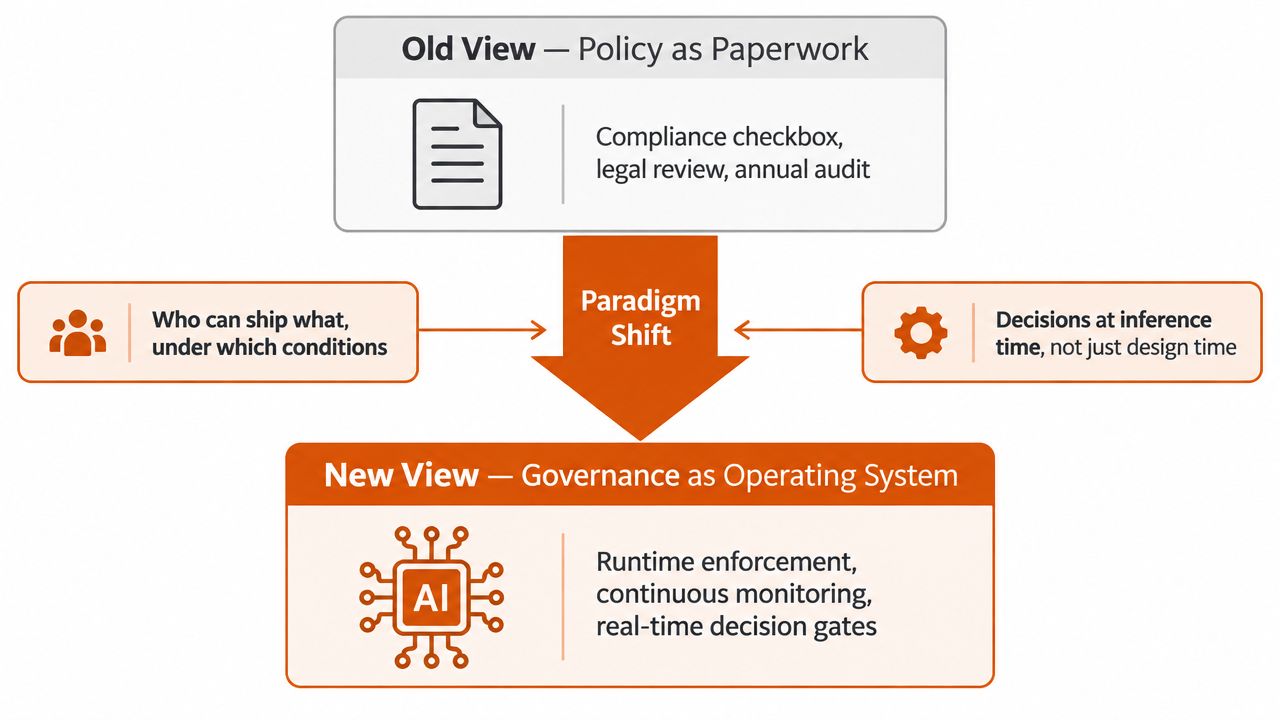
A policy is the starting point. Governance is the control layer that decides what happens after the policy is approved.
A 30-page acceptable-use document signed once does not answer the operational questions that matter. Can a sales manager connect an unapproved agent to customer records? Does a vendor model update require a new assessment? Who signs off when an AI system affects pricing, eligibility, hiring, or customer communications? What evidence must a product team keep before release?
Without those answers, the policy sits in a shared drive. It governs nothing.
The Control Layer Leaders Actually Need
Useful governance creates a repeatable path from idea to deployment:
- Intake: Every model, agent, vendor tool, and material use case enters one register.
- Classification: The organization assigns a risk tier based on potential harm, autonomy, data sensitivity, and system privileges.
- Decision rights: Named people approve, reject, escalate, or pause the use case.
- Evidence: Teams record data sources, testing, human oversight, incidents, and material changes.
- Update triggers: A model change, new data source, new jurisdiction, or altered business purpose prompts reassessment.
That is why a credible engagement leaves behind more than policy language. It should produce a documented intake form, a tiered risk classifier, a model registry entry, and a named accountable owner that fit the existing product, procurement, security, and change-control cycles.
The enterprise AI governance framework should be built around how the company builds, buys, deploys, and retires technology. If governance requires a separate process that teams must remember to visit, adoption will decay.
Practical rule: If a control does not appear in a workflow, a system, a role description, or an approval record, it is not operational governance.
The value of AI governance consulting is hardwiring accountability into execution. Consultants should define who can ship what, under which conditions, and what happens when the facts change. That matters most for mid-market operators, where AI risk usually sits across legal, security, data, product, and commercial leaders instead of a dedicated function.
The Regulatory and Market Forces Driving Demand
AI governance stopped being a debate about ethics the moment regulators turned it into an operating requirement. The NIST AI Risk Management Framework 1.0 was released in January 2023, and ISO/IEC 42001 followed in October 2023 as the first international AI management system standard, according to Atlan.
The EU AI Act adds the structure buyers need. It sorts use cases into unacceptable, high, limited, and minimal or no-risk tiers, and the European Commission says it bans nine practices, including harmful manipulation, social scoring, untargeted scraping for facial-recognition databases, emotion recognition in workplaces and schools, and real-time remote biometric identification for law enforcement in public spaces. Prohibitions on unacceptable-risk practices took effect in February 2025, GPAI governance structures became operational in August 2025, and EU high-risk AI enforcement begins in August 2026.
The United States creates a different kind of pressure. Federal direction on safe AI development now sits alongside sector expectations and state rules. Texas TRAIGA became effective in January 2026, while Colorado's AI Act takes full effect in June 2026. Financial services teams still have to map governance to model-risk expectations, healthcare teams have to account for medical-device and clinical-use controls, and insurers face obligations tied to underwriting and customer treatment.
Regulation sets the floor. Procurement and customer trust set the revenue ceiling.
Enterprise buyers increasingly ask suppliers to explain how AI is used, what data it touches, how vendors monitor changes, and who owns incidents. ISO/IEC 42001 certification is also showing up in procurement conversations. Leaders who treat governance as a legal task miss the commercial question, can the company prove control well enough to stay eligible for the deal?
The market is already responding. One estimate places responsible AI governance consulting at $291.76 million in 2024, after a 48.12% CAGR since 2019, with projections of $1.84 billion by 2029 and $10.83 billion by 2034, according to The Business Research Company. A narrower segment definition from the same source puts the market at $0.43 billion in 2025, rising to $3.14 billion by 2030 at a 48.3% CAGR, with North America identified as the largest region in 2025.
For executives who need a plain definition, what is regulatory compliance is a useful reference point. The point is ongoing control, not a one-time legal review.
| Driver | Effective Date / Status | Commercial Trigger |
|---|---|---|
| NIST AI RMF 1.0 | Released January 2023 | A practical structure for governance, risk mapping, measurement, and management |
| ISO/IEC 42001 | Published October 2023 | AI management system requirements and evidence expectations |
| EU AI Act | Entered into force August 2024 | Risk classification, prohibited-practice controls, documentation, and oversight |
| Unacceptable-risk prohibitions | Effective February 2025 | Immediate removal or redesign of prohibited use cases |
| GPAI governance structures | Operational August 2025 | New governance expectations for general-purpose AI |
| Texas TRAIGA | Effective January 2026 | State-level compliance and policy mapping |
| Colorado AI Act | Full effect June 2026 | Additional state obligations for covered AI uses |
| EU high-risk enforcement | Begins August 2026 | Readiness evidence, controls, monitoring, and auditability |
Mid-market buyers feel this pressure hardest. They do not have a dedicated AI risk function, but they still have revenue teams, procurement reviews, security gates, and legal sign-off. That is why ai governance consulting gets funded. It protects contracts, shortens approval cycles, and keeps revenue-generating AI systems deployable.
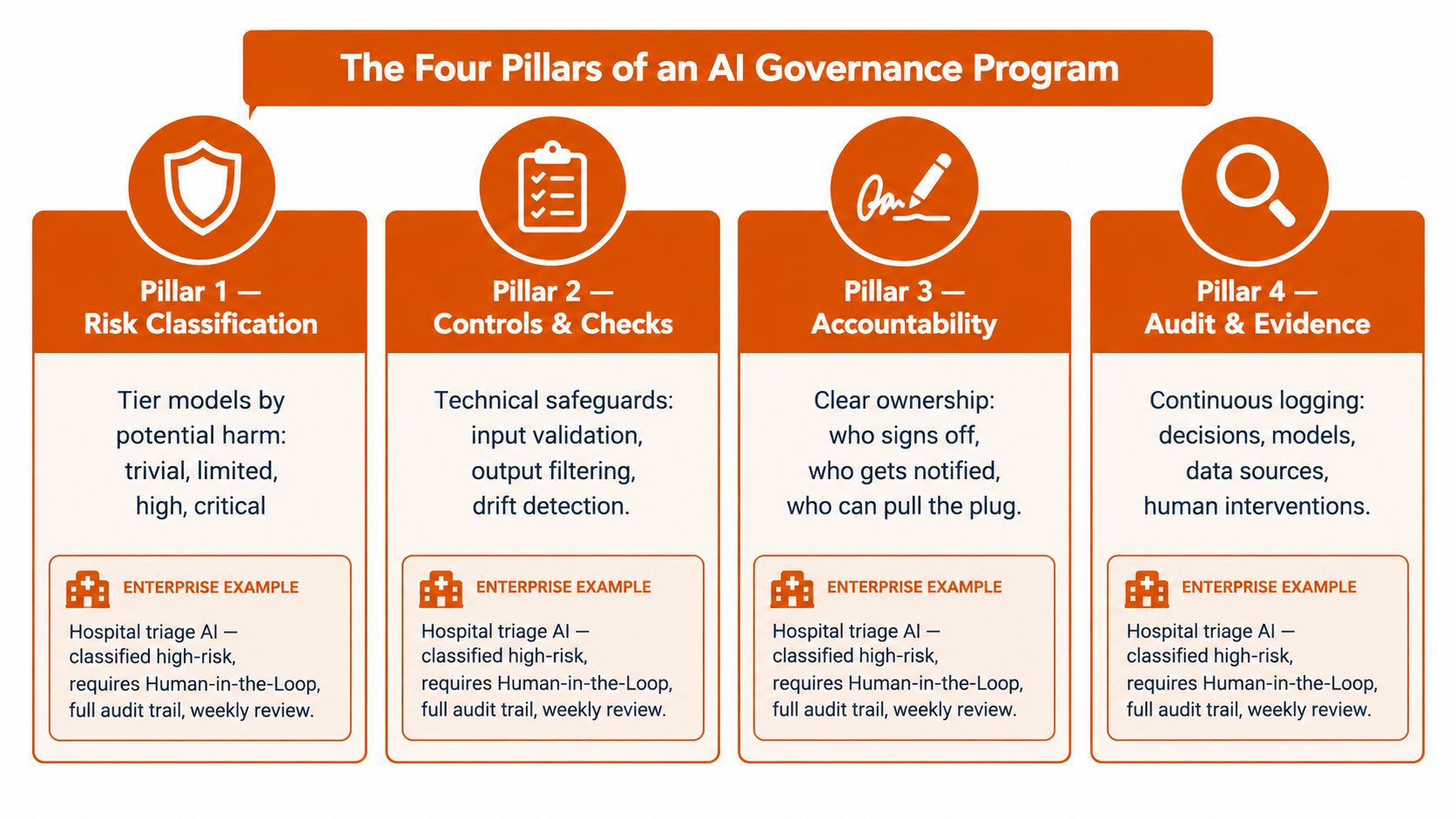
The Four Pillars of an AI Governance Program
A credible program has four connected pillars. Remove one, and the remaining documents become incomplete.
Policy and standards
Start with a tiered acceptable-use policy, not a universal ban or an open-ended permission statement. Exploratory use of a public generative AI tool for drafting internal notes shouldn't follow the same path as a customer-facing agent that retrieves account data or recommends a commercial action.
The policy should define prohibited use, permitted experimentation, required approvals, data handling rules, human oversight, vendor obligations, and escalation. It must also point to the workflow where employees submit a use case. A policy that doesn't tell people what to do next will be bypassed.
Risk assessments and impact evaluations
Risk classification turns abstract principles into a decision. For a credit-scoring model, an algorithmic impact assessment should document the purpose, affected groups, data sources, performance limits, human review, monitoring plan, and remediation path. The assessment should map to applicable model-risk expectations, including SR 11-7, and to EU AI Act high-risk criteria where relevant.
NIST's framework organizes work through GOVERN, MAP, MEASURE, and MANAGE. Its Governance function is cross-cutting and should inform the other three, with policies and procedures that are transparent and implemented in practice, as described by NIST's AI RMF core guidance.
Model and vendor lifecycle management
A registry should cover internally built models, purchased systems, agents, vendors, infrastructure, dependencies, and sanctioned or unsanctioned tools. Each entry needs an owner, purpose, risk tier, data profile, deployment location, approval status, monitoring obligations, and retirement trigger.
Connect those records to the software development lifecycle and procurement workflow. A material model update, new data source, changed business purpose, or vendor change should create a reassessment task rather than relying on memory.
Compliance, audit, and roles
The final pillar makes accountability visible. A RACI should name the business owner, technical owner, legal or compliance reviewer, security reviewer, and executive escalation point. For a material system, the accountable owner should sit high enough in the organization to make tradeoffs and stop deployment.
ISO/IEC 42001 requires organizations to establish, implement, maintain, and continually improve an AI Management System, with identified AI risks documented alongside the controls used to address them, according to ISO's standard overview. The related AI management systems guidance covers leadership, objectives, risk management, lifecycle controls, transparency, performance monitoring, continual improvement, and role definitions.
A quarterly attestation cycle can work when it is tied to evidence, not ceremony. The AI governance documentation playbook should be treated as an operating record, not a library of static templates.
What an Engagement Actually Looks Like
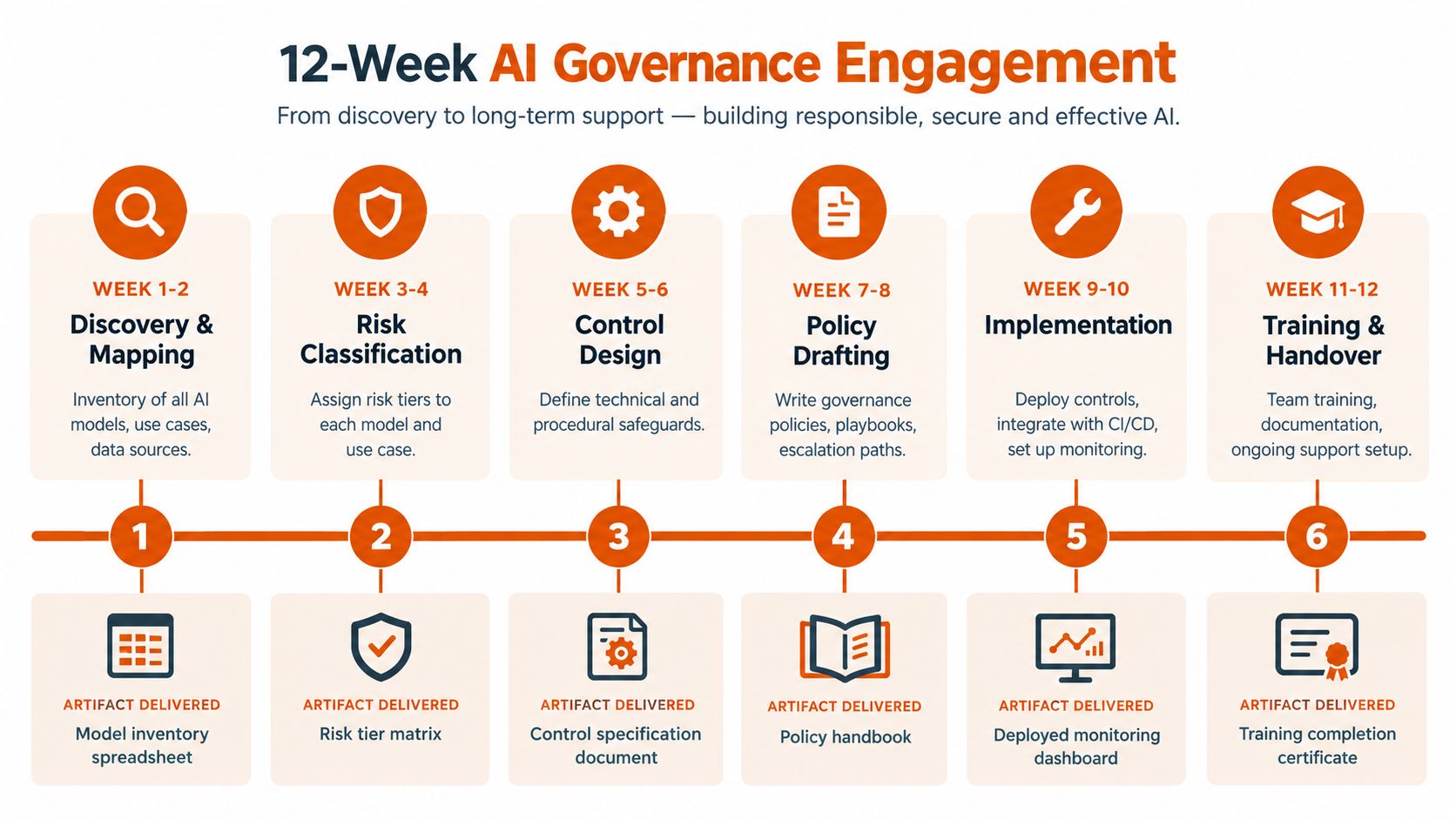
A useful engagement feels like a working partnership from the first week. The consultant interviews product, data, legal, security, procurement, and commercial leaders during weeks 1 and 2, then turns those conversations into an initial inventory of models, agents, vendors, use cases, data sources, and owners.
Weeks 3 and 4 bring the inventory into a risk-tiering workshop. The team doesn't debate every theoretical use case. It identifies the systems touching revenue, sensitive data, customer decisions, security privileges, or regulated activity, then assigns practical review paths.
From design to a live control
During weeks 5 through 7, the team drafts the acceptable-use policy, intake form, risk rubric, approval thresholds, and exception process. By weeks 8 and 9, it defines the operating model, including councils, roles, escalation routes, reporting, and update triggers.
The work becomes real in weeks 10 and 11. The team pilots the gate on one revenue-generating model, reviews evidence, tests escalation, and runs a red-team exercise. A red-team review should expose how the process handles unsafe inputs, unexpected outputs, data leakage, weak human intervention, and an owner who wants to bypass a control.
Week 12 is a handover, not a farewell presentation. Executives should see the operating playbook, current inventory, risk register, decision log, monitoring design, training record, and a 30-60-90 adoption cadence.
A consultant should be able to show the control running on a real use case before calling the engagement complete.
The visible artefacts should arrive at each gate:
- Discovery gate: AI inventory, stakeholder map, and exposure summary.
- Risk gate: Risk-tier matrix, assessment templates, and prioritization record.
- Design gate: Policy, intake form, approval thresholds, RACI, and exception workflow.
- Pilot gate: Completed model record, test evidence, monitoring view, and red-team findings.
- Handover gate: Playbooks, training materials, reporting cadence, and named internal owners.
Choosing the Right Engagement Model
Buy the smallest engagement that can produce a live control, not the smallest engagement that can produce a report.
A diagnostic is appropriate when the board wants a defensible baseline and a prioritized punch list. A build is the right choice when an AI system is already in production and more are queued without a clear approval owner. A retainer or fractional governance leader fits a company where responsibility is shared across two people and ongoing coverage matters. A project sprint makes sense when a specific customer RFP, model audit, or EU AI Act readiness question creates an immediate deadline.
| Engagement Model | Typical Duration | Best-Fit Buyer Signal | Primary Deliverable | Exit Criterion |
|---|---|---|---|---|
| Diagnostic | 6 weeks | “We need a defensible board deck and a punch list in eight weeks.” | Maturity baseline, risk register, and remediation roadmap | Board-ready decision pack with prioritized actions |
| Build | 12 weeks | “We have one AI in production and three more queued, without anyone owning approvals.” | Live governance workflow, inventory, policy, controls, and pilot | One revenue-linked model passes the new gate |
| Retainer or Fractional Head of AI Governance | Ongoing | “Our AI risk function is a shared duty across two people and we need cover.” | Operating cadence, advisory, monitoring, and executive reporting | Internal owner operates the cadence with defined escalation |
| Project-Based Sprint | Scope-defined | “We need EU AI Act readiness or a model audit for a major customer RFP.” | Targeted assessment, evidence pack, or remediation | Required customer or regulatory decision is supported by evidence |
Match scope to sponsorship
The sponsor should match the decision being made. A diagnostic usually belongs with the COO, General Counsel, CIO, or board risk sponsor. A build needs product, data, security, and commercial participation because it changes how teams ship. A retainer needs an executive who will protect the governance owner's time.
Fixed pricing can be useful when scope and exit criteria are clear. Don't accept a fixed-price package that hides the number of systems reviewed, workshops delivered, controls implemented, or pilot requirements. If the engagement ends with a document drop, the price was fixed but the business outcome wasn't.
How to Pick a Firm and Measure ROI
Interview firms as if you're buying an operating capability, not a memo. Ask each candidate to show the intake form, risk assessment, model record, decision log, monitoring design, and executive report they would adapt to your environment. Then ask where those artefacts will live in your existing tools, such as Jira, ServiceNow, OneTrust, Microsoft Purview, a procurement platform, or a model registry.
The firm should demonstrate four things in the room:
- Workflow implementation: It can place controls in product, procurement, change management, and vendor-risk processes.
- Model-level judgment: It can assess a real use case, not merely recite principles.
- Decision-right design: It names who approves, who escalates, and who can stop deployment.
- Sustainable ownership: It leaves update triggers, training, reporting, and an internal owner.
For a broader buying lens, use an AI consulting partner checklist to structure questions about sector experience, delivery capability, and commercial fit. Then apply those questions to a live work sample rather than a polished credentials deck.
A scorecard your steering committee can defend
Run a 60-minute vendor bake-off with the same scenario for every firm. Give each candidate a model or agent description and ask them to classify it, identify missing evidence, define approval rights, and explain what changes would trigger reassessment.
| Criterion | Suggested Weight | Test Question |
|---|---|---|
| Operating-system thinking | 25% | What workflow will enforce the decision? |
| Model-level risk assessment | 20% | Which facts change the risk tier? |
| Implementation capability | 20% | Where will the control run in our existing stack? |
| Ownership and update triggers | 15% | Who owns the record after handover? |
| Sector and regulatory fluency | 10% | Which obligations affect this use case? |
| Commercial clarity | 10% | What is included, excluded, and measured? |
Measure ROI through four outcome families. Revenue enabled includes deals supported by credible AI attestations. Risk avoided includes incidents caught before production, unresolved audit findings, and regulator questions. Cycle time tracks the time from idea to approved deployment. Cost avoided captures duplicate model builds, vendor lock-in, and post-launch rework.
The AI vendor security due diligence checklist can strengthen the procurement side of this scorecard, especially when external tools touch customer or operational data.
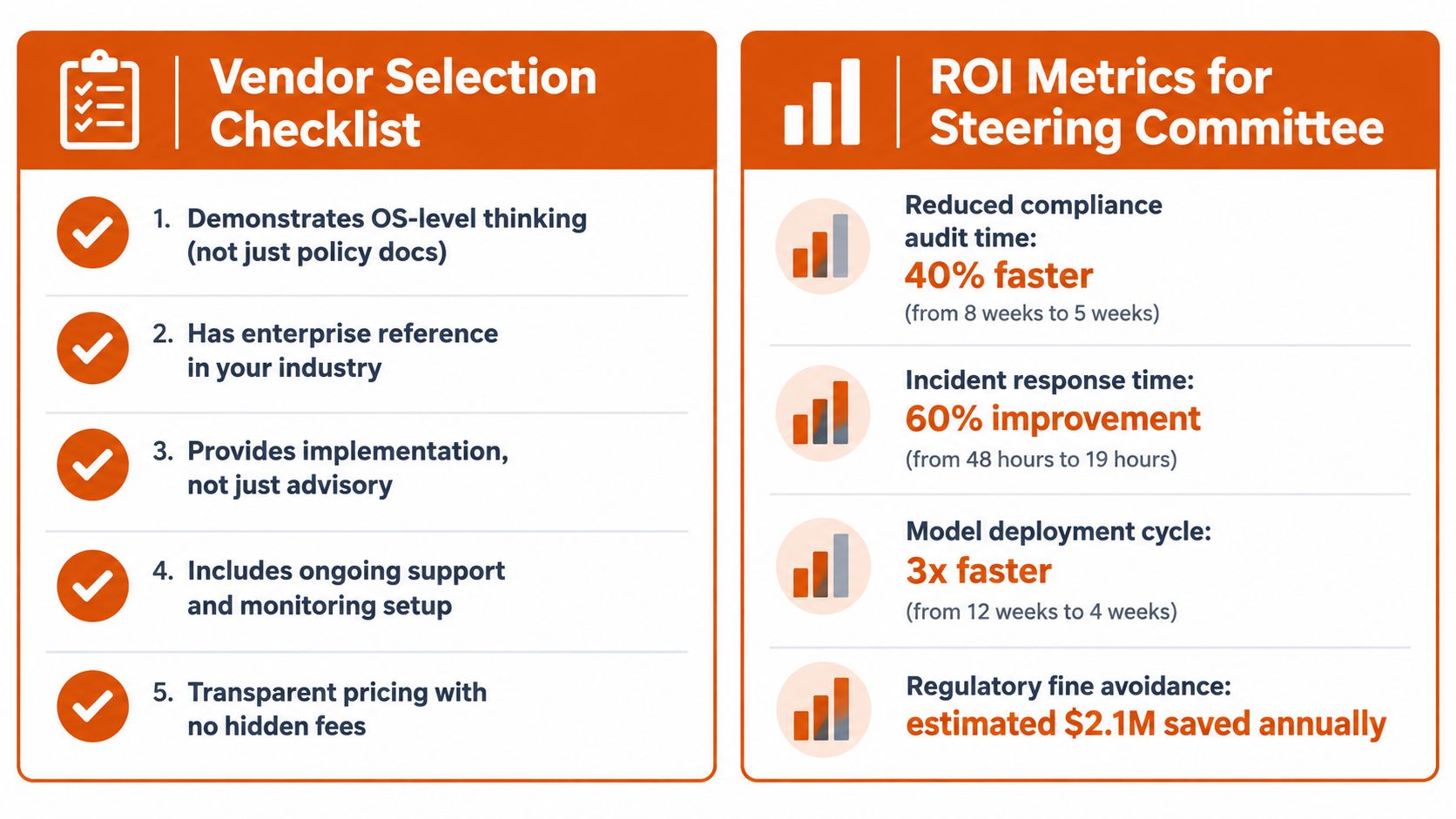
The infographic below contains illustrative metrics that aren't part of the verified evidence for this article. Treat it as a visual prompt, not as a benchmark or forecast.
Real-World Examples From Mid-Market Operators
Consider a 240-employee precision parts manufacturer with a computer-vision defect system stalled between pilot and production. The trigger was simple: the plant could not place the model on the line without a clear answer about who owned false negatives, how operators could challenge outputs, and what evidence the steering committee would review.
The team introduced a model intake gate before production approval. The key artefact was a one-page decision record that translated model purpose, data sources, operator intervention, failure modes, and escalation into language a non-technical committee could use. The manufacturer reached a 14-week production rollout because risk review ran in parallel with data work instead of starting after technical development.
The second vignette involves a community bank with $1.8 billion in assets. Its trigger was a vendor model update from a core provider. The bank connected its vendor model inventory to a quarterly trigger schedule, requiring review when the provider changed the scoring logic or supporting data.
The steering committee received a model-change record showing the old and new purpose, affected underwriting decisions, ownership, testing evidence, and approval status. That record made the decision legible before the update cleared underwriting and helped the bank avoid a fair-lending write-up.
These are anonymized operating examples, not general performance claims. Their common pattern matters more than the sectors. Each company started with one revenue path, chose an artefact that made responsibility visible, and expanded only after the control worked in production.
Governance gains credibility when the first pilot helps a team ship safely, rather than when the first committee approves another policy.
The lesson for a mid-market buyer is to resist the enterprise-wide rollout instinct. Inventory the systems that affect revenue first. Put one gate in front of one material use case. Measure whether the process catches issues, clarifies ownership, and preserves a workable path to deployment.
Your 90-Day Next Step and a Practical Starting Point
A 90-day starter path should produce a live operating cadence, not a complete governance universe.
During weeks 1 and 2, inventory every model, agent, vendor tool, and automated decision touching a revenue path. Name one accountable owner for each use case. Don't accept a department as the owner. A department can't approve an exception at 4 p.m. on a launch day. A person can.
During weeks 3 through 6, create three simple artefacts: a one-page intake gate, a risk-tier rubric, and a decision log connected to existing change control. Use the smallest workable classification model. Add complexity only when a real use case proves that the current path can't distinguish between low-impact experimentation and material customer risk.
Pilot the decision, then tune the system
Weeks 7 through 10 should focus on the highest-priority model. Run the intake, complete the assessment, assign reviewers, record the decision, and test the escalation path. Instrument the measures that executives can act on:
- Review cycle time: How long does a complete decision take?
- Models shipped per quarter: Does governance support delivery rather than freeze it?
- Incidents caught pre-production: Which issues did the control identify early?
- Update triggers: Did a model, vendor, data source, or purpose change create the right reassessment?
In weeks 11 and 12, retire controls that create paperwork without reducing exposure. Keep the controls that clarify ownership, preserve evidence, and help teams make faster decisions. Publish the operating cadence, including review frequency, reporting recipients, trigger conditions, and escalation authority.
This is the practical impact opportunity. A mid-market company doesn't need to imitate a large enterprise's committee structure before it has identified its own AI inventory. It needs a small, enforceable system that protects a revenue path and can expand as adoption grows.
Prometheus Agency's complimentary Growth Audit conversation can pressure-test this 90-day plan against your actual pipeline, regulatory exposure, existing CRM and GTM workflows, and team capacity. Bring one live AI use case and one upcoming deployment, then leave with a decision about what should be governed first.
Prometheus Agency helps growth leaders connect AI enablement, CRM implementation, GTM strategy, process design, and accountability controls into practical revenue systems. Visit Prometheus Agency to start a Growth Audit and AI strategy conversation before your next board meeting.