An effective AI Center of Excellence setup is what separates the AI dabblers from the AI masters. It’s the difference between running a few scattered, interesting experiments and building a unified, value-generating program that actually moves the needle. Think of it as the central hub for your entire AI strategy, a place that standardizes best practices, manages risk, and ensures every single initiative aligns with your core business goals. This is how you escape 'pilot purgatory' for good.
Key Takeaways
- An AI Center of Excellence (CoE) transforms scattered AI experiments into a unified, value-generating program aligned with business goals.
- The core components of a CoE include Governance, Talent, Technology, and a clear focus on demonstrating ROI.
- Choosing the right operating model (Centralized, Decentralized, or Federated) is critical and depends on company culture and AI maturity. The federated model is often the most effective.
- A cross-functional team with roles like Head of AI, Product Manager, and MLOps Engineer is essential for success.
- Scaling from pilot to enterprise-wide adoption requires a phased rollout and a strong change management plan to ensure user trust and buy-in.
Building Your Foundation for AI Success
Many organizations get excited about artificial intelligence, but their efforts quickly splinter. The marketing team buys one tool, sales pilots another, and engineering is building something else entirely in a silo. You end up with redundant spending, conflicting data strategies, and a graveyard of promising pilots that never deliver real, enterprise-wide impact.
This is exactly where an AI Center of Excellence (CoE) comes in.
An AI CoE isn't just another box on the org chart; it’s the central nervous system for your AI strategy. Its job is to provide the structure, expertise, and governance needed to knit those standalone AI projects into a cohesive, scalable program that drives measurable business outcomes. Without this foundation, even the most brilliant AI models are little more than expensive science experiments.
From Scattered Pilots to Strategic Impact
To really understand the power of a CoE, you have to appreciate the bigger picture of how to use AI in business effectively. The CoE is the bridge connecting high-level strategy to on-the-ground execution.
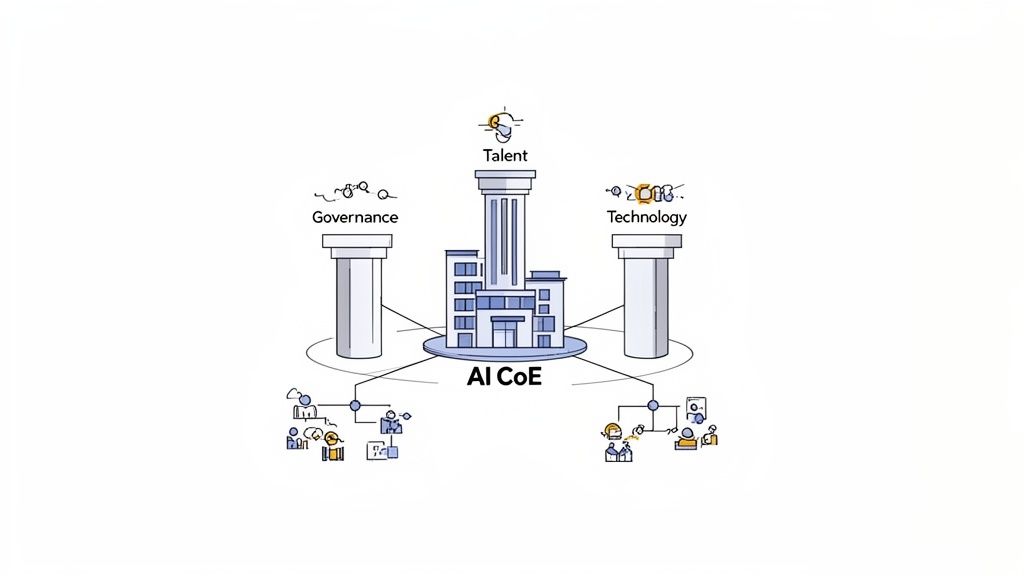
The table below breaks down the core components that make a CoE truly effective. It’s a great quick-reference guide to keep handy as you start mapping out your own structure.
The Core Components of a High-Impact AI CoE
| Pillar | Core Objective | Key Activities |
|---|---|---|
| Governance & Risk | Establish the "rules of the road" for AI. | Define data usage policies, ensure model transparency, and manage ethical considerations. |
| Talent & Competencies | Build and nurture AI expertise across the organization. | Identify skill gaps, create training programs, and build a data-literate culture. |
| Tech & Infrastructure | Provide the right tools and platforms for the job. | Select, manage, and standardize the AI tech stack to support development and deployment. |
| Value & ROI | Ensure AI initiatives deliver tangible business results. | Define success metrics, track performance, and communicate value back to stakeholders. |
This structured approach is designed to prevent the chaos of uncoordinated efforts.
Practical Example: A retail company centralized its disparate AI projects under a new CoE. Previously, both the marketing and e-commerce teams were using separate, expensive tools to build customer propensity models. By unifying under the CoE, they eliminated redundant software licenses and created a single, more accurate customer behavior model, resulting in a 30% reduction in tool spending and a 15% lift in campaign conversion rates within the first year.
Why a Centralized Hub Matters Now More Than Ever
The AI wave is here, and it’s big. A recent survey showed that a staggering 78% of organizations now use AI in at least one business function, a huge jump from 55% just the year before. But without a CoE, that rapid growth can create more problems than it solves.
Impact Opportunity: Mature organizations with strong CoEs report up to a 20% increase in profit margins compared to those still stuck with a scattered approach. The hub provides the focus and discipline needed to turn potential into profit by standardizing technology, reducing duplicated effort, and ensuring every project is directly tied to a key business performance indicator.
Key Takeaway: An AI CoE acts as the blueprint for scalable innovation. It ensures every AI initiative—from a small departmental pilot to an enterprise-wide system—is built on a solid foundation of strategic alignment, strong governance, and clear business value.
This centralization is also critical for building momentum and securing long-term executive buy-in. To get a better sense of where your organization stands, it's worth exploring frameworks that can measure your team's overall AI Quotient.
Choosing Your CoE Operating Model and Governance
Once you've got executive buy-in, you’ve hit a huge milestone. But now comes the real architectural work: designing the structure of your AI Center of Excellence. This isn't a copy-paste job. The right operating model and governance framework have to sync up with your company’s size, culture, and where you currently stand with AI.
Get this part wrong, and you could accidentally build a bottleneck that suffocates innovation or, just as bad, create a free-for-all that descends into chaos.
The biggest decision you'll make here is how centralized your AI efforts should be. This choice cascades down, defining how expertise is shared, how projects get the green light, and who's ultimately on the hook for the results. There are really three main ways to slice it.
Centralized Model for Speed and Control
In a centralized model, one core team holds all the keys to the AI kingdom. They own the strategy, the resources, and the execution for the entire company, acting as the single source for AI services.
Practical Example: A 150-person tech startup uses a centralized model. A single, five-person AI team handles all requests, from building a new recommendation engine for the product to creating a lead scoring model for the sales team. This ensures consistent standards and rapid initial development but can become a bottleneck as the company grows.
Decentralized Model for Autonomy
On the complete other end of the spectrum is the decentralized model. Here, individual business units or departments have free rein to build out their own AI capabilities. Each one controls its own budget, hires its own people, and runs its own projects.
Practical Example: A massive global conglomerate allows its consumer goods division in Europe and its financial services division in Asia to operate independent AI teams. This builds domain-specific innovation, but they risk using incompatible technologies and duplicating efforts on common problems like fraud detection.
The Hybrid Federated Model
For most growing companies and large enterprises, the sweet spot is the federated (or hub-and-spoke) model. It’s the best of both worlds, pairing a central "hub" with enabled "spokes" that live inside the business units.
- The Hub: This is your central CoE team. Their job is to set the guardrails—enterprise-wide standards, governance policies, and managing the core tech stack. They also nurture the community, making sure everyone is learning and sharing.
- The Spokes: These are smaller teams or even single experts embedded in departments like marketing or finance. They live and breathe the business context. They use the hub's resources to build AI solutions that solve their specific problems.
Practical Example: A global financial services firm uses a federated model. The central "hub" establishes ironclad data privacy and risk protocols to stay compliant with regulations like GDPR. At the same time, "spokes" in the North American wealth management and Asian retail banking divisions can independently develop custom fraud detection models tuned to local market behaviors—all built on the same approved, secure infrastructure provided by the hub.
Impact Opportunity: The federated model gives you that perfect balance between centralized control and decentralized execution. It lets business units own their problems and solve them with AI, all while making sure every project meets enterprise standards for quality, security, and ethics. This accelerates innovation without sacrificing strategic oversight.
Establishing strong AI Governance
No matter which model you land on, a rock-solid governance framework is non-negotiable. This is your rulebook. It’s what ensures your AI work is responsible, ethical, and doesn’t land you in legal hot water.
For any B2B leader with global operations, these hubs are a defense against fragmentation. Disjointed AI efforts can lead to serious regulatory and risk headaches. A CoE standardizes everything from ethics and bias mitigation to the metrics you use to measure success, which ultimately drives profit.
With major regulations like the EU AI Act (enforceable from 2026), GDPR, and HIPAA already in play, strong governance isn't a "nice to have"—it's essential for building AI that can scale.
To really nail this, you need to go deep on the essentials. Explore these AI governance best practices to make sure you're building a responsible foundation from day one. This is how you create a framework that fuels innovation without losing strategic control.
Assembling Your AI CoE Dream Team
An AI Center of Excellence is built on people, not just platforms. You can have the most sophisticated tech stack in the world, but without the right cross-functional team, it’s just expensive shelfware. Your team is the engine, the critical link that translates big strategic goals into real-world AI solutions that actually work.
Building this "dream team" isn't about just hiring a bunch of data scientists. A truly effective CoE needs a careful balance of skills to manage the entire AI lifecycle—from brainstorming and ethical reviews all the way to deployment and making sure the models don't go haywire a month later.
The structure of this team often depends on the operating model you choose. The model you pick will dictate how centralized or decentralized your AI efforts are.
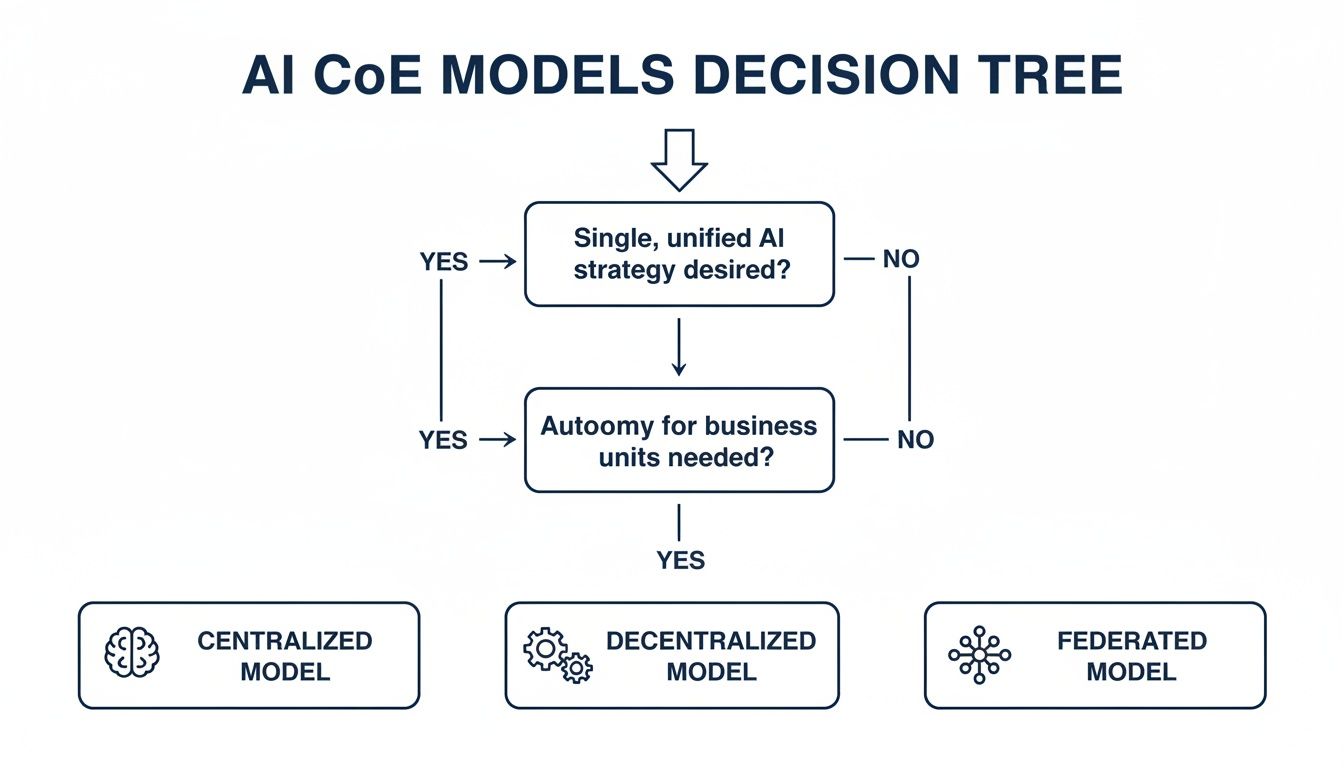
As you can see, the choice between centralized, decentralized, or federated models really comes down to control versus autonomy. The federated model—a hybrid approach—often hits the sweet spot. It allows you to scale innovation across the business while keeping a firm grip on quality and standards.
Core Roles Your AI CoE Cannot Live Without
To get your AI initiatives off the ground, you need a mix of strategists, tech gurus, and operational wizards. In smaller companies, one person might wear a few of these hats, but you absolutely have to have these functions covered.
Head of AI: This is your visionary, your champion. They’re the ones getting executive buy-in, writing the CoE's charter, and making sure every project actually ties back to company objectives. They think less about code and more about business value and ROI.
AI Product Manager: This role is the glue between the business folks and the tech team. They take a vague business need, like "we need to find better sales leads," and turn it into a concrete project, like building a predictive lead scoring model. Absolutely critical.
AI Ethicist / Governance Lead: With regulations tightening everywhere, this role is no longer a "nice to have." It's a necessity. This person sets the guardrails for responsible AI, runs bias audits, and ensures your models are fair, transparent, and compliant with laws like GDPR.
MLOps Engineer: Think of the MLOps engineer as the backbone of your production AI. They’re the ones building the automated pipelines that deploy, monitor, and retrain models in the wild, making sure they stay reliable and accurate over time.
For any executive in this space, learning how to spot and develop these skills is paramount. It’s about building a new generation of AI-enabled leaders who can navigate this new terrain.
Key Takeaway: Your CoE team isn't just a collection of individuals; it's a balanced portfolio of skills. You need the visionaries who see the business potential, the tech experts who can build it, and the operational specialists who make sure it all runs smoothly and responsibly.
Sourcing Your Talent: The Internal vs. External Debate
One of the first questions I always get is: should we build, buy, or borrow our AI talent? The truth is, the most sustainable path is usually a mix of all three.
Start by looking inward. You likely have high-potential people with deep institutional knowledge just waiting for an opportunity. Practical Example: That marketing analyst who knows your customer data inside and out? They are an ideal candidate to upskill. Training them in data science is often faster and more effective than hiring an external expert who has to learn your entire business from scratch.
A simple competency matrix is a great tool for this.
| Competency | Current Skill Level (1-5) | Target Skill Level (1-5) | Development Action |
|---|---|---|---|
| Business Acumen | 4 | 5 | Pair with business unit leaders on a project |
| Python/R Programming | 2 | 4 | Enroll in an advanced coding bootcamp |
| MLOps Principles | 1 | 3 | Shadow the MLOps engineer on the pilot project |
| AI Ethics & Governance | 2 | 4 | Complete a certification on responsible AI |
This kind of matrix makes it easy to spot the gaps and create a real plan to fill them. For those super-specialized roles, like a seasoned MLOps engineer, you might need to hire externally or bring in a consultant to get moving quickly while your internal team ramps up.
The end goal is to create a self-sustaining talent pipeline that will power your AI CoE for years to come.
How to Execute High-Impact AI Pilots
So, you’ve got your team and a governance plan. Now for the fun part: delivering real value. The fastest way to show your AI Center of Excellence isn't just another line item on the budget is to nail a high-impact pilot project.
A solid win here builds momentum like nothing else. It proves the concept, demonstrates ROI, and gives you the political capital to go after bigger things.
The mission is to score a quick, decisive victory. Don't try to boil the ocean. You're looking for that sweet spot where a strategic business need meets an achievable technical scope—something that matters but won't get stuck in development hell for six months.
Selecting the Right Use Case
Picking your first pilot is more art than science, but it’s a critical decision. It's easy to get distracted by the most technically interesting project, but that's a classic mistake. Instead, hunt for something that solves a genuine, painful business problem. This ensures your CoE is seen as a value-driver from day one, not a science fair project.
A great pilot candidate has a few things going for it:
- A Clear Business Pain: It should tackle a well-known headache, like painfully slow lead follow-up or sky-high customer service costs.
- Ready-to-Go Data: You need clean, relevant data to work with. The best pilots use data sources you're already collecting.
- A Measurable Outcome: You have to be able to quantify the impact. This is non-negotiable for building a business case.
This focused approach is a pillar of a successful AI Center of Excellence setup. Practical Example: A B2B software company might be tempted to build a complex market prediction model. A much smarter first move would be an in-CRM lead scoring model that helps the sales team prioritize their day. It uses existing data, solves a clear pain point (which leads to follow up on?), and its impact is easily measured in conversion rates and sales cycle time.
Defining Success Beyond Technical Metrics
Teams often get fixated on technical success, like model accuracy. A 95% accuracy rate sounds great in a lab, but it means absolutely nothing to your CFO if it doesn’t move a business needle. Your stakeholders care about impact, not algorithms.
You have to shift the conversation from technical jargon to business KPIs.
Impact Opportunity: Stop reporting on model precision. Start reporting on the business outcomes it creates. "Our new AI model cut customer service response times by 15%" is infinitely more powerful than "Our model's F1-score is 0.92." The first statement gets you more funding; the second gets you blank stares.
Draft a pilot plan that clearly defines what success looks like in business terms. It needs to cover the scope, timeline, who's doing what, and—crucially—a risk mitigation plan. What's the backup if the data is dirtier than you thought? What if a key stakeholder pushes back on the new process? Thinking through this stuff upfront is what separates the pros from the amateurs.
Measuring and Communicating ROI
With the pilot live, it’s time to measure its impact against those KPIs you defined earlier. Gather the data, but don't just present a spreadsheet. You need to build a compelling story around the results—a narrative that showcases the CoE's value and makes future investment a no-brainer.
Keep your ROI story simple, clear, and laser-focused on business results. For a sales pilot, your report card could look something like this:
| Metric | Before AI Pilot | After AI Pilot | Business Impact |
|---|---|---|---|
| Lead-to-Appointment Time | 72 hours | 12 hours | 83% Faster Sales Cycle |
| Qualified Leads per Rep | 15 per week | 25 per week | 67% Increase in Sales Pipeline |
| Manual Data Entry Time | 4 hours/week | 1 hour/week | Frees up reps for actual selling |
This kind of data-driven storytelling is irrefutable. It turns your pilot from a tech experiment into a strategic business win. It's the proof you need to walk back into the boardroom and say, "This worked. Here’s the data. Now, let's scale it."
This focus on delivering tangible results is everything. For companies looking to fast-track their progress, a structured program can provide the frameworks and expertise to turn these early wins into an enterprise-wide transformation. Learn more about how to get started with AI enablement and build on your success.
Scaling AI Initiatives Across the Enterprise
Getting a pilot program off the ground feels great, but moving from a successful experiment to an enterprise-wide solution is where the real work—and the real transformation—begins. This is the moment your AI Center of Excellence proves its worth, taking an isolated win and embedding it into the very fabric of how your business operates. To pull this off, you need a smart, two-pronged strategy: one part focused on the tech, the other on the people.
It’s a deceptively tricky transition. While tons of organizations are dipping their toes in the AI waters, most get stuck in the pilot phase. In fact, while 88% of businesses say they use AI in some capacity, only about a third have actually managed to scale those initiatives. That’s a massive amount of value left on the table. If you want to dig into the numbers, McKinsey has some great insights on the state of AI.
The data tells a clear story: the companies that succeed are the ones with a plan. High-performing organizations are 52% more likely to have documented scaling processes than their peers. This isn't about bureaucracy; it's about being disciplined and methodical.
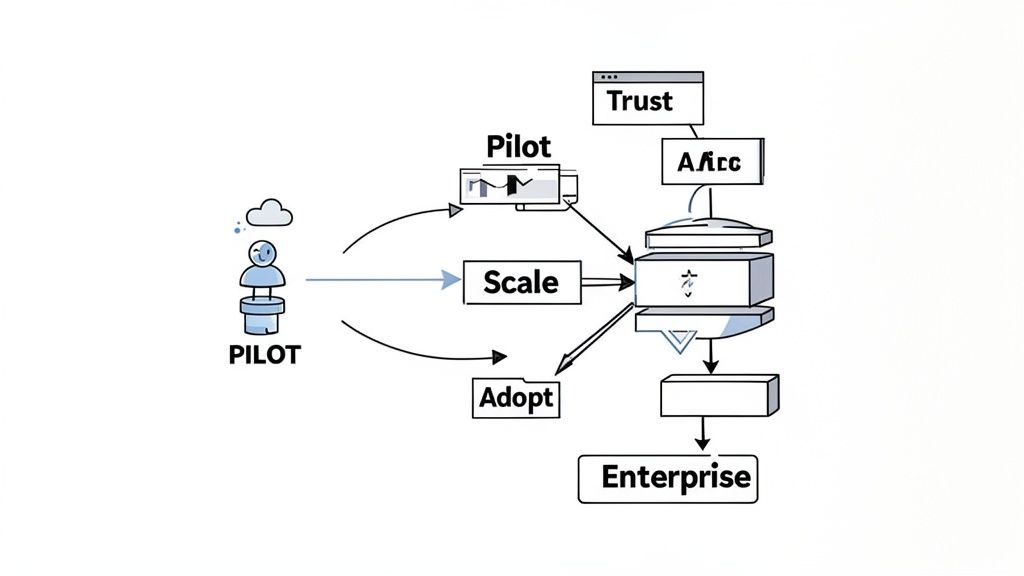
Building a Phased Rollout Plan
Trying to go from zero to one hundred with a "big bang" launch is a classic recipe for failure. You're just asking for chaos. A phased rollout is the only sane way to go. It breaks the deployment into manageable chunks, minimizes disruption, lets you learn as you go, and builds positive momentum.
Your plan needs to clearly map out the expansion from your initial pilot group to the rest of the company. Think in waves:
- Wave 1 (The Allies): Start with a department or team that’s genuinely excited about the tech. These early adopters will be your friendly test group, helping you work out the kinks and becoming your first internal success story.
- Wave 2 (The Impact Zone): Next, target the business units where the AI solution will deliver the biggest, most obvious wins. This is where you solidify the business case and get executive attention.
- Wave 3 (The Full Rollout): With a proven model and lessons learned, you can now push the solution out across the rest of the organization.
Engineering Trust Through Change Management
Let’s be honest: the biggest hurdle to scaling AI is almost never the technology. It’s the people. Resistance to change is a powerful force, and when you add in fears about job security and a general distrust of "black box" algorithms, you have a perfect storm that can sink even the most brilliant initiative. Your change management plan has to tackle these human factors head-on.
Practical Example: A sales team is refusing to use a new AI-powered lead scoring tool. They don't trust its recommendations and are worried it's going to dictate how they do their jobs. Instead of forcing it on them, the AI CoE could build a simple dashboard that shows why a lead was scored as "hot"—listing the exact data points like recent website visits, email clicks, or specific job titles. Suddenly, the AI isn't a mysterious oracle; it's a helpful co-pilot, and trust begins to build.
Key Takeaway: Scaling AI is as much about managing perceptions as it is about managing data pipelines. The only way to truly embed AI into your organization’s DNA is with a change management plan built on transparency and clear communication.
To make this happen, your plan needs a few core components:
- Communicate the "Why": Don't just announce the change. Explain why it's happening and what's in it for everyone. Frame it around how it will make their jobs easier or more effective, not how it will replace them.
- Targeted Training: One-size-fits-all training doesn't work. Executives need a high-level overview of the strategic impact. Frontline users need hands-on workshops to master the day-to-day workflow.
- Find Your Champions: Identify and enable "AI champions" in each department. These are the respected team members who get it. They can advocate for the tool, answer questions, and provide that crucial on-the-ground support.
The Technical Backbone of Scaling
While the people side is critical, your technical foundation has to be rock-solid. This is where MLOps (Machine Learning Operations) becomes non-negotiable. MLOps brings the discipline and automation you need to reliably manage AI models in a live production environment. We're talking about continuous monitoring for performance issues, automated retraining pipelines, and proper version control for both models and data.
Impact Opportunity: A mature AI CoE doesn't reinvent the wheel every time. It builds a library of reusable AI components—things like pre-approved data connectors, feature engineering scripts, and model architectures. When a new project kicks off, teams can pull from this library instead of starting from scratch. This approach drastically accelerates future development by up to 50% and creates a powerful compounding effect on your company's AI capabilities.
Answering the Tough Questions on AI Center of Excellence Setup
Even with a solid plan, kicking off an AI Center of Excellence can feel like a massive undertaking. It's only natural for executives and team leads to have some pointed questions about what it really takes to get one up and running.
Let's cut through the noise and tackle the most common questions. My goal is to give you clear, practical answers to help you move forward with confidence.
How Long Does It Take to Set Up a Functional AI CoE?
There's no single answer here, but what doesn't work is a "big bang" launch. Trying to do everything at once is a recipe for disaster. The smart play is a phased approach that focuses on racking up small, meaningful wins along the way.
This kind of incremental rollout lets you prove value early, build momentum, and fine-tune your strategy based on what’s actually working.
Here’s a realistic timeline you can work with:
- First 90 Days: This is all about laying the groundwork. Your top priorities are securing committed executive sponsorship, drafting a CoE charter that clearly defines your mission, and, most importantly, identifying a pilot project with high impact and low complexity.
- By 180 Days: You should have your core team hired and a basic governance framework in place. Your first pilot needs to be deep in execution, already spinning off data and early lessons learned.
- Within 12 to 18 Months: This is the window for a fully mature CoE. By now, it should be the central nervous system for multiple AI initiatives, running company-wide training, and curating a library of reusable AI models and components.
Think evolution, not revolution. Each phase builds on the last, creating a durable structure that scales as your organization’s AI muscle grows.
What Are the Biggest Mistakes to Avoid When Building an AI CoE?
Knowing what not to do is just as critical as having a good plan. I’ve seen too many well-intentioned CoEs stumble over the same predictable hurdles. Sidestepping these common traps is crucial for your long-term success.
Here are the big ones to watch out for:
- Chasing tech instead of solving business problems. Your CoE can't be a science fair project. It has to be laser-focused on value. Every single project needs to answer the "so what?" question with a clear line back to a strategic business goal.
- Skimping on change management. It’s one thing to deploy a cool new AI tool. It’s another thing entirely to get people to actually use it, trust it, and make it part of their daily routine. If you ignore the human element, your adoption rates will plummet.
- Working in a silo. If your CoE becomes an "ivory tower" or a bureaucratic gatekeeper, it will quickly become irrelevant. It must be embedded within the business units, acting as a partner and an enabler, not a bottleneck.
- Putting governance and ethics on the back burner. In the mad dash to innovate, it's easy to say, "we'll figure out governance later." This is a huge mistake that can open you up to massive reputational, legal, and customer trust issues down the road.
How Do We Measure the ROI of an AI CoE?
You absolutely have to prove the value of your CoE to keep the budget and executive buy-in flowing. The most effective way to do this is to build a multi-layered ROI story that captures its full impact.
Key Takeaway: A convincing ROI case for your CoE isn't just about one project's return. It's a combination of direct financial gains, metrics showing you're building organizational AI capability, and the new strategic doors you're opening.
You need to track performance across three layers:
- Direct Project Impact: This is the easy one. Measure the hard numbers from your AI projects—things like increased revenue from smarter lead scoring, cost savings from automating back-office tasks, or faster production cycles.
- CoE Enablement Value: This is about measuring how the CoE makes the whole organization better at AI. Are you deploying models faster? Are you reducing redundant spending on AI tools? Are more projects moving from pilot to production? These are the metrics to watch.
- Strategic Business Value: This is the big-picture stuff. Here, you track the new capabilities AI has unlocked. Did you enter a new market? Launch a hyper-personalized product line? Create a competitive moat that's hard for others to cross?
Should We Build Our CoE Team Internally or Outsource?
For most companies, a hybrid approach is the sweet spot. You get the best of both worlds: the deep institutional knowledge of an internal team blended with the specialized expertise and speed of an external partner.
It's non-negotiable to build a core internal team that lives and breathes your business context, culture, and strategic goals. This group owns the AI strategy for the long haul. But let's be realistic—finding a seasoned MLOps engineer or an AI ethicist with deep regulatory knowledge is tough and takes time.
Impact Opportunity: Bringing in a specialized firm can be a massive accelerator. You get instant access to top-tier talent and battle-tested frameworks. This lets you score those critical early wins and build momentum while you thoughtfully upskill your own people for the long run. It's the fastest way to get value while minimizing risk, potentially cutting your time-to-value for the first AI pilot by 4-6 months.
At Prometheus Agency, we partner with growth leaders to transform their AI ambitions into scalable revenue systems. Our hands-on approach combines AI enablement with deep CRM and GTM expertise, ensuring every initiative is tied to real business outcomes. If you're ready to move from pilots to enterprise-wide impact, let's build your AI roadmap together.