The most important AI agent news in 2026 isn't a model launch. It's the trust gap. Only 23% of organizations are scaling an agentic AI system in at least one business function, while 39% are still experimenting, according to McKinsey's State of AI research. The market is moving quickly, but production confidence isn't keeping pace.
That gap matters for B2B leaders. An agent that produces an impressive demo but can't respect permissions, explain decisions, or recover from an exception isn't a revenue system. It's an unowned operational risk. The useful question in current AI agent news is no longer whether agents can act. It's where they should act, how you evaluate them, and who remains accountable when they fail.
The State of AI Agent News in 2026
Forecasts show why AI agent news focuses so heavily on launches and adoption. One industry summary values the market at USD 7.84 billion in 2025 and projects USD 52.62 billion by 2030, implying a 46.3% CAGR. Other forecasts place 2026 market value near USD 10.9 billion and estimate a long-run value as high as USD 182.97 billion by 2033, as summarized in AI agent market statistics.
The commercial signal is strong, but market growth does not make every workflow suitable for autonomous execution. Gartner-cited estimates say 40% of enterprise applications will include task-specific AI agents by the end of 2026, up from less than 5% in 2025. The figure points to broad software adoption, not proven reliability in every business process.
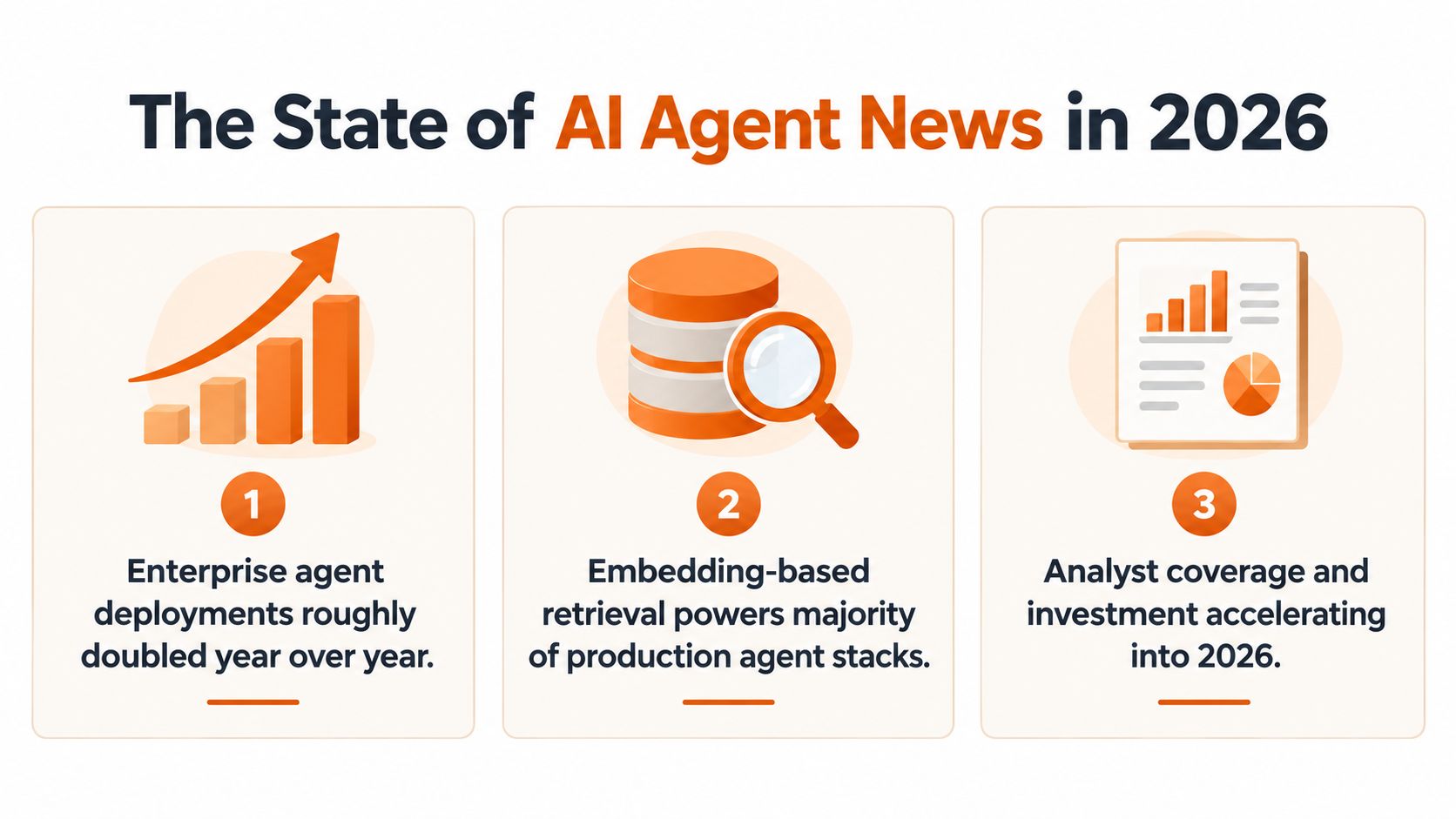
Agents can now retrieve context, reason through steps, call tools, and complete bounded workflows well enough to produce commercial value. The constraint has shifted from capability to control. B2B teams need evidence that an agent follows permissions, produces repeatable outcomes, and stops or escalates when conditions fall outside its design.
The New Operating Standard
Grade agents on more than answer quality. Production readiness requires controlled rollout, traceable actions, measurable workflow lift, and a clear escalation path. Start with a narrow process, define failure conditions, and measure the work the agent improves before expanding its authority.
The best AI agent examples for business are not necessarily the most autonomous. They improve a defined GTM motion without creating an audit problem. A support agent that safely resolves routine requests can create more value than a general-purpose agent that attempts everything and leaves managers to inspect every action.
2026 is the governance year. Vendors will keep announcing stronger capabilities. B2B leaders should decide where agents earn trust, where human review remains required, and where deployment should wait.
What an AI Agent Actually Does
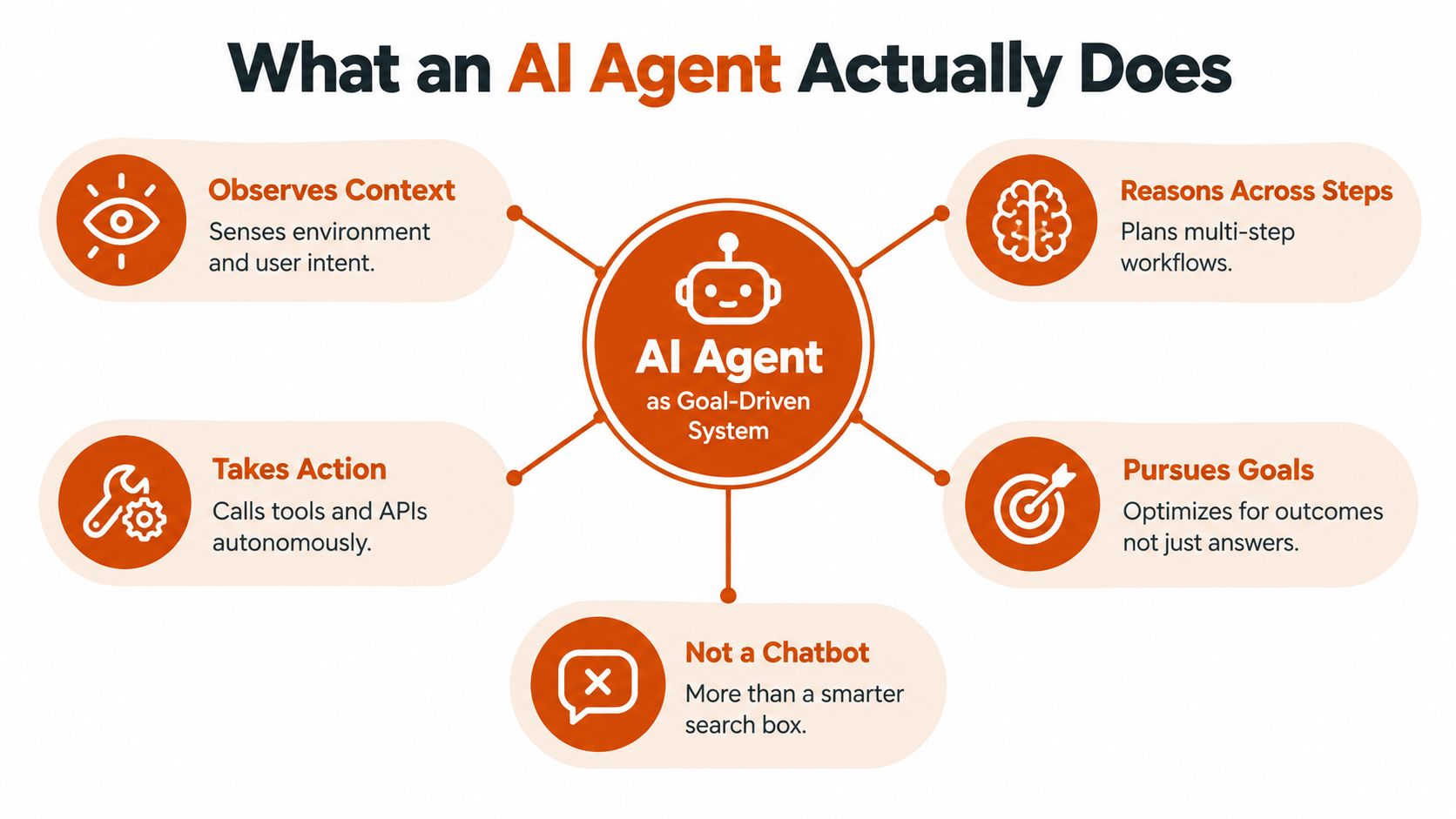
An AI agent isn't a smarter search box, and it isn't a chatbot with a more engaging personality. Think of it as a sensei for a defined business objective. It observes the situation, chooses a path, uses the available tools, checks its work, and keeps moving until it reaches a useful stopping point or hands the task to a person.
The first layer is perception. The agent reads a support ticket, CRM record, contract, call transcript, or customer message and identifies the relevant context. Without reliable inputs, every later step is compromised.
The second layer is planning. Instead of answering one prompt, the agent breaks an objective into actions. For an account brief, that might mean finding firmographic data, reviewing recent interactions, identifying open opportunities, and summarising buying signals.
Five layers that create agency
- Perception: It interprets user intent and operational data.
- Planning: It decomposes a goal into sequenced tasks.
- Execution: It calls APIs, searches records, updates systems, or drafts an action.
- Memory: It carries relevant state across sessions and workflow steps.
- Reflection: It checks whether the result meets the objective and revises or escalates when it doesn't.
A copilot usually proposes the next move. Traditional automation follows a predetermined path. An agent can choose the next action based on the state it observes, which gives it flexibility but also creates a larger control surface.
Practical rule: Call a system an agent only when it can complete a multi-step task inside your stack, with a human involved at the edges rather than approving every keystroke.
That threshold prevents inflated vendor claims from distorting buying decisions. If the system only drafts text, label it a drafting assistant. If it selects tools, acts in systems, and manages exceptions within defined authority, it has crossed into agent territory.
For a business-focused explanation, what an AI agent means in a business context is a useful distinction to make before comparing products.
Major Announcements and Trends Shaping 2026
The important developments aren't isolated launches. They show that the category is becoming a software layer with its own runtimes, protocols, memory systems, and control mechanisms.
Frontier models are increasingly paired with native agent runtimes. That combination improves the economics of always-on work, especially for inbound qualification, support triage, and research. Lower reasoning cost can make continuous assistance viable, but it doesn't remove the need to define what the agent may do.
Agent-to-agent communication standards are also changing build-versus-buy decisions. If systems can exchange tasks and results through common protocols, a company may not need one monolithic platform. It can assemble specialised agents, provided identity, permissions, and accountability remain consistent across the chain.
Retrieval is advancing. Embedding-based search helps agents find semantically related information, while graph structures preserve relationships among accounts, people, products, and policies. Better long-context memory can improve deal qualification, but only if the underlying CRM data is accurate and access rules are enforced.
Signals that matter to revenue teams
| Announcement or Trend | What Changed Technically | Implication for GTM Leaders |
|---|---|---|
| Native agent runtimes | Models can plan and execute through structured tools | Always-on qualification and support become more practical |
| Agent-to-agent standards | Separate systems can exchange tasks and results | Interoperability changes the build-versus-buy calculation |
| Embedding and graph retrieval | Agents can combine semantic relevance with business relationships | Account research can use richer context than keyword search alone |
| Evaluation harnesses | Vendors are testing workflows, policies, and failure cases | Procurement must score reliability and controls, not just capability |
| Policy controls | Teams can restrict tools, data, and approval paths | Governance becomes part of the product rather than an afterthought |
The strongest signal is that vendors are shipping evaluation harnesses and policy controls alongside agents. Procurement teams will increasingly ask how a system behaves under exceptions, not just how quickly it completes the happy path.
For buyers comparing the field, Browse AI agent platforms offers a practical way to map available categories before shortlisting vendors. Use directories for discovery, then validate every candidate against your own workflows, data boundaries, and escalation requirements.
Practical Examples of Agents at Work
A Tier-1 SaaS support operation gives executives a useful picture of what “good” looks like. In the supplied deployment scenario, an agent resolves 38% of tickets end-to-end, drafts responses for 41% more, and escalates the remaining 21% with context. That distribution creates a clear operating model: routine work moves without human touch, uncertain work reaches a person with preparation already complete.
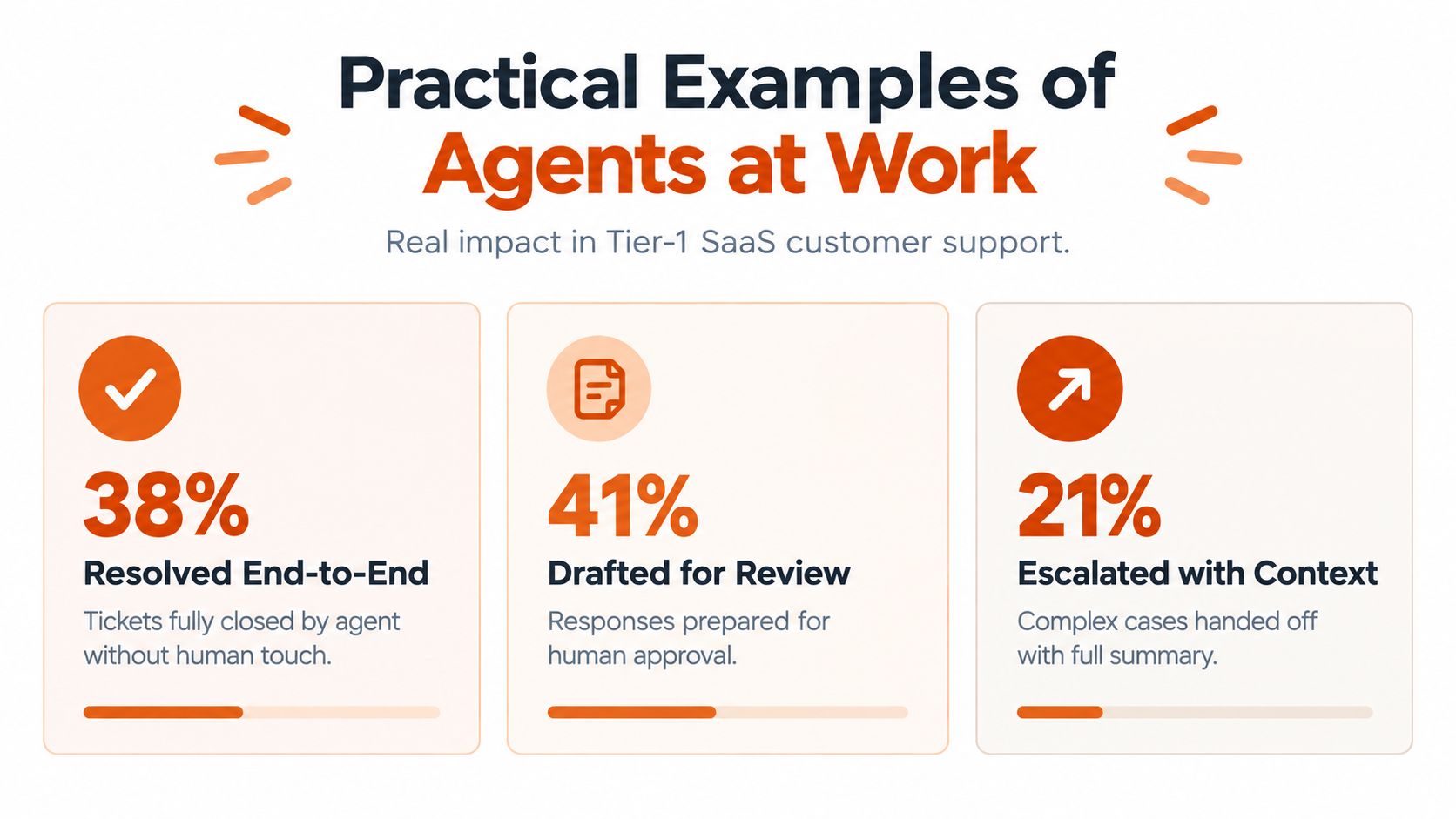
The economics still need to be measured inside the company. Track handling time, backlog, customer satisfaction, reopen rates, escalation quality, and cost per resolved case. Don't claim hours saved until you compare agent-assisted work with a pre-pilot baseline and account for review time.
Three deployment stories
A sales-research agent can prepare an account brief in four minutes in the scenario described. It earns trust because the account executive can inspect sources, correct the brief, and use the result before a meeting. The agent changes the seller's day by removing preparation work, not by pretending to replace discovery judgment.
A contract-review agent can fail for the opposite reason. If legal won't allow it to redline outside a sandbox, the agent may stall before creating value. That isn't necessarily a model failure. It may reveal that the workflow has high compliance exposure and needs assisted review rather than autonomous editing.
A Stanford-NBER study of 5,179 customer support agents found that access to a generative AI conversational assistant increased issues resolved per hour by 14% on average, with a 34% gain for novice and low-skilled workers and minimal impact for experienced workers, as reported in the Quarterly Journal of Economics study. Benefits vary by role, so target first-line bottlenecks rather than assuming every employee will gain equally.
Three patterns recur:
- Clear objectives: Agents perform best when success is easy to define.
- Small blast radius: Reversible actions make experimentation safer.
- Human judgment: Empathy, negotiation, and irreversible commitments still need people.
A broad review of agent research reported efficiency improvements from about 5× to more than 300×, with a median speedup of roughly 25× and cost reductions of two to three orders of magnitude, according to the large-scale AI agent review. Treat those figures as research-reported ranges, not a forecast for your business.
Which Workflows to Hand Over and Which to Keep
Autonomy should follow risk, not excitement. Put routine, reversible work in the agent's hands. Keep decisions involving money, legal exposure, customer rights, or reputation behind an approval gate.
| Tier | Oversight Rate | Example Tasks |
|---|---|---|
| Tier 1, full handoff | Minimal review for bounded work | FAQ responses, CRM data entry, transcript summaries, renewal-date reminders |
| Tier 2, human in the loop | Human approval before release | Prospecting emails, RFP responses, deal-desk approvals, knowledge-base updates |
| Tier 3, human owned | Human decision and execution | Pricing exceptions, security disclosures, terminations, regulated communications |
A manager can apply one rule to each tier. Tier 1: delegate when the action is reversible and the expected result is unambiguous. Tier 2: require approval when the agent can prepare the work but a person owns the consequence. Tier 3: keep the decision human when an error creates legal, financial, or relationship damage that can't be easily reversed.
Use four questions to score a candidate workflow in under five minutes:
- Reversibility: Can someone undo the action cleanly?
- Judgment load: Does the task require negotiation, empathy, or interpretation?
- Data sensitivity: Does the agent handle personal, confidential, or restricted information?
- Compliance exposure: Would an error trigger contractual, regulatory, or reporting consequences?
Don't confuse high volume with suitability. A high-volume workflow with sensitive data may belong in assisted mode, while a lower-volume administrative task may be safe for full handoff. AppLighter's workflow examples for apps can help teams identify candidate processes, but your own risk scoring must determine the autonomy tier.
Governance and Risk You Cannot Skip
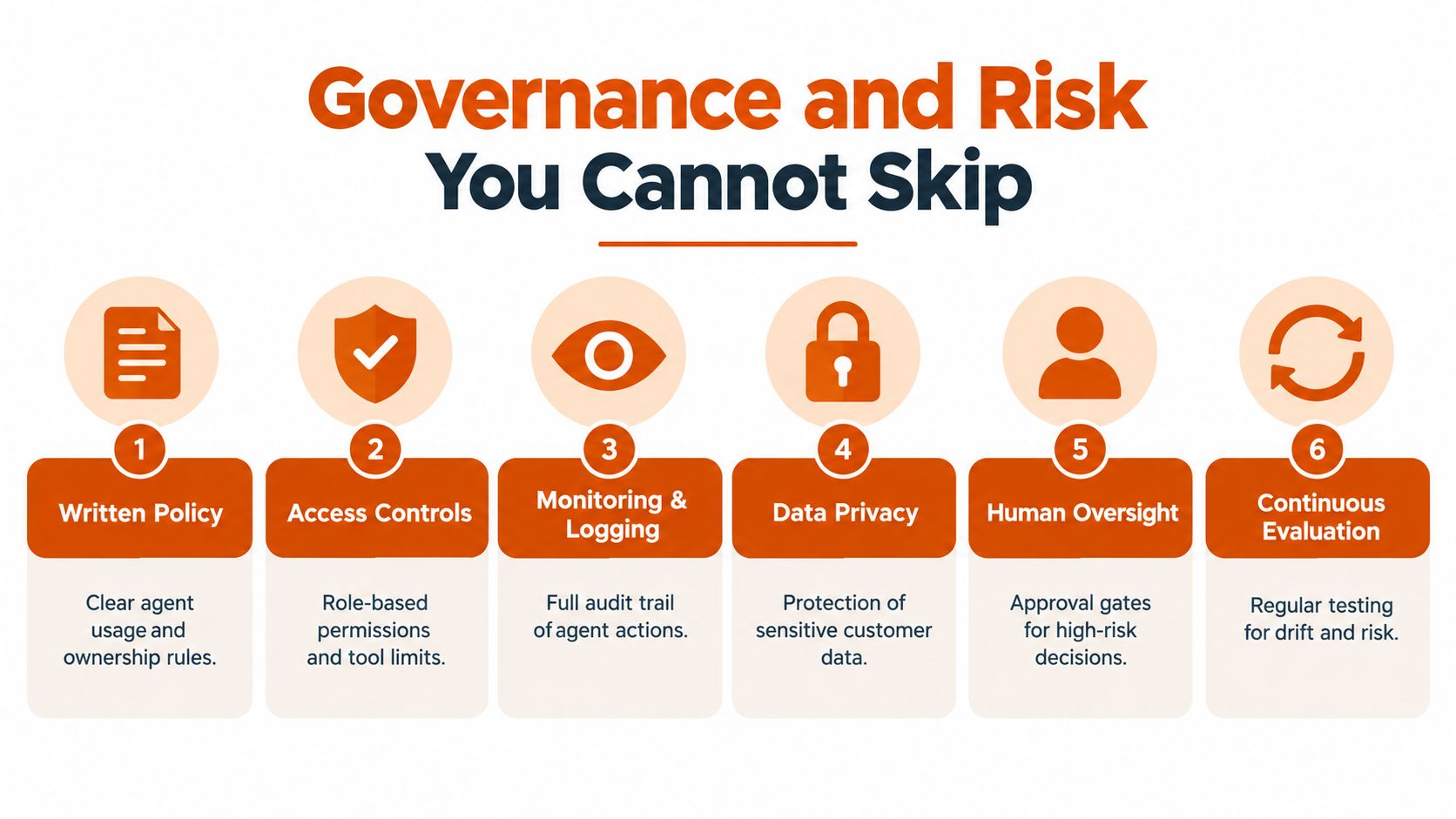
Governance is the moat in 2026. Agent launches attract attention, but B2B value depends on whether teams can evaluate decisions, control access, and identify workflows where autonomy creates unacceptable exposure. Uncontrolled rollout is irresponsible when ownership, data boundaries, and recovery procedures remain unclear.
Set six controls before an agent reaches production:
- Written policy: Name the business owner, permitted scope, prohibited actions, data boundaries, and kill-switch authority.
- Evaluation harness: Test accuracy, hallucination, and policy compliance against a golden set before each release.
- Least-privilege access: Give agents only the tokens and tools required for their workflow. Redact sensitive data before retrieval.
- Observability: Log actions, tool calls, prompt traces, outcomes, overrides, and customer-facing audit records.
- Regulatory readiness: Map the workflow to the EU AI Act high-risk category, the Colorado AI Act, HIPAA, SOX, and applicable sector rules.
- Incident response: Define severity levels, escalation owners, rollback procedures, and communication requirements.
Tighter evaluation cycles slow shipping. Accept that cost when testing reduces post-launch escalations. Treat disciplined evaluation as an operational target to validate, not a guaranteed result.
Two failure modes regularly surprise leadership teams. Silent model drift changes behaviour without a visible product release. Shadow-agent sprawl creates unregistered automations across departments, each with unclear data access and ownership. Both problems grow when teams track launches but ignore the wider agent estate.
Control the estate quarterly: inventory every agent, review permissions and logs, rerun representative evaluations, and retire anything without a named owner.
For a practical starting point, review AI agent governance guidance for business teams. Legal, security, RevOps, and process owners must adapt the guidance to each deployment, define who can approve changes, and document where agents must stop.
A 30-60-90 Day Adoption Plan
Days 1 to 30
Run a growth audit across pipeline, support, and RevOps. Inventory the workflows that consume staff time, then score each one for volume, error cost, and data sensitivity.
Choose two pilot candidates with recoverable failure modes. Good candidates usually involve structured inputs, clear outcomes, and a human fallback. Assign an executive sponsor and a process owner before any vendor configuration begins.
Days 31 to 60
Stand up governance before scale. Give each pilot an agent owner, connect action logs and observability, define permissions, and create an evaluation set of 50 to 100 real prompts with golden answers.
Run the agents in shadow mode against human work. Compare proposed actions with what employees did, identify recurring exceptions, and fix source data before adding more autonomy. The owner should report a small scorecard, not a narrative update:
- Cycle time: How long does the workflow take?
- Error rate: How often does the agent require correction?
- Override rate: How often does a human reject the proposed action?
- Business result: Does the workflow improve qualified pipeline, resolution, or another defined outcome?
Days 61 to 90
Expand only the winners. Move proven low-risk tasks toward full handoff, keep higher-stakes work in assisted mode, and compare results with the pre-pilot baseline.
Each milestone needs a named owner and a measurable outcome. If the team can't identify who approves a policy change, who reviews an incident, and which baseline defines success, the deployment isn't ready for expansion.
The right sequence is deliberately unglamorous. Audit first, test in shadow mode, then widen authority. That approach creates evidence that a finance leader, security team, and revenue executive can all inspect.
Frequently Asked Questions for B2B Leaders
How can we separate real capability from demo polish?
Ask the vendor to run your workflow, including exceptions, incomplete data, permission limits, and escalation. Require action logs and measure completed outcomes, not fluent responses. A polished demo hides the hardest production conditions.
Which KPIs should we watch first?
Start with cycle time, deflection rate, qualified pipeline uplift, and human override rate. Add quality and compliance measures appropriate to the workflow. A faster process with more corrections isn't a win.
How much should we budget for a pilot?
Don't set a universal dollar figure without knowing the workflow, integration burden, data condition, and review requirement. Budget for implementation, evaluation, observability, security review, and process redesign, not only model usage.
When should we buy instead of build?
Buy when a vendor already handles your workflow, integrations, permissions, and audit needs. Build when the process is a genuine differentiator and your team can maintain evaluations, security, and version changes. Most B2B teams should buy the foundation and customise the operating layer.
What disclosure and consent posture is expected?
Tell customers when an agent materially interacts with them or makes a decision affecting their experience. Obtain consent where law, contract, or sector rules require it, and provide a human escalation route. Keep records showing what the agent did and which authority allowed it.
Where is the regulatory floor in 2026?
The floor depends on jurisdiction and use case. Review the EU AI Act, the Colorado AI Act, HIPAA, SOX, contractual duties, and sector-specific requirements with qualified legal and compliance owners. Don't wait for a regulator or customer to identify a missing control.
The central argument is simple. Governance and evaluation discipline create more durable value than unchecked autonomy. Start with a constrained pilot, an evaluation harness, and one accountable owner. Broad rollout comes only after the evidence supports it.
Prometheus Agency helps growth leaders turn existing CRM and GTM stacks into governed, scalable revenue systems through AI enablement, workflow automation, CRM optimisation, and implementation. Visit Prometheus Agency to explore a complimentary Growth Audit and AI strategy session for your next agent pilot.