Marketing Operations is the strategic backbone of any modern marketing department. It’s the essential function that manages the people, processes, and technology required to run efficiently, scale predictably, and most importantly, prove its value to the business.
In short, Marketing Operations connects a brilliant marketing idea to a measurable business result.
The Engine Room of Modern Marketing
Think of your marketing department as a high-performance race car. Your creative campaigners and demand gen specialists are the drivers, laser-focused on winning the race for customers.
Marketing Operations (MOPs) is the expert pit crew, the engineers, and the race strategist all rolled into one. They aren't in the driver's seat, but without them, that car wouldn't even make it to the starting line, let alone finish the race.
This team works behind the scenes, building and fine-tuning the systems that allow marketing to function at scale. They are the architects of efficiency, obsessed with making sure every dollar spent and every hour worked delivers a tangible return.
Key Takeaways
- Marketing Operations (MOPs) is the functional core of marketing, providing the structure, systems, and data needed for success.
- It centers on optimizing three key areas: people, processes, and technology.
- MOPs owns the marketing technology (MarTech) stack, ensures data integrity, and builds the reporting that measures performance.
- Its ultimate goal is to transform marketing from a cost center into a predictable, data-driven revenue engine.
What Does Marketing Operations Actually Do?
At its core, MOPs ensures the creative and strategic parts of marketing have the tools and frameworks they need to succeed. The discipline really came into its own in the early 2000s, exploding in importance with the rise of digital marketing tools and the flood of data they created.
Historically, MOPs grew out of the need to manage increasingly complex campaigns, technology stacks, and data flows. Today, smart organizations recognize it as the absolute foundation of marketing effectiveness.
To put it in context, here are the four fundamental pillars that define the work of a Marketing Operations team.
The Four Core Pillars of Marketing Operations
| Pillar | Primary Responsibility | Practical Examples |
|---|---|---|
| Technology Management | Selecting, implementing, and managing the marketing technology (MarTech) stack. | Administering the marketing automation platform (HubSpot, Marketo), integrating CRM, and managing analytics tools. |
| Process Optimization | Designing and refining workflows to improve marketing efficiency and scalability. | Creating lead management processes (scoring, routing, nurturing), campaign execution workflows, and budget management systems. |
| Data Governance & Analytics | Ensuring data quality, creating reporting frameworks, and analyzing performance. | Cleansing and enriching database contacts, building performance dashboards, and defining campaign attribution models. |
| Strategic Alignment | Aligning marketing efforts with sales and overall business goals. | Developing the lead handoff process (SLA), defining key metrics (MQLs, SQLs), and forecasting marketing's contribution to revenue. |
These pillars work together to create a well-oiled machine that not only executes campaigns but also measures their impact with precision. You can learn more by exploring the best practices that define modern marketing operations.
Why Should You Care About MOPs?
Simply put, MOPs directly impacts revenue and growth. A well-run operations function prevents wasted budget on broken processes, eliminates frustrating bottlenecks, and provides clear visibility into what’s working and what isn’t. A huge piece of this is figuring out how different marketing touchpoints actually contribute to a sale. If you want to go deeper on that topic, it's worth understanding what is marketing attribution.
Impact Opportunity
By grasping the principles of Marketing Operations, you can start spotting opportunities to improve your own team’s output—ensuring your marketing efforts are not just creative, but powerfully effective and accountable. This leads directly to a stronger ROI, a more efficient sales cycle, and a clear, defensible case for marketing's budget and strategic importance.
The Four Pillars of Modern Marketing Operations
So, what exactly is Marketing Operations? We’ve called it the engine of the marketing department, but to really get it, you have to look under the hood. The MOPs engine isn't just one big part; it's built on four foundational pillars. Each one handles a critical function, and together, they create a system that drives efficiency, accountability, and predictable growth.
Think of them as Technology Management, Process Optimization, Data Governance, and Performance Measurement. These aren’t separate silos. They’re deeply interconnected, and a weakness in one will absolutely compromise the others, holding your entire marketing function back.
This visual shows how Marketing Operations sits at the intersection of people, process, and technology to make things happen.
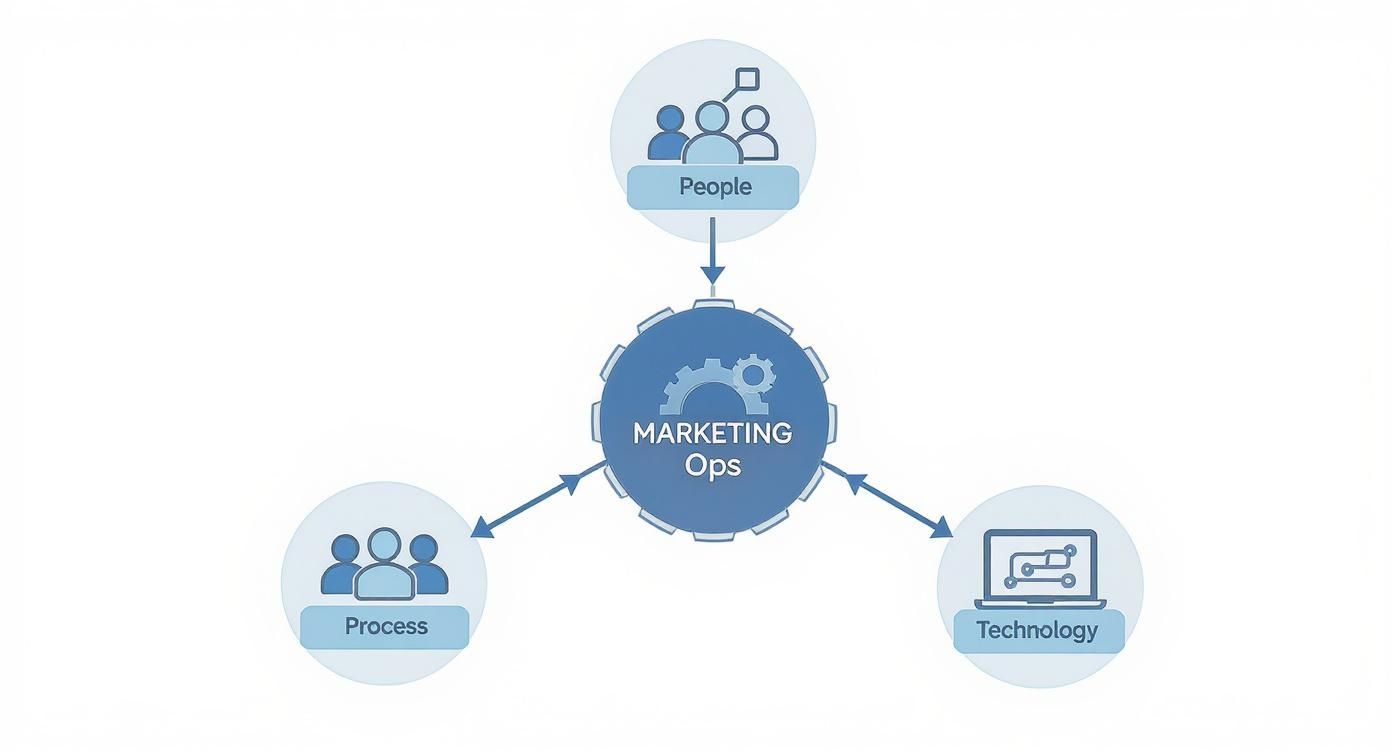
As you can see, successful MOPs isn't just about the tools you buy. It’s about orchestrating the interplay between the teams using them and the workflows they follow day in and day out.
Technology Management
Modern marketing runs on technology. That collection of software you use to find, engage, and keep customers is called the MarTech stack—and MOPs professionals are its architects. But their role goes way beyond just buying the latest shiny tool.
Technology management really breaks down into a few key jobs:
- Selection and Procurement: Sizing up business needs and picking the right tools—like a CRM (think Salesforce) or a marketing automation platform (like HubSpot)—that actually line up with your goals and budget.
- Integration and Implementation: Making sure all your systems talk to each other without a hitch. A classic example is ensuring a new lead from your website flows instantly into your marketing platform and then syncs perfectly with the CRM for sales to take over.
- Administration and Optimization: Managing who has access, training the team, and constantly tweaking the platforms to get the most value out of them. A solid CRM strategy is what turns a piece of software into a genuine revenue-generating machine.
Process Optimization
If technology gives you the tools, process is the blueprint for how the work actually gets done. Process optimization is all about methodically stamping out bottlenecks, killing manual work, and building scalable, repeatable workflows. MOPs acts like an internal consultant, always asking, "How can we do this better, faster, and more efficiently?"
A well-designed process ensures that the right information gets to the right person at the right time, every time. It’s the difference between organized chaos and a predictable system for growth.
Practical Example: Automating Lead Routing
Take lead routing, for instance. A high-value lead fills out a demo form. Without a good process, that lead might sit in an inbox for hours, get routed to the wrong rep, or just fall through the cracks. A MOPs team fixes this by building an automated workflow. The system instantly scores the lead based on their industry, company size, and title. It then routes them to the right salesperson based on territory rules and shoots out a notification for immediate follow-up. That single process can slash response times from hours to minutes, which massively increases the odds of closing the deal.
Data Governance
Data is the fuel for modern marketing. But dirty, unreliable data is like putting sand in your engine. Data governance is the pillar dedicated to making sure the information you use to make decisions is clean, compliant, accurate, and secure. This has quickly become one of the most central roles for MOPs.
The stats back this up. In a survey of over 550 marketing operations pros, more than 70% said their responsibilities in tech integration and data governance have grown over the last five years. The same study found that 65% of MOPs teams list improving campaign efficiency as their top goal—something that’s flat-out impossible without good data. You can dig into more of these findings from the Filestage report, which pulled insights from over 20 industries.
Performance Measurement
Finally, Marketing Ops is on the hook to answer the C-suite's favorite question: "What did we get for our marketing spend?" Performance measurement is all about building the dashboards, reports, and attribution models that translate marketing activities into real business impact.
This means moving past vanity metrics (like clicks and likes) to focus on what actually matters to the bottom line:
- Marketing-Sourced Pipeline: How much sales pipeline did our campaigns generate?
- Customer Acquisition Cost (CAC): How much are we spending to land each new customer?
- Campaign ROI: For every dollar we put into a campaign, how many dollars in revenue did we get back?
By building the infrastructure to track these numbers accurately, MOPs gives leadership the data they need to make smart budget decisions. More importantly, it proves that marketing isn't a cost center—it's a primary driver of revenue.
Key Roles and Team Structures in Marketing Operations
A Marketing Operations team isn't a one-size-fits-all department. Its shape and size morph depending on a company's scale, complexity, and how fast it’s growing. What starts as one person juggling a dozen hats at a startup can blossom into a specialized, multi-layered team inside a major enterprise.
Understanding these roles and how they fit together is key. It gives you a blueprint for figuring out where your company is right now and what comes next—whether that’s hiring your first specialist or building out an entire department.
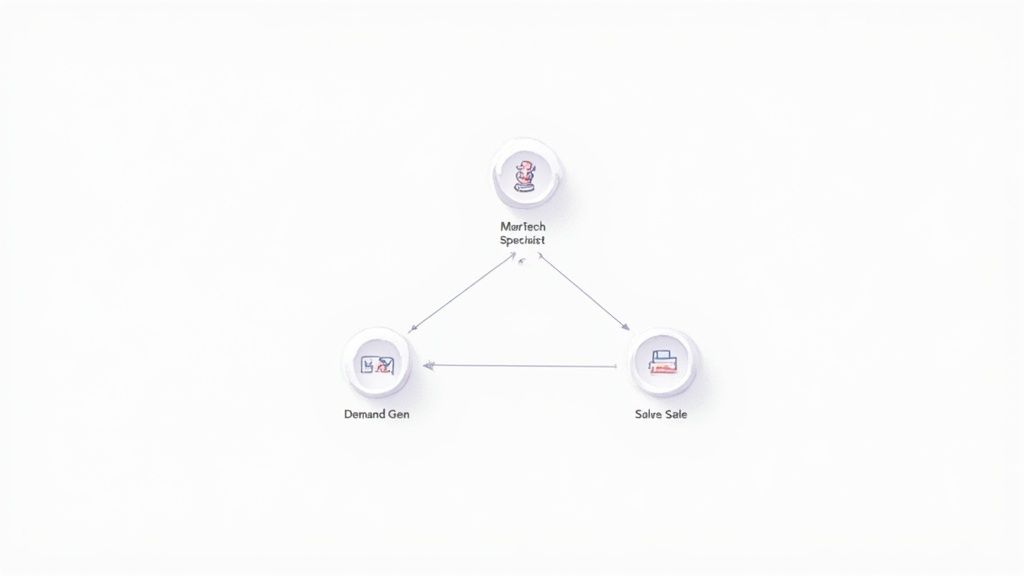
As you can see, the MOPs team is the critical connector between marketing efforts (like demand gen) and the sales team, making sure the handoff is smooth, trackable, and efficient.
The Essential Players on a MOPs Team
While the exact structure changes, a mature Marketing Operations function usually has a few core roles, each with a specific job to do. Think of these specialists as the crew that keeps the marketing engine finely tuned and running at full throttle.
Here are the most common positions you'll find:
- Marketing Operations Manager: This is the captain of the ship. They oversee day-to-day operations, manage the MOPs team, and ensure every process and platform is firing on all cylinders to support campaigns and hit strategic targets.
- MarTech Specialist: The architect of your tech stack. This person manages, integrates, and optimizes all the marketing technology. They make sure data flows seamlessly between your CRM and marketing automation platform and are the first call when a technical snag pops up.
- Marketing Analyst: The data storyteller. This individual builds the dashboards, tracks the KPIs, and digs into campaign performance to answer the all-important question: "What's working and why?" Their insights are what allow for truly data-driven decisions on budget and strategy.
How MOPs Teams Evolve: A Maturity Model
A company's need for Marketing Operations changes dramatically as it grows. Knowing where you are on this journey helps you prioritize the right hires and investments. Most companies find themselves in one of three stages.
The journey from a one-person show to a fully specialized department is a sign of a maturing business—one that understands marketing must be both accountable and scalable to drive real revenue growth.
This progression marks the shift from constantly putting out fires to proactively planning for the future.
Stage 1: The Accidental MOPs Pro
In most startups and small businesses, "marketing operations" isn't a job title; it's a list of tasks someone already has. This is usually a demand gen manager or a digital marketer who also runs the email platform, pulls basic reports, and does their best to keep the contact database from becoming a complete mess.
At this stage, the focus is all about execution and survival. The biggest challenge is a constant lack of time and specialized skills, which leads to reactive fixes instead of building systems that can actually scale.
Stage 2: The Emerging MOPs Function
As a company scales up, the pain of not having a dedicated MOPs person becomes impossible to ignore. This stage typically kicks off with the hiring of a Marketing Operations Manager or Specialist. Their first mission? Bring order to the chaos.
This person gets to work documenting processes, scrubbing the database, and standardizing the MarTech stack. They build the foundational workflows for lead management and create the first truly reliable performance dashboards, introducing a new era of accountability for the entire marketing team.
Stage 3: The Strategic MOPs Department
In large or enterprise-level companies, MOPs is no longer just a function—it's a fully-fledged, strategic department with a roster of specialized roles. The team is now led by a Director or VP of Marketing Operations who is focused on long-term strategy and aligning MOPs with C-suite goals.
Under them, you'll find dedicated specialists for MarTech, analytics, automation, and campaign operations. This team doesn't just support marketing; it actively drives strategy by delivering deep performance insights, forecasting results, and optimizing the entire customer journey from the very first touch to the final sale.
Measuring The Metrics That Define Marketing Success
Marketing Operations is the team that finally gives the C-suite a straight answer to their oldest question: "Is our marketing actually working?"
To do that, MOPs has to look past surface-level vanity metrics—things like social media likes or email open rates. Instead, they build the entire system needed to track the key performance indicators (KPIs) that draw a direct line from marketing campaigns to real business outcomes.
This is the whole point of marketing operations. It’s about turning the marketing department from a line item on the expense sheet into an undeniable engine for revenue. It’s about having the hard, data-backed proof that every dollar spent on a campaign is bringing a tangible return.
CMOs are now leaning heavily on their operations teams for this. They need real-time visibility into what’s working and what isn’t. As highlighted in Adriel.com's analysis of marketing ops trends, modern teams are pulling data from advertising platforms, CRMs, and analytics tools to create attribution models that were once just a pipe dream.
Tactical Metrics Versus Strategic Impact
One of the biggest jobs for Marketing Operations is to teach the organization the difference between two kinds of metrics: tactical and strategic. Tactical metrics tell you how efficiently you’re working. Strategic metrics tell you what impact you’re having on the business.
Think of it this way: tactical metrics are like checking the oil and tire pressure on a race car. They're essential for keeping the car running, but they don't tell you if you're winning the race. Strategic metrics are your lap times, your position on the track, and how you’re performing against the competition. MOPs makes sure the team is watching both dials.
MOPs is uniquely positioned to build the bridge between marketing activity and business results. It connects the "what we did" (tactical) with the "so what?" (strategic), providing a complete picture of performance.
A mature ops function is a master translator. With solid reporting and analytics, they can show leadership not just how many leads a campaign generated, but how much pipeline and revenue those leads ultimately produced.
Below is a breakdown of how MOPs connects these two worlds. Notice how a simple, tactical metric like "Email Open Rate" can be traced all the way to a strategic goal like "Customer Lifetime Value."
Marketing Operations KPI Comparison
| KPI Category | Example Metric | What It Measures | Strategic Impact |
|---|---|---|---|
| Lead Generation | Cost Per Lead (CPL) | The efficiency of lead acquisition spend for a specific channel or campaign. | Informs budget allocation to the most profitable channels, lowering Customer Acquisition Cost (CAC). |
| Campaign Efficiency | MQL to SQL Conversion Rate | The quality of leads being passed from marketing to sales. | Indicates marketing and sales alignment; a higher rate leads to a more efficient sales cycle. |
| Pipeline Acceleration | Sales Cycle Length | The average time it takes for a lead to become a paying customer. | Shorter cycles mean revenue is realized faster, improving cash flow and forecast accuracy. |
| Revenue Impact | Marketing-Sourced Revenue | The amount of closed-won revenue directly attributed to marketing efforts. | Proves marketing's contribution to the bottom line, justifying budget and investment. |
| Customer Value | Customer Lifetime Value (CLV) | The total revenue a business can expect from a single customer account. | Informs long-term growth strategy, retention efforts, and sustainable acquisition spending. |
As the table shows, a single tactical number is just the start of the story. MOPs is responsible for telling the rest of the story, connecting every action to a result that the CFO and CEO actually care about.
Practical Example: Proving Content ROI
Let's say a B2B SaaS company launches a big top-of-funnel content campaign with a few new ebooks and a webinar series. The demand gen team is thrilled—they're reporting record-high download numbers (a tactical metric). But the CFO is skeptical, seeing it as just another expense.
This is where the MOPs team shines.
- They Connect the Dots: Using a multi-touch attribution model built inside their CRM and marketing automation platform, the MOPs team tags and tracks every single lead that engages with the content.
- They Follow the Journey: Over the next six months, they monitor how these leads progress—from Marketing Qualified Lead (MQL) to Sales Qualified Lead (SQL) and, finally, to a closed-won deal.
- They Present the Impact: The MOPs team creates a dashboard showing that leads who consumed the content had a 25% higher conversion rate to pipeline and ultimately generated $750,000 in marketing-sourced revenue.
This data-driven story changes the entire conversation. Suddenly, the content campaign isn't a "cost" anymore. It’s a high-performing investment with a clear return.
Impact Opportunity
This is where a strong marketing operations function truly makes its mark. When you master performance measurement, you can walk into any budget meeting armed with undeniable data. You can justify your current spending, secure resources for new initiatives, and elevate marketing to its rightful place as a strategic partner in the business.
Getting Started: How to Build Your MOPs Function
So, you're ready to build out your marketing operations function—or maybe level up the one you already have. Where do you even begin?
It’s tempting to think the answer lies in a shiny new piece of software, but that's rarely the case. Building a truly effective MOPs function is about something far more fundamental: creating a solid system of processes, technology, and data that drives predictable growth. To get there, you need a roadmap. A clear, deliberate plan is what gets you buy-in and delivers immediate, meaningful wins.
The journey always starts with an honest look in the mirror. Before you can dream up a future state, you need to get real about your current capabilities, bottlenecks, and tech gaps. This initial audit is non-negotiable. It stops you from making premature investments and ensures your first steps are aimed at solving the most painful problems.

Key Takeaways
- Start with an Audit: Always evaluate your current tech, processes, and data before you change a single thing.
- Create a Phased Plan: A 30-60-90 day plan gives you a structured, actionable way to deliver quick wins and build momentum.
- Focus on High-Impact Fixes: Don’t try to boil the ocean. Prioritize solving one major bottleneck at a time.
- Align with Sales: Your work is useless in a vacuum. Constant collaboration with sales ops is the only way to ensure a smooth lead handoff.
Your First Step: The Marketing Operations Audit
Before you can build, you have to assess. Think of a marketing operations audit as a diagnostic tool for your entire GTM engine. It’s a systematic review that pinpoints your biggest pain points and, more importantly, your biggest opportunities.
This shouldn’t be a solo mission. Pull in stakeholders from marketing, sales, and even IT. Get their unfiltered feedback on process friction, data that doesn't add up, and tech that just gets in the way. This isn't just about finding problems—it's about building consensus on what needs to be fixed first.
A solid audit digs into three core areas:
- Technology Stack: What tools are you actually using? Are they talking to each other? Are you paying for features you don't need, or is there untapped potential sitting right under your nose?
- Processes and Workflows: Map out your key processes, especially lead management. Where are the handoffs? Where do leads go to die? Is any of this documented, or is it all just tribal knowledge?
- Data and Analytics: Can you trust the numbers? Are your dashboards giving you actionable insights, or just a bunch of vanity metrics that look pretty but mean nothing?
Practical Example: Building a 30-60-90 Day Plan
If the audit is your diagnosis, the 30-60-90 day plan is your prescription. This framework turns the overwhelming task of "fixing MOPs" into something you can actually tackle. It breaks the work into manageable, time-bound chunks, making it a powerful tool for showing progress and keeping leadership on your side.
Here’s what that might look like for a mid-market B2B company just getting its MOPs function off the ground:
Days 1-30: Foundational Documentation and Discovery
Your first month is all about listening, learning, and mapping things out. The goal here isn't to fix anything yet—it's to gain a deep understanding of the current state and pinpoint the one single bottleneck that’s costing the company revenue.
- Objective: Document the entire lead management process, from capture to sales handoff.
- Action Items:
- Interview key players in sales and marketing to map the current lead journey.
- Identify the main chokepoint (e.g., leads are sitting untouched for days, qualification is a mess).
- Create a simple flowchart of the process to share with leadership. Make it visual.
Days 31-60: Implement One High-Impact Automation
With the biggest problem identified, month two is for action. You're going to implement one targeted fix that delivers a measurable improvement. This quick win is crucial—it builds your credibility and proves the value of having an operational mindset. Understanding the core business process automation benefits, like boosting efficiency and cutting down on errors, is key here.
- Objective: Fix the bottleneck you found with an automated workflow.
- Action Items:
- Build an automated lead routing rule in your marketing automation platform or CRM.
- Implement a simple lead scoring model to push the best leads to the front of the line.
- Train the sales team on the new process and watch the initial results like a hawk. For tools like HubSpot, these fixes are often easier than you'd think; our playbook on HubSpot quick wins covers several high-impact tweaks you can make right away.
Days 61-90: Standardize Core Reporting
In the third month, you shift to measurement. You’ve improved a key process, and now you need to prove its impact with cold, hard data. This phase is all about creating a single source of truth for marketing performance.
- Objective: Build and standardize a core set of marketing KPI dashboards.
- Action Items:
- Define 3-5 critical metrics everyone can agree on (e.g., MQLs, SQLs, conversion rates).
- Build one shared dashboard in your CRM or BI tool that both marketing and sales live in.
- Set up a weekly rhythm to review the data together and spot trends.
Common Pitfall to Avoid: Don’t buy new technology without a clear strategy. A shiny new tool won't fix a broken process. Your audit and 30-60-90 day plan must come first, making sure any tech purchase is driven by a real, well-defined need—not just vendor hype.
Impact Opportunity
By following this structured approach—Audit, Plan, Execute—you create a clear, defensible roadmap for building or scaling your marketing operations. This isn't just a to-do list; it's a strategic document you can hand to your leadership team. It shows you have a thoughtful, data-driven plan, which makes it a whole lot easier to get the budget, resources, and buy-in you need to turn marketing into a scalable revenue engine.
Common Questions About Marketing Operations
Even after you get the hang of the core concepts, a few common questions always pop up when teams start to really dig into marketing operations. Let's clear up some of the usual points of confusion to make sure your understanding is rock-solid.
The Short Answers
- Operations vs. Automation: Think of MOPs as the entire traffic control system for your marketing. Automation is just one of the cars on the road.
- MOPs for Small Teams: You don’t need a huge team. Start by simply writing down your processes, picking a solid CRM, and keeping your data clean from day one.
- Must-Have MOPs Skills: The best people are a mix of tech-savvy, data-curious, and business-focused problem-solvers.
- Working with Sales: MOPs and Sales Ops are partners in revenue. Their most important job together is making sure the handoff from marketing to sales is flawless.
What Is the Difference Between Marketing Operations and Marketing Automation?
This is easily the most common question, and getting the distinction right is critical. Marketing automation is a tool. It’s a piece of software—think HubSpot or Marketo—that helps you automate repetitive tasks like sending emails or scoring leads.
Marketing operations, on the other hand, is the strategic function that owns and optimizes that tool, along with your entire marketing tech stack.
Here’s an analogy: marketing automation is the car. Marketing Operations is the driver, the mechanic, and the person who designed the entire highway system. MOPs chooses the car, sets the rules of the road (your processes), makes sure the fuel is clean (data governance), and tracks how efficiently you’re getting to your destination (ROI).
How Can a Small Business Implement Marketing Operations?
For a small business, getting started with MOPs is less about hiring a big team and more about building good habits. You can create an incredibly strong foundation by focusing on the fundamentals now, which will save you from absolute chaos later on.
- Map Out Your Core Processes: Start simple. Just draw out how a brand new lead gets from your website into the hands of a salesperson.
- Pick a Scalable Hub: Choose a user-friendly CRM that can be your single source of truth for all customer data. Don't overbuy.
- Obsess Over Data Hygiene: Create dead-simple rules for data entry from the very beginning. This will pay massive dividends down the road.
- Build One Simple Dashboard: Start with a single report that tracks just 2-3 key metrics, like where your best leads come from and your lead-to-customer conversion rate.
This isn’t about a huge budget or headcount. It’s about building a scalable framework that sets you up to win as you grow.
What Are the Most Critical Skills for a MOPs Professional?
A great MOPs pro is a rare breed—part tech wizard, part data detective, and part business strategist. They’re the people who love untangling messy systems and making everything run more smoothly. While the role touches a lot of areas, a few skills are completely non-negotiable.
The best MOPs professionals don't just know how to push the buttons; they understand why the buttons exist and can connect every technical task back to a bigger business goal.
Here are the skills that matter most:
- Technical Aptitude: A genuine curiosity for figuring out how technology works and making different platforms talk to each other.
- An Analytical Mind: The ability to look at a spreadsheet and see a story—not just what happened, but digging into why it happened.
- Systemic Problem-Solving: A knack for looking at a complex, tangled process and seeing a clear, efficient path forward.
- Project Management: The discipline to juggle multiple projects, stakeholders, and deadlines without letting anything fall through the cracks.
- Business Acumen: The ability to directly connect marketing activities, tech, and data to the ultimate goal: driving revenue.
How Does Marketing Operations Work With Sales Operations?
Marketing Ops and Sales Ops are two sides of the same revenue coin. Getting them to work together isn't just a nice-to-have; it's essential for any kind of predictable growth. They may focus on different stages of the customer journey, but their work has to connect seamlessly.
MOPs owns the top of the funnel—things like lead capture, nurturing, and data quality. Sales Ops typically owns the bottom of the funnel, focusing on CRM management, territory assignments, and forecasting.
Their most intense and important collaboration happens right in the middle: the handoff of a qualified lead from marketing to sales. When MOPs and Sales Ops are in lockstep, you get a smooth customer experience and a clear view of the entire revenue pipeline. When they aren't, leads vanish, the blame game starts, and revenue takes a hit.
At Prometheus Agency, we help growth leaders transform their technology and processes into scalable revenue systems. If you're ready to tame your tech stack and build a durable growth engine, our complimentary Growth Audit and AI strategy session is the perfect first step. Learn more at https://prometheusagency.co.