Let's be honest, the term "digital transformation" gets thrown around so much it’s almost lost its meaning. But get past the buzz, and you'll find a powerful business concept. A real digital transformation strategy isn't about buying the latest software or just "going digital."
It's a complete rethink of how your business runs and how it creates value for customers, with technology as the engine driving that change.
Key Takeaways
- Business-First, Not Tech-First: A digital transformation strategy is a business plan to achieve specific goals like efficiency or improved customer experience using digital tools. The technology serves the strategy, not the other way around.
- Four Pillars: A successful strategy balances four key areas: People & Culture, Process Optimization, Technology Integration, and Customer Experience. Neglecting any one of these leads to failure.
- Digital vs. AI Transformation: Digital transformation is the foundational overhaul of systems (like moving to a modern CRM). AI transformation is a specialized capability that uses that new foundation for intelligent automation and prediction. You need the first to do the second effectively.
- Roadmap is Crucial: A phased roadmap with clear KPIs is essential. Start with a clear "why," get leadership buy-in, prioritize quick wins, and measure everything to prove ROI and maintain momentum.
Defining Your Digital Transformation Strategy

Too many leaders fall into the trap of seeing this as an IT project. It's not. That’s like mistaking building a skyscraper for just buying a new crane.
Think of it this way: technology like AI, the cloud, or a new CRM are just the tools—the raw materials. Your strategy is the architectural blueprint that shows how every beam, wire, and window comes together to build something that fundamentally works better.
This blueprint weaves technology into the very DNA of your business model, your day-to-day operations, and every customer touchpoint. The real goal isn't just to do what you're already doing a little bit faster. It's to completely redefine what's possible. A huge piece of this puzzle is getting your go-to-market teams on the same page, which is why implementing Revenue Operations (RevOps) best practices is so critical.
To give you a clearer picture, let's break down the core components of a solid strategy.
Key Pillars of a Digital Transformation Strategy
This table breaks down the essential components that form a strong digital transformation strategy, offering a clear, at-a-glance reference.
| Pillar | Focus Area | Example Objective |
|---|---|---|
| Customer Experience | Redefining customer journeys and engagement | "Launch a self-service portal that reduces support tickets by 30% within one year." |
| Operational Agility | Modernizing internal processes and workflows | "Automate 50% of manual data entry tasks in finance to reallocate team focus." |
| Culture & Leadership | building a mindset of innovation and learning | "Train 80% of managers on data-driven decision-making principles by Q4." |
| Technology Integration | Building a unified, scalable tech stack | "Migrate from legacy on-premise servers to a cloud infrastructure to improve uptime." |
Each pillar supports the others. A great customer experience, for instance, is impossible without agile operations and a supportive culture behind it.
The Core Objective of Digital Transformation
So, what's the end game? To build a business that's more nimble, more efficient, and relentlessly focused on the customer. When you thread digital capabilities through every part of the company, you create a living system—one that can pivot with market changes, predict what customers want next, and scale without breaking.
It’s about building resilience for the long haul.
And businesses are betting big on this. Global spending on digital transformation hit a staggering $1.85 trillion in 2022 and is on track to nearly double by 2027. That's not just "nice to have" spending; it’s a clear signal that this is a critical, board-level priority.
The Four Core Components of a Successful Strategy

A real digital transformation strategy isn't a vague mission to "go digital." It's a balanced framework that stands on four interconnected pillars. If you neglect one, you're trying to build on uneven ground. Sooner or later, the whole thing starts to wobble.
To drive real, lasting change, your strategy has to weave together people, processes, technology, and the customer experience. Each one feeds the others, creating a powerful cycle of continuous improvement.
1. People and Culture
Let’s be clear: technology is just a tool. It's only as good as the people using it. This first pillar is arguably the most critical—and often the hardest to get right. It all starts with a fundamental shift in mindset, from the very top all the way down.
A digital-first culture is one that encourages curiosity, embraces data-driven decisions, and breaks down silos between departments. Think about Microsoft’s famous pivot from a competitive "know-it-all" culture to a "learn-it-all" one. That single cultural shift was the key that unlocked their dominance in cloud computing and, later, AI.
Key Takeaway: A winning digital transformation strategy puts people first. You have to build a culture that welcomes change and gives your team the skills and psychological safety to adapt and thrive.
2. Process Optimization
The second pillar is all about redesigning your internal operations for a new era. This means taking a hard look at every manual, repetitive, or clunky workflow and asking a simple question: "How can technology make this smarter, faster, and more reliable?"
This is much deeper than just slapping automation on top of old habits. It's about completely re-engineering how work gets done to eliminate bottlenecks and find new efficiencies.
- Practical Example: A B2B manufacturer might ditch its paper-based inventory system for IoT sensors. These sensors provide real-time data, automatically reorder parts when stock runs low, and even predict maintenance needs. The result? A massive reduction in downtime and human error.
3. Technology Integration
Now we get to the tools. The third pillar is about strategically choosing and implementing technology that directly pushes your business goals forward. It’s not about chasing shiny new objects; it’s about building a cohesive, scalable tech stack that works for you.
This stack often includes a central CRM, cloud infrastructure, automation platforms, and, increasingly, AI. The whole point is to create a unified system where data flows freely, giving everyone a single source of truth for making smart decisions.
A common trap here is "shadow IT"—when different departments go rogue and adopt their own tools. A solid technology strategy heads this off by providing governed, centralized solutions that actually meet the business's needs securely.
4. Customer Experience Reinvention
Finally, all these internal shifts have to lead to one thing: a radically better customer experience. This pillar is about using your optimized processes and integrated tech to create seamless, personalized, and genuinely valuable interactions for your clients.
Today's B2B buyers have high expectations, shaped by their experiences as consumers. They want self-service portals, proactive support, and communication that’s actually relevant to them and where they are in their journey.
- Practical Example: A professional services firm can use its new CRM to get a 360-degree view of every client. When a client calls support, the agent instantly sees their entire history—past projects, recent marketing touches, open invoices. This allows for a conversation that is incredibly contextual and efficient.
These four pillars aren't a checklist you work through one by one. They're parallel streams of work. A successful strategy moves them all forward at the same time, ensuring your people are ready for the new processes, which are powered by the right technology—all in service of delivering an unmatched customer experience.
Digital Transformation vs AI Transformation
Many leaders use “digital transformation” and “AI transformation” interchangeably, but they’re not the same thing. This confusion often leads to misallocated resources, muddled strategies, and wildly unrealistic expectations.
Getting the distinction right is the first step toward building a strategy that actually works.
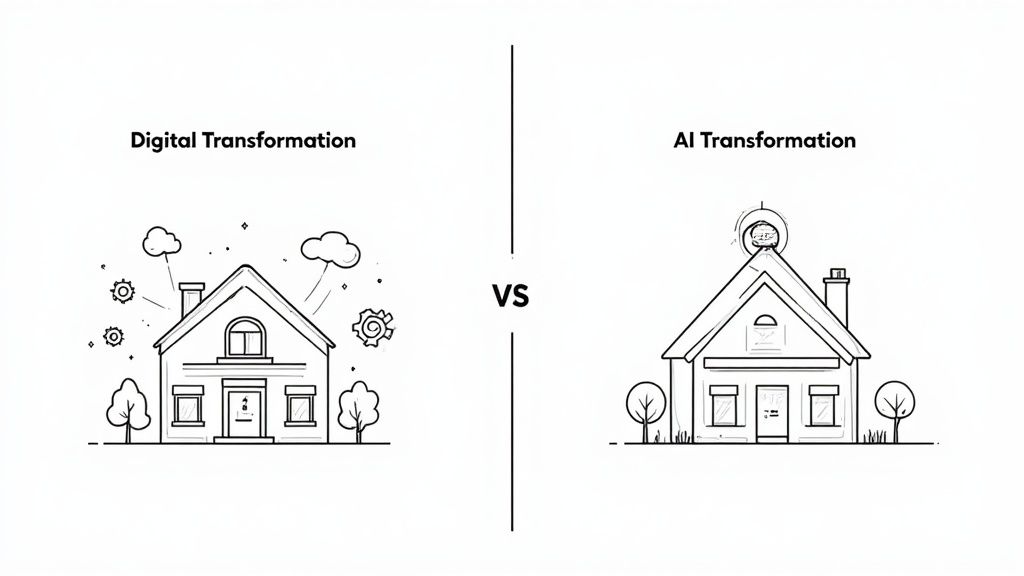
Think of it like renovating a house. Digital transformation is the big, foundational overhaul. It's ripping out the old plumbing, rewiring the electrical systems, and knocking down walls to create a modern, open-concept layout. You’re building the new infrastructure the house needs to function today.
AI transformation, on the other hand, is like installing a state-of-the-art smart home system inside that newly renovated house. This system is a specialized, advanced capability that automates your lights, manages the climate, and provides intelligent security. It's incredibly powerful, but it’s completely reliant on the modern wiring and plumbing you just installed.
Foundational Change vs Specialized Capability
Digital transformation is the broad, fundamental change. It’s about migrating to the cloud, adopting a modern CRM, or digitizing core business processes that used to live in spreadsheets. You're building the data-rich foundation your business needs to even compete.
AI transformation is a much more focused initiative that uses that new foundation to do something extraordinary. It's a subset of digital transformation, not a replacement for it. True AI enablement is only possible once the digital groundwork is solid, giving intelligent systems access to the clean, structured data they need to thrive.
Key Takeaway: Digital transformation builds the modern, high-tech house by overhauling core systems. AI transformation is what makes that house a "smart home" by embedding intelligent capabilities into the new foundation.
Practical Examples Clarifying the Difference
Let’s make this concrete. A company’s digital transformation might involve migrating its sales data from a dozen scattered spreadsheets into a single, cloud-based CRM like Salesforce. This move instantly improves data access, simplifies reporting, and creates a single source of truth for the entire sales team.
The AI transformation comes next, building on that new foundation. It might involve using machine learning models within that CRM to analyze sales data and predict which leads are most likely to convert. Or it could mean deploying an AI-powered chatbot on the company’s new website that pulls real-time information from the CRM to answer customer questions.
Digital transformation strategies are increasingly built with AI in mind. In fact, by 2025, it's expected that 90% of organizations will be actively pursuing digital-first initiatives. AI agents are leading the charge by automating tasks like code generation and testing, which can slash modernization timelines by a staggering 40-50%.
Digital Transformation vs AI Transformation A Comparative Overview
To crystallize the difference, this table breaks down the key attributes of each transformation.
While they are distinct, a smart digital transformation almost always includes AI. It's critical to understand how AI is used in business to see how these two concepts work together.
| Attribute | Digital Transformation | AI Transformation |
|---|---|---|
| Scope | Broad and enterprise-wide, affecting culture, processes, and technology across the entire organization. | Focused and specialized, targeting specific business functions with intelligent automation and predictive insights. |
| Primary Goal | To improve operational efficiency, enhance customer experience, and build business model agility. | To automate complex tasks, generate predictive insights, and create new, data-driven capabilities. |
| Technologies | Cloud computing, CRM systems, automation platforms, data analytics tools, ERP software. | Machine learning, natural language processing (NLP), computer vision, generative AI models. |
| Impact Opportunity | Increases organizational agility and resilience, preparing the business for future technological shifts. | Unlocks new revenue streams and creates significant competitive advantages through superior intelligence. |
Ultimately, digital transformation sets the stage. AI transformation is the headline act that can only perform once that stage is built. One without the other is a missed opportunity.
Building Your Strategic Roadmap in 5 Steps
Knowing you need a digital transformation strategy is one thing. Actually building it is another beast entirely. A vague vision won't get you past the starting line. To make it real, you need a concrete, actionable roadmap.
This five-step framework breaks the whole process down, turning an overwhelming idea into a manageable plan that gives your team clear direction.
1. Define Your Why and Get Brutally Honest About Your Starting Point
Before you can plan your journey, you need to know exactly where you're going and where you are right now. The first step is to nail down the core business problem you’re trying to solve.
Is it to slash customer churn? Boost operational efficiency? Break into a new market? Your "why" has to be a tangible business outcome, not a fluffy desire to "be more digital."
Once your objective is crystal clear, it’s time for a brutally honest assessment of your current digital maturity. A classic SWOT analysis works wonders here.
- Strengths: What are you already good at? Maybe you have a sharp data analytics team or your sales crew actually uses the CRM.
- Weaknesses: Where are the gaps? This could be anything from siloed data and ancient legacy systems to a glaring lack of digital skills in key departments.
- Opportunities: What's happening out there that you can jump on? Think new AI tools, shifting customer expectations, or new market trends.
- Threats: What could derail this whole effort? This might be cybersecurity risks or a competitor who’s already moving faster.
This assessment isn't just a box-ticking exercise. It's the critical context you'll need for every single decision that follows.
2. Lock In Leadership Buy-In and Build Your A-Team
Let's be clear: a digital transformation strategy can't be some siloed IT project. It has to be championed from the very top. Securing genuine, vocal buy-in from the C-suite is completely non-negotiable.
This means more than just a signature on a budget approval. It means you have leaders who will actively communicate the vision, model the changes, and clear roadblocks.
With your executive sponsors in place, assemble a cross-functional team. This group needs representatives from every corner of the business—sales, marketing, operations, finance, IT, and HR. This diversity ensures the strategy tackles real-world challenges and builds a coalition of internal champions who can drive adoption.
Impact Opportunity: A cross-functional team is your secret weapon against the departmental silos that kill most transformation efforts. When sales understands marketing's data needs and IT understands the operational bottlenecks in finance, you build a complete plan that actually works.
3. Prioritize Initiatives Based on Impact and Effort
You’re going to end up with a long list of potential initiatives. Trying to boil the ocean and do everything at once is a classic recipe for failure. The next step is ruthless prioritization.
A simple but powerful way to do this is to map each initiative on an impact/effort matrix.
This helps you sort every project into one of four buckets:
- Quick Wins (High Impact, Low Effort): These are your immediate priorities. They build momentum, prove the concept, and show value early on.
- Major Projects (High Impact, High Effort): These are the big, strategic moves that require serious planning and resources.
- Fill-Ins (Low Impact, Low Effort): Tackle these when you have spare capacity, but don't let them distract from the main goals.
- Reconsider (Low Impact, High Effort): Stay away from these unless one is an absolute prerequisite for a higher-impact project.
This exercise forces you to make data-driven decisions instead of political ones and focuses your organization's energy where it truly matters.
4. Develop a Phased Implementation Plan
With your priorities locked in, you can build your implementation plan. A phased approach is almost always better than a "big bang" launch. It lets you learn, adapt, and manage risk much more effectively.
Your plan needs to have clear milestones, realistic timelines, and designated owners for each phase.
Start with pilot projects, especially for those big, high-effort initiatives. For example, before you roll out a new system to the entire sales team, test it with a small, receptive group. This lets you work out the kinks, gather feedback, and create a success story that gets everyone else excited. A well-designed pilot is your proof of concept, making the case for further investment.
5. Establish KPIs and Create Feedback Loops
A strategy is useless if you can't measure whether it's working. Before you start anything, define clear Key Performance Indicators (KPIs) for each initiative. These metrics must tie directly back to the "why" you established in step one.
For example, if your goal was to improve efficiency, a great KPI would be "reduction in manual data entry hours."
Just as important is creating solid feedback loops. This means regular check-ins, performance dashboards, and open channels for employees to share what’s really going on. This constant flow of information allows you to optimize your approach, fix issues before they blow up, and ensure the transformation stays aligned with the real needs of the business. For many companies, a strong CRM strategy is the backbone for gathering this kind of crucial customer and operational feedback.
How to Measure Success and Calculate ROI
A strategy without metrics is just a guess. To prove your digital transformation is actually working—and to get the budget for your next big move—you have to connect your efforts to real business outcomes. This means moving beyond vanity stats and identifying Key Performance Indicators (KPIs) that tell the true story of your impact.
Measuring success isn't about tracking every single data point you can get your hands on. It’s about picking the right ones. Your metrics should tie directly back to the objectives you laid out in your roadmap, giving you a clear, data-driven way to justify the investment and decide what to do next.
Identifying Meaningful Key Performance Indicators
To get a complete picture, your KPIs need to cover three critical areas: how you operate, how you serve your customers, and how you enable your team. Each one reveals a different piece of the puzzle.
Operational Efficiency Gains: This is where you see if your new tech and processes are making the business run smoother and smarter. Look at metrics like reduced process cycle times, lower operational costs, or a drop in error rates. A manufacturer, for instance, might celebrate a 15% reduction in equipment downtime after implementing a new predictive maintenance system. That's a clear win.
Customer Engagement Improvements: A successful transformation should make your customers happier, more engaged, and more loyal. Track metrics like Customer Lifetime Value (CLV), Net Promoter Score (NPS), and churn rate. For a B2B software company, a 25% increase in feature adoption after launching a new in-app onboarding experience is a fantastic sign that things are heading in the right direction.
Employee Productivity Boosts: Your team is at the heart of this change, so don’t forget to measure their experience. Are they actually using the new tools? How much time are you saving them on manual tasks? A 40% adoption rate for a new collaboration platform within the first quarter is a strong indicator that you’ve chosen the right solution and supported your team well.
The visual below maps out a simple five-step process for building your digital roadmap. Notice how it all leads to the final, crucial step: "Measure."
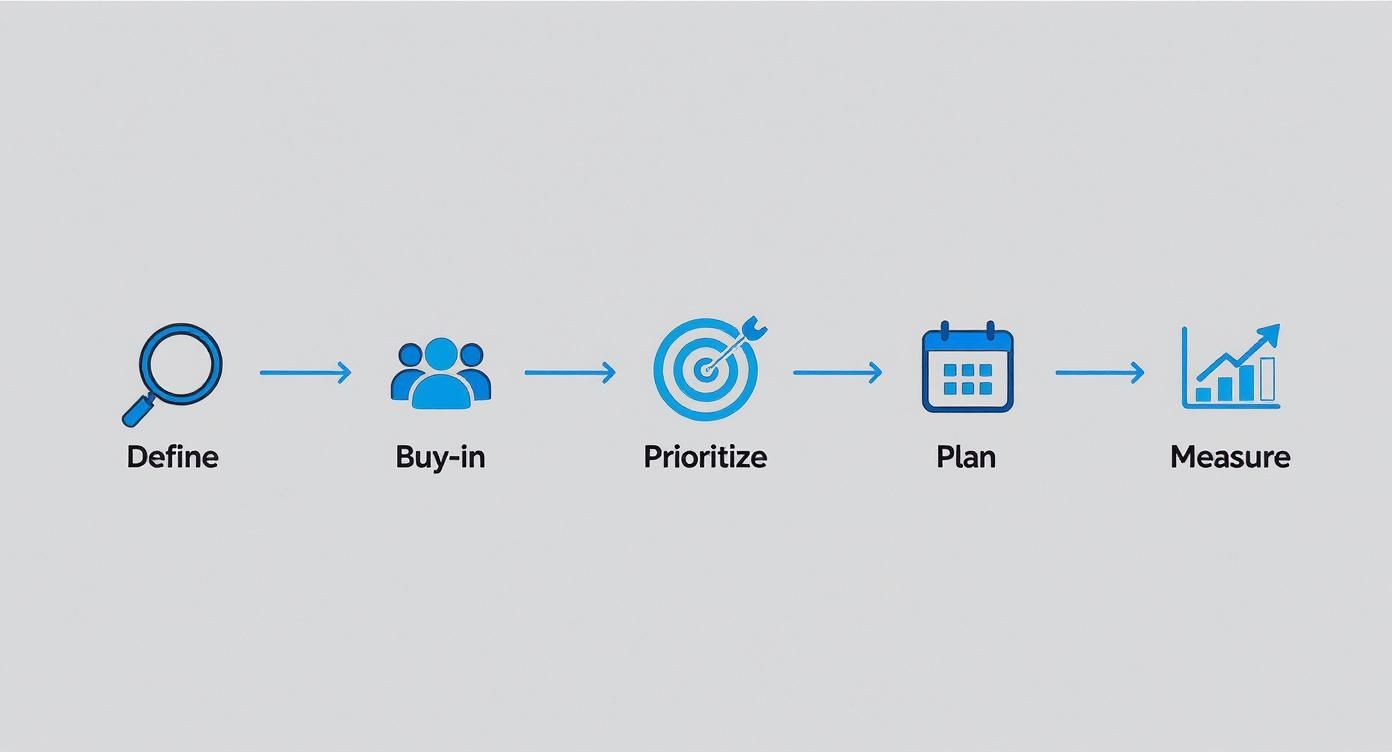
This isn't an accident. Measurement isn't just the end of the line; it’s the feedback loop that helps you refine and improve your entire strategy over time.
A Straightforward Approach to Calculating ROI
Calculating Return on Investment (ROI) is how you prove your strategy’s financial worth. The formula itself is simple—ROI = (Net Profit / Total Investment) x 100—but the real work is in figuring out what goes into those numbers.
Your "Net Profit" isn't just about hard cost savings. It also includes the strategic benefits you've gained.
Impact Opportunity: Don’t get stuck only looking at cost-cutting. Strategic wins like improved market agility or a stronger brand reputation deliver massive long-term value. For example, being able to launch a new service 50% faster than your competitors is a significant advantage that’s worth its weight in gold.
On the other side of the equation, your "Total Investment" needs to be comprehensive. Account for everything: software licenses, implementation partners, employee training, and ongoing maintenance. Being thorough here makes your final ROI calculation credible and defensible.
A disciplined approach to reporting and analytics is what pulls all this together, giving you the structured data you need to run the numbers with confidence. By tracking these metrics consistently, you turn your strategy from a set of ideas into a measurable engine for growth.
Common Pitfalls and How to Avoid Them
Let's be honest: digital transformation is a high-stakes game. For every success story, there are countless initiatives that stall out, failing to deliver anything close to their promised value despite huge investments.
Knowing where things usually go wrong is the first step to getting it right.
One of the biggest mistakes is treating transformation like an IT project. When the focus is all on the shiny new software and not the people who have to use it, you’re practically begging for low adoption and active resistance. Remember, people are the engine of change; technology is just the vehicle.
Another classic killer is organizational silos. When marketing, sales, and operations are all running their own separate plays, guarding their own data, and refusing to communicate, it’s impossible to build the seamless customer experience that a true transformation is supposed to create.
Navigating the Most Common Challenges
Dodging these bullets isn't about having a perfect plan from the get-go. It’s about building a resilient strategy that anticipates the human side of change and can adapt when things get messy.
Key Takeaways: Most failures boil down to a few core issues: a tech-only focus, a fuzzy vision from leadership, and deep-seated organizational silos. Success depends on tackling these human and structural problems with the same energy you put into the tech.
The numbers don't lie. One study found that only 35% of global digital transformation efforts actually hit their targets. But here’s the kicker: the same research showed that companies with a comprehensive strategy—one that tightly aligns new tech with clear business goals—saw their success rates triple. You can discover more insights on transformation challenges and see what separates the winners from everyone else.
So, how do you stack the odds in your favor?
- Lead with a People-First Mindset. Don't just install software; invest heavily in change management. This means constantly communicating the "why," providing hands-on training that makes sense for different roles, and creating real feedback loops to hear and address what your team is worried about.
- Establish a Dedicated Transformation Team. You can’t break down silos from inside a silo. Form a cross-functional team with members from IT, sales, marketing, and operations. This group becomes your internal coalition, ensuring the strategy solves real-world problems and building momentum across the company.
- Secure Vocal Leadership Buy-In. A weak vision from the top is a death sentence. Leaders need to do more than sign checks. They have to be the biggest champions of the change, model the new ways of working, and be ready to step in and clear roadblocks for their teams.
By getting ahead of these common obstacles, you can turn potential points of failure into genuine strategic advantages and dramatically increase your chances of a successful, lasting transformation.
Frequently Asked Questions
When you start digging into a real-world digital transformation strategy, the practical questions quickly bubble up. Let's tackle some of the most common ones to give you a clearer picture of the road ahead.
How Long Does a Digital Transformation Strategy Take to Implement?
This is probably the most common question, and the honest answer is: it’s not a one-and-done project. Think of it as an ongoing evolution, not a race with a finish line.
That said, you absolutely should see tangible results from your first few projects within 6-12 months. The key is to design a strategy that delivers early, high-impact wins. This approach proves the value of the investment right away, which is crucial for getting everyone on board for the long haul. It builds momentum while you work toward the bigger vision of continuous improvement.
Digital Transformation vs. AI Transformation: A Quick Comparison
It's easy to get these two mixed up, but telling them apart is critical for planning how you'll spend your time and money.
Digital transformation is the broad, foundational overhaul of your company's processes, tools, and technology. AI transformation is a specialized layer that uses artificial intelligence to make those newly upgraded systems smarter.
In simple terms, digital transformation builds the modern house—the new CRM, the cloud data warehouse, the updated marketing automation. AI transformation is what you plug into that house to make it intelligent, like predictive lead scoring that tells you which deals to chase or a chatbot that automates customer service. You really need the first to make the second work.
Can a Small Business Implement a Digital Transformation Strategy?
Absolutely. This isn't just a game for enterprise giants. For a small business, transformation isn't about dropping six figures on massive software suites. It’s about applying the same core principles: using digital tools to work smarter and create better customer experiences.
For a small business, this might look like:
- Switching to cloud-based accounting tools to automate invoicing and get paid faster.
- Using a simple, affordable CRM like HubSpot or Zoho to keep track of every client relationship.
- Digging into social media analytics to figure out what your customers actually want to see.
The goal is the same no matter your size: use technology to solve real business problems and make your customers happy.
How Do You Get Employee Buy-In for Digital Transformation?
This is non-negotiable. If your team isn't on board, even the best strategy will stall out. You can't just drop a new tool on them and expect a standing ovation; buy-in has to be earned.
Success comes down to great change management. You have to communicate the "why" behind every change, clearly and consistently. Show people how these new tools will make their jobs easier, not harder—like automating the mind-numbing reports they hate building every month.
Provide solid training, get your team involved in picking and testing the new software, and celebrate the early wins publicly. When people see their peers succeeding and their own frustrations disappearing, you'll start building the positive momentum you need to make the change stick.
Ready to turn all this theory into a concrete plan? The team at Prometheus Agency builds actionable roadmaps that transform your tech stack into a genuine revenue-generating system. We can start by pinpointing your biggest opportunities with a complimentary Growth Audit and AI strategy session.
Find out more at https://prometheusagency.co.