At its core, the change management process is a structured approach to guiding people—not projects—through big organizational shifts to hit specific business goals. It's the human-centric playbook for getting buy-in, minimizing resistance, and making sure a new technology, process, or strategy actually sticks around.
Key Takeaways
- Human-Centric Playbook: Change management is not about managing projects, but about guiding the people affected by the change. Success hinges on employee adoption.
- Structured Process: It's a formal, systematic approach with clear phases—not an improvised effort. This provides a repeatable framework for any organizational shift.
- Business Goal Alignment: Every change initiative must be directly tied to a measurable business outcome, ensuring a clear return on investment (ROI).
- Resistance is Normal: A key part of the process is anticipating, understanding, and addressing the natural human resistance to change through clear communication and support.
What Is The Change Management Process, Really?
Imagine a city deciding to overhaul its entire subway system. The project managers are busy laying new tracks and bringing in modern trains. But the change managers? They’re focused on the people.
Their job is to make sure riders understand the new routes, know how to use the new payment cards, and ultimately feel good about the whole upgrade. Without that human focus, the city gets a shiny new system that no one uses correctly, leading to total chaos and a massive waste of money.
That’s exactly what change management does inside a company. It isn't just about sending an email announcing a change. It's the deliberate, systematic work of preparing, equipping, and supporting every single person to adopt a new way of working.
To put it simply, here’s a breakdown of the fundamental pillars that make up a successful change management process. Each component works together to ensure a transition is not only implemented but truly embraced.
Core Components Of The Change Management Process
| Component | Description | Business Impact |
|---|---|---|
| Human-Centric Focus | Prioritizes the people side of change, recognizing that success hinges on employee adoption, not just technical deployment. | Increases employee morale, reduces turnover during transitions, and builds a more resilient and adaptable workforce. |
| Structured Methodology | A formal process with distinct phases, strategies, and tools—not just an improvised, "let's see what happens" effort. | Provides a predictable, repeatable framework for managing any type of organizational shift, improving consistency and outcomes. |
| Business Goal Alignment | Ensures every change initiative is directly tied to a measurable business outcome, like higher revenue or better efficiency. | Guarantees that the effort and resources invested in the change deliver a tangible return on investment (ROI). |
| Resistance Mitigation | Actively anticipates, understands, and addresses the natural human resistance to change through clear communication and support. | Minimizes productivity dips, prevents active sabotage of new initiatives, and accelerates the timeline for full adoption. |
In essence, these components transform change from a top-down mandate into a collaborative journey, ensuring the human element is always at the center of the strategy.
The Real-World Impact
Mastering change management isn't just a "nice-to-have"—it's a massive competitive advantage. Most companies are terrible at making transformations stick.
While a staggering 96% of companies report they're in some phase of transformation, a brutal 70% of those change initiatives fail. The number one reason? A lack of employee buy-in. This reveals a huge gap between the need for change and the ability to actually pull it off. You can get a deeper look into the fundamentals of what change management entails to understand why.
A solid change management process closes that gap. Instead of forcing changes that just create resentment and kill morale, you build a team that's ready and willing to embrace what's next. This directly impacts the bottom line by speeding up the adoption of new tools, cutting down on the productivity slumps that always come with transitions, and making sure you see the full ROI on your big bets.
Practical Example: Failed ERP Rollout
A manufacturing company invested millions in a new Enterprise Resource Planning (ERP) system. The project team focused entirely on the technical launch, which went flawlessly. However, they provided only a single, generic training session and no follow-up support. The warehouse staff, finding the new system confusing, reverted to their old spreadsheet-based methods. The result? Inaccurate inventory data, shipping delays, and zero return on the massive technology investment—a classic failure of change management.
Impact Opportunity
The biggest opportunity lies in closing the gap between strategy and execution. By focusing on the human side of change, organizations can dramatically increase the success rate of their most critical initiatives. This transforms change management from a simple support function into a strategic driver of competitive advantage, ensuring that every dollar invested in new technologies or processes delivers its maximum intended value.
Exploring Essential Frameworks and Core Stages
Every organizational shift has its own quirks, but the path forward usually follows a surprisingly universal, three-stage journey. Think of it like building a house: you can’t hang pictures on the walls before you’ve poured the foundation. Success hinges on moving logically from preparation, to active management, and finally, to reinforcement.
Understanding these stages gives you a reliable roadmap, turning what could be a chaotic transition into a predictable sequence of actions. They’re the backbone of any effective initiative, no matter how big or small.
This structure is all about connecting a solid plan, the people involved, and the ultimate business goals.
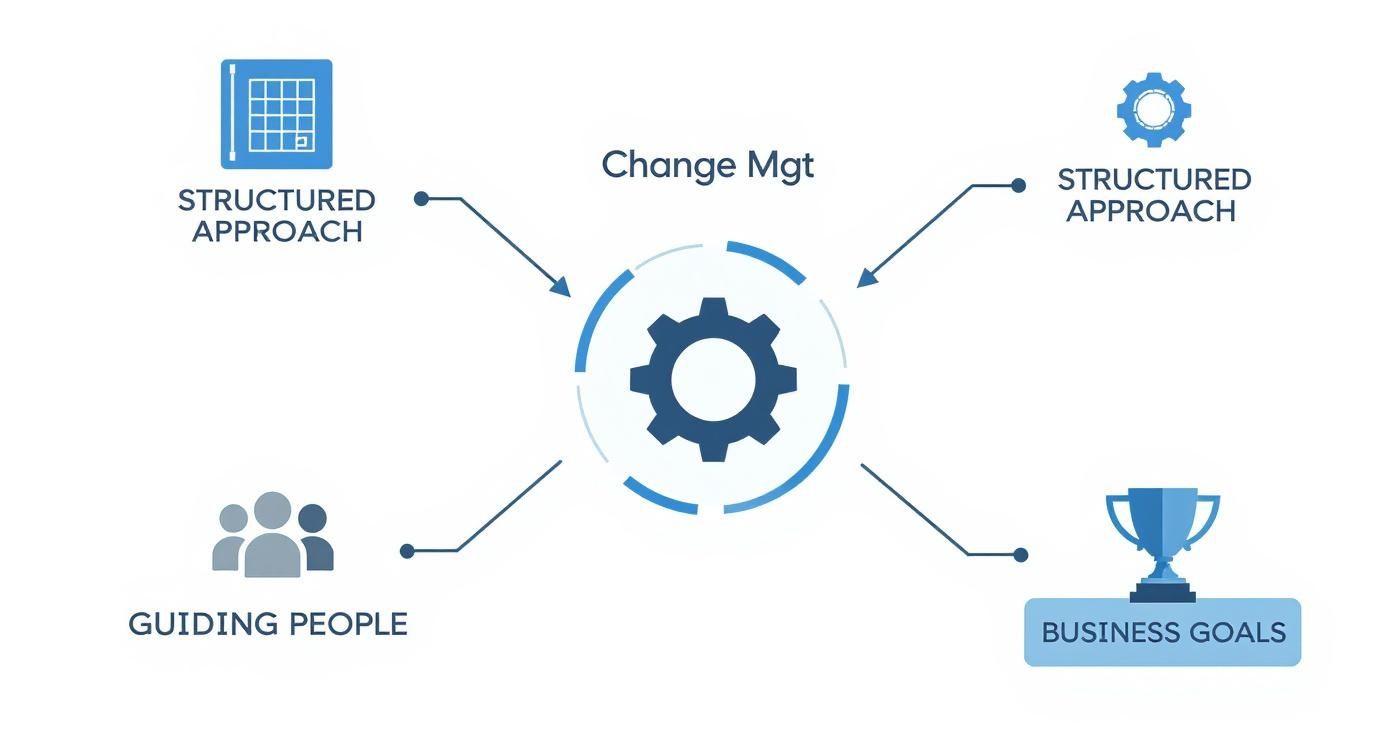
As you can see, real success isn't just about the technical plan. It's about strategically aligning the human element with concrete business objectives through a structured methodology.
The Three Core Stages of Change
Let's break down what each stage looks like in the real world.
Prepare for Change This is your foundation. It's all about assessing the impact and getting your organization ready. You're defining the change strategy, figuring out who will be affected, and anticipating challenges before they even pop up.
- Practical Example: Before rolling out a new CRM, a company runs readiness assessments. They interview sales managers to map out current workflow pain points and survey frontline reps to gauge their technical skills and initial buy-in. This data spots potential resistance early on.
Manage the Change Here, the plans you laid out are put into motion. This stage is all about communication, training, coaching, and dealing with resistance as it happens. It’s the most active and visible part of the entire process.
- Practical Example: During the CRM launch, the project team runs a detailed communication plan with weekly email updates, live Q&A sessions with the project sponsor, and targeted training workshops built specifically for the sales and marketing teams' different needs.
Reinforce the Change The final stage ensures the new way of doing things actually sticks. This means collecting feedback, diagnosing gaps, making adjustments, and celebrating successes. Skip this, and you’ll find people sliding right back into their old habits.
- Practical Example: Six weeks after the CRM go-live, the company analyzes adoption data. They see the marketing team is all in, but the sales team is lagging. They celebrate marketing's win publicly and kick off a "power user" coaching program where top-adopting salespeople mentor their peers, reinforcing the new behavior.
Demystifying Leading Change Management Frameworks
While the three stages tell you what to do, frameworks offer the how. Two of the most proven and respected models out there are Prosci's ADKAR Model and Kotter's 8-Step Process.
A structured process isn't about adding bureaucracy; it’s about removing uncertainty. By systematically preparing, managing, and reinforcing change, you give your teams the clarity and support they need to move from resistance to adoption—directly impacting how fast you see results.
Prosci ADKAR Model: A Person-Centric Approach
The ADKAR model is brilliant because it zeroes in on the individual's journey. It gets that an organization doesn't change until each person makes their own successful transition. ADKAR is an acronym for the five outcomes someone needs to hit for a change to succeed.
- Awareness of why the change is needed.
- Desire to jump in and support it.
- Knowledge of how to make the change.
- Ability to use the new skills and behaviors.
- Reinforcement to make the change last.
Use ADKAR as a diagnostic tool. When a change stalls, you can pinpoint where people are getting stuck. Are they lacking Awareness (they don't get the "why") or Ability (they don't have the skills)? This lets you deliver targeted help instead of generic, one-size-fits-all fixes. For a complex project like a full-scale CRM implementation, this focused approach is absolutely crucial to make sure every stage is handled correctly.
Kotter's 8-Step Process: A Top-Down Transformation Engine
Developed by Harvard Professor John Kotter, this model is built for large-scale, organization-wide transformations. It’s a top-down approach that relies on strong leadership to build and sustain momentum across the entire company. It’s less about individual psychology and more about creating the right environment for change to flourish.
Kotter's 8 Steps for Leading Change
| Phase | Steps |
|---|---|
| Create a Climate for Change | 1. Create a Sense of Urgency 2. Build a Guiding Coalition 3. Form a Strategic Vision and Initiatives |
| Engage and Enable the Org | 4. Enlist a Volunteer Army 5. Enable Action by Removing Barriers 6. Generate Short-Term Wins |
| Implement and Sustain | 7. Sustain Acceleration 8. Institute Change |
Choosing between these frameworks isn't about which one is "better." It's about which one is better for your initiative. ADKAR is your go-to for ensuring person-by-person adoption, while Kotter gives you a powerful roadmap for driving massive, structural shifts from the top down.
Defining Roles And Measuring What Matters
Trying to lead a major change without clearly defined roles is like sailing a ship in a storm with no one assigned to the helm, the sails, or the navigation. You can have a lot of people working hard, but without coordination, you’re just creating chaos.
Pinpointing who does what is the step that turns a change management plan from theory into a powerful, coordinated effort.
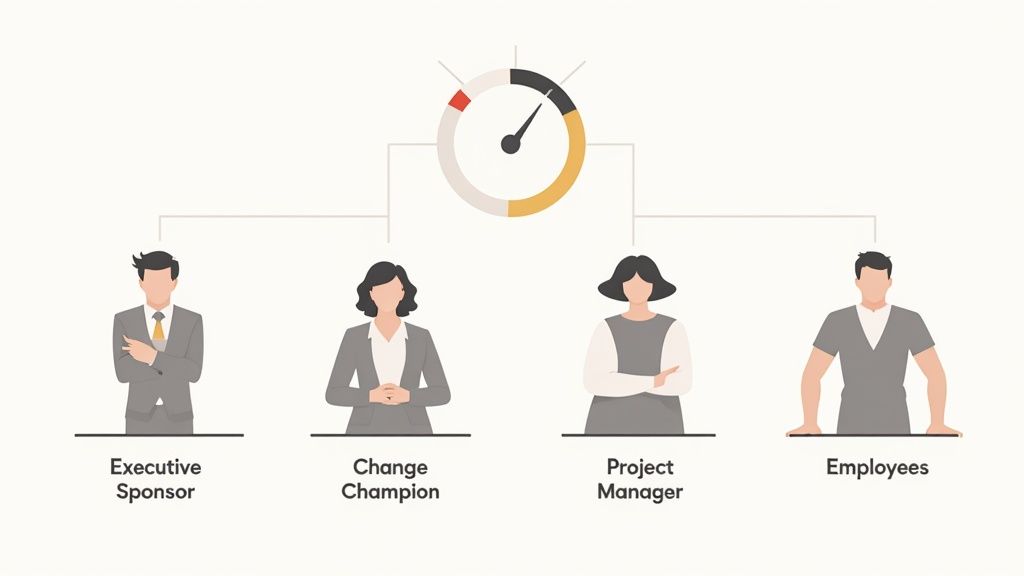
This structured approach ensures every part of the transition, from the C-suite vision down to the on-the-ground support, has an owner. It builds an unstoppable coalition to guide everyone through the shift smoothly.
The Core Players In Your Change Initiative
While the job titles might differ from company to company, most successful change projects depend on a few key players working in sync. Each role serves a distinct purpose, and if you’re missing even one, you'll likely hit some serious roadblocks.
To make this crystal clear, here’s a breakdown of who you need on your team.
Key Roles In The Change Management Process
| Role | Primary Responsibility | Key Contribution |
|---|---|---|
| Executive Sponsor | To champion the change at the highest level, secure resources, and communicate the vision. | Provides authority, credibility, and top-down momentum, removing organizational barriers. |
| Project Manager | To manage the technical side of the project—the timeline, budget, and deliverables. | Ensures the "solution" (e.g., new software, process) is delivered on time and within scope. |
| Change Manager | To focus on the people side of the change, including communication, training, and resistance management. | Drives adoption and ensures employees are ready, willing, and able to embrace the new way of working. |
| Change Champions | To act as influential grassroots advocates who support the change within their teams. | Builds peer-to-peer trust, provides real-world feedback, and helps normalize the new behaviors. |
Each person has a lane, but they all need to be moving in the same direction. For a more granular way to define who does what, you can use a Responsibility Assignment Matrix to map out every task.
Measuring Success Beyond The Checklist
So, how do you actually prove your change management plan is working? Just ticking a box that says "training complete" is not nearly enough.
Real success is measured in tangible business outcomes and visible shifts in behavior, not just by how many activities you completed.
Key Takeaway: The goal isn't just to "manage" change; it's to achieve desired business results. Effective measurement connects your change activities directly to KPIs that the C-suite cares about, demonstrating a clear return on investment.
This mindset shift moves the conversation from, “Did we do the thing?” to, “Did the thing we did actually work?”
Practical KPIs For Real-World Impact
To show your value, your metrics have to be specific, measurable, and tied directly to the initiative’s goals. Remember, strong leadership is what reinforces these new behaviors and helps you hit your KPIs. You can learn more about how human-centric leadership drives team performance in our related article.
Here are a few practical examples of what to track:
Adoption and Utilization Rates: Go beyond asking if people are using the new CRM. Measure how they're using it. Are 85% of sales reps logging activities daily? Are specific high-value features getting consistent use?
Proficiency and Competency Scores: Don’t just track who showed up for training. Use pre- and post-training assessments to measure what people actually learned. Then, follow up with on-the-job evaluations to see if that knowledge translated into skill, aiming for a 70% increase in proficiency.
Speed of Adoption: How fast are people getting up to speed? Measure the time it takes from "go-live" to when an employee can use the new tool competently. Your goal could be to cut this period by 30% compared to your last rollout.
Impact on Business Metrics: This is the ultimate proof. You have to connect the change directly to core business drivers. Did the new go-to-market strategy lead to a 15% increase in qualified leads? Did the new AI tool cut customer service response times by 40%?
When you focus on these outcome-driven metrics, you can clearly articulate the business value of your work. You’ll have undeniable evidence that your change management efforts aren’t just a cost center—they're a direct contributor to growth and success. That's how you make change management a strategic imperative, not just a soft skill.
Your Step-By-Step Digital Transformation Playbook
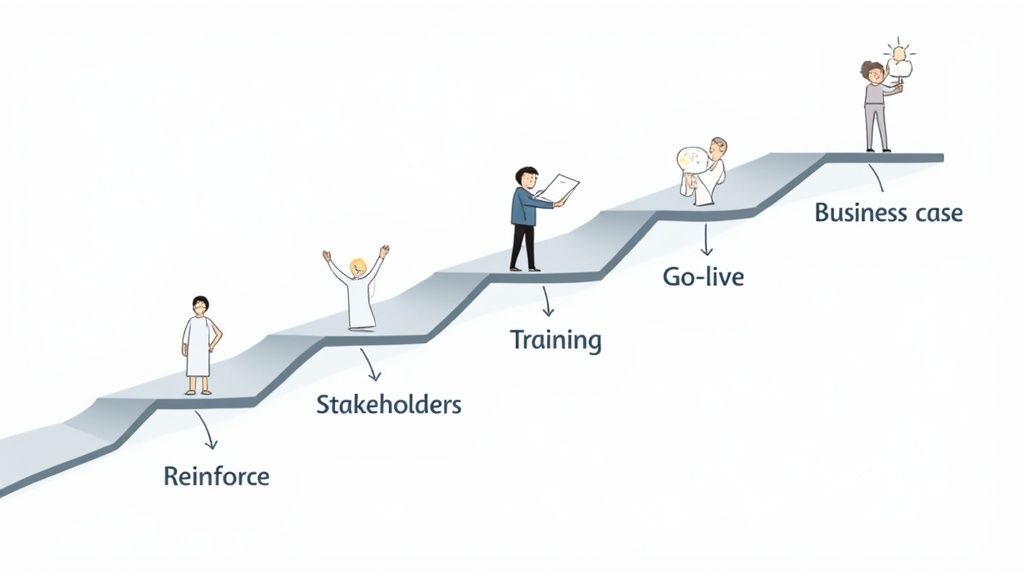
Knowing the frameworks is one thing. Putting them to work during a high-stakes digital transformation is another beast entirely. Whether you're rolling out a new CRM or weaving AI into your workflows, this hands-on playbook gives you a clear, actionable blueprint to get you from concept to lasting adoption.
This isn't about theory; it's about execution. Follow these phases to turn complex strategy into concrete results, minimize disruption, and actually see a return on your tech investment.
Phase 1: Build The Business Case And Vision
Before anyone writes a single line of code or buys a new license, you need a rock-solid business case. This phase is all about defining the "why" in a way that clicks with everyone, from the C-suite to the folks on the front lines.
Your job here is to paint a compelling picture that ties the transformation directly to business outcomes. Forget the tech jargon. Focus on tangible benefits—things like cutting down manual work, speeding up sales cycles, or making customers stick around longer.
Practical Example: New CRM Implementation A company is stuck with an outdated, clunky CRM. Instead of just saying, "we need a new system," they build a case showing the old one costs them $250,000 a year in lost productivity from slow performance and data entry mistakes. The new CRM is projected to boost sales team efficiency by 20%, bringing in an estimated $1.2 million in new revenue within 18 months. Now that's a why.
Phase 2: Engage Stakeholders And Build A Coalition
With a clear vision locked in, it's time to get the right people in your corner. This is where you identify key stakeholders, lock down executive sponsorship, and build a small army of change champions who will advocate for the project across the organization.
Getting people on board is more than just sending a company-wide email. It means actively listening, answering the tough questions, and pulling them into the planning process to create a sense of shared ownership.
A digital transformation succeeds or fails based on the strength of its human network. Your most powerful tool isn't the new software; it's the influential and trusted coalition you build to champion its adoption from the inside out.
Phase 3: Plan And Execute Go-Live
Here’s where the technical and logistical work happens. The go-live phase covers detailed project planning, system configuration, data migration, and—most importantly—rolling out solid communication and training plans. A perfect technical launch is useless if your team doesn't know how to use the new tools on day one.
Training can't be one-size-fits-all. A sales team needs a completely different curriculum for a new CRM than the marketing team does. At Prometheus Agency, we live by this. We build targeted training and often compile our best strategies into resources like our guide to HubSpot Quick Wins.
Artificial Intelligence (AI) is also becoming a huge help here. Organizations are now using AI-driven tools to personalize communications, track adoption in real-time, and even gauge how ready the team is for change. AI can run sentiment analysis to spot resistance early, letting you step in with support that actually helps. You can discover more insights about AI's role in change management and how it's shaping the modern workplace.
Phase 4: Drive Adoption And Reinforce New Behaviors
The system is live, but the job isn't done. Not even close. This final, ongoing phase is all about making the change stick. It means monitoring who's using the new tools, gathering feedback, offering continuous support, and celebrating early wins to build momentum.
Reinforcement creates a positive feedback loop. When people see their colleagues crushing it with the new system and hear leaders celebrating those wins, they're far more likely to jump on board. This is where the real ROI of all your hard work finally shows up.
Practical Example: AI Tool Adoption A marketing team rolls out an AI tool for content creation, but adoption is flat. Instead of sending another generic email, they find a few "power users" and showcase how they've cut their research time by 50%. They create quick video tutorials featuring these champions and offer one-on-one coaching, boosting team-wide adoption by 70% in a month.
Key Takeaways
- Start with "Why": A strong, data-driven business case is the bedrock of any successful transformation.
- People First: You absolutely need a coalition of sponsors and champions to drive support from the ground up.
- Tailored Execution: Cookie-cutter training and communication plans are a recipe for failure.
- Reinforce Relentlessly: Adoption isn't a one-and-done event. It requires continuous support, feedback, and celebration.
Impact Opportunity By following this playbook, you can turn a potentially chaotic tech project into a strategic advantage. The real opportunity isn't just to install new software—it's to build a more agile, adaptable, and efficient organization along the way. A structured approach ensures you squeeze every drop of value from your digital investments.
Avoiding The Most Common Change Management Pitfalls
Most change initiatives don’t fail because the new tech is faulty or the strategy is off. They fail because of predictable human factors. Getting ahead of these challenges is the secret to building a change management process that holds up under real-world pressure.
Think of this as your risk management guide. When you know where the traps are, you can navigate around them and make sure your project is one of the few that actually succeeds.
Let’s get into the most critical pitfalls.
Pitfall One: Weak Executive Sponsorship
A visible and active executive sponsor isn’t a nice-to-have; it's the single most important factor in whether a change sticks. When leadership is disengaged, it sends a loud—and damaging—message to everyone else.
What it looks like: The sponsor kicks off the project with a big announcement and then vanishes. They skip key meetings, delegate away critical decisions, and don’t publicly back the change, leaving the project team powerless to clear roadblocks.
How to avoid it: From day one, define the sponsor's role with crystal-clear expectations. They need to be regularly communicating the vision, actively showing up to steering committee meetings, and using their influence to get resources and shut down conflicts. Their engagement has to be consistent and seen by everyone.
Pitfall Two: Poor Communication
When there’s no clear, consistent information, people will fill the silence with rumors and fear. This "change vacuum" is where misinformation spreads, resistance builds, and morale tanks.
What it looks like: The project is announced in a single all-hands meeting, followed by weeks of radio silence. Employees start hearing conflicting stories from different managers, and there's no official way to ask questions or give feedback.
How to avoid it: Create a communication plan with a steady rhythm of updates across multiple channels. Mix it up with emails, team huddles, and Q&A sessions to share progress and address what’s on people’s minds. Most importantly, create dedicated feedback loops so employees feel heard, not just talked at.
Pitfall Three: Underestimating Employee Resistance
Resistance isn’t just negativity—it’s a completely natural human reaction to being disrupted. If you ignore it or just assume everyone will "get on board," you’re setting yourself up for failure.
A common mistake is treating resistance as a problem to be squashed. It’s actually valuable data. Resistance often points to a lack of awareness or a gap in training, giving you a clear roadmap for where to focus your support.
This is especially true as change fatigue kicks in. Only about 43% of employees now believe their organizations manage change well, a huge drop from past years. How you implement matters. Companies that use an employee-driven approach finish their transformations about 33% faster than those who push from the top down.
Pitfall Four: Declaring Victory Too Early
Change doesn’t end the day you go live. Real adoption only happens when the new way of doing things becomes the default. If you celebrate too soon and pull back support, old habits will creep right back in, undoing all your hard work.
What it looks like: The project is marked "done" the day the new system launches. The project team is disbanded, training guides disappear, and nobody follows up to measure adoption or reinforce the new workflows.
How to avoid it: Plan for a long-term reinforcement phase. Keep a close eye on your adoption metrics, gather feedback for ongoing tweaks, and publicly celebrate the people and teams who are crushing it with the new way of working. Make reinforcement an active, long-term habit.
Key Takeaways
- Sponsorship is Non-Negotiable: An active, visible executive sponsor is the number one predictor of success.
- Communicate Relentlessly: You cannot over-communicate during a change. A lack of information creates fear and resistance.
- Resistance is Data: Treat employee resistance as valuable feedback that highlights gaps in your plan, not as a problem to be suppressed.
- Reinforce Past Go-Live: The project isn't over at launch. The reinforcement phase is what makes the new behaviors stick and delivers long-term value.
Impact Opportunity By proactively addressing these common pitfalls, you shift from a reactive to a strategic posture. The opportunity is not just to avoid failure, but to build a resilient change management process that increases employee trust, accelerates adoption, and ensures that your strategic initiatives consistently deliver their promised results. This builds organizational change capability for the long term.
The Bottom Line on Making Change Work
When you boil it all down, steering any big organizational shift comes back to a handful of core ideas. Getting the change management process right means you’ve moved past just rolling out a new tool. Instead, you're focused on how your people will actually adopt it, use it, and ultimately, benefit from it. The road can be bumpy, but the essentials for success are refreshingly simple.
At its heart, change is a human journey. No fancy framework or meticulously crafted project plan will ever work without genuine buy-in, crystal-clear communication, and unwavering support for the people on the front lines.
Core Principles to Make Change Stick
To make sure your next big move actually delivers on its promises, zero in on these non-negotiables:
- Put People First: Real success is measured by adoption, not installation. You have to start by understanding where your employees are coming from. Anticipate resistance—it’s just feedback in disguise—and build a rock-solid support system with open communication and training that’s easy to access.
- Lean on a Proven Framework: Don’t just wing it. Models like ADKAR or Kotter's 8-Step Process give you a reliable roadmap. They provide a structured path to prepare for, manage, and lock in the change, taking the guesswork out of the equation so you don’t miss a critical step.
- Define Who Does What: Any change initiative needs a dedicated crew. You need an active executive sponsor to lend authority and credibility, plus a team of change champions on the ground to build that grassroots momentum. When everyone knows their role, you avoid chaos and create a powerful force for success.
- Get Ahead of the Risks: The most common landmines—bad communication, a sponsor who’s checked out, or celebrating a win way too early—are completely predictable. If you can see them coming, you can build a plan to sidestep them from day one. That’s how you build resilience into your strategy.
The real goal here isn’t just to get through one project. It’s to build change into your company’s DNA. Every successful transformation makes your organization better at adapting, innovating, and growing, turning what could be a painful disruption into a real competitive edge.
The Big Opportunity
The single most powerful thing you can do is shift your mindset. Stop seeing change as a one-off, disruptive headache.
Instead, treat the what is change management process as a continuous cycle of improvement that builds a stronger, more agile business. This simple switch changes everything. You’ll go from just trying to survive change to using it as a deliberate strategy to make your company better from the inside out.
Common Questions Answered
When you're knee-deep in a major organizational shift, a lot of practical questions come up. Let's tackle some of the most common ones that leaders ask when they’re trying to make change stick.
What’s The Difference Between Change Management And Project Management?
It’s easy to get these two mixed up, but they have completely different jobs.
Think of it like building a new house. The project manager is the general contractor. Their job is to get the house built on time and on budget—framing, plumbing, electrical, everything. They manage the tasks, timelines, and resources to deliver the finished structure.
The change manager is the one who helps the family actually turn that house into a home. They make sure everyone knows where their new rooms are, how the fancy new appliances work, and helps them feel comfortable and settled in. Their focus is on the people—making sure the new thing is adopted, used, and ultimately delivers its intended value. You need both to succeed.
How Do You Actually Manage Resistance To Change?
First things first: resistance is normal. It’s a human reaction to disruption, not a sign you've failed. Most of the time, it comes from a place of fear—fear of losing a skill, losing status, or just fear of the unknown.
The key is to treat resistance as valuable feedback, not an obstacle. Get out in front of it by communicating the "why" behind the change, over and over again. Then, listen more than you talk. Create forums for people to voice their real concerns, and involve them in finding solutions.
When employees feel heard and have a hand in the process, they start to take ownership. And when leaders are out there, visibly championing the change every single day, it sends a powerful signal that this is the new way forward.
Which Change Management Model Is The Best One?
There’s no magic bullet here. The "best" model is the one that fits your company's culture and the specific change you’re trying to make. Don't just pick one from a textbook; think about what you actually need.
Here’s a simple way to think about it:
- Is your change focused on getting individuals to adopt a new tool or behavior? Prosci's ADKAR model is fantastic for this. It gives you a clear roadmap for one person's journey, from Awareness all the way to Reinforcement.
- Are you driving a massive, top-down cultural transformation? Kotter's 8-Step Process is your go-to. It’s built to create a powerful sense of urgency and keep the momentum going across the entire organization.
Key Takeaways
- Change vs. Project Management: One builds the tool, the other ensures people love using it. Project management delivers the output; change management achieves the outcome.
- Managing Resistance: Don't fight it—use it. Resistance is just data. Address it with relentless communication, genuine listening, and leadership that walks the talk.
- Choosing a Model: Match the model to the mission. Use ADKAR for individual adoption and Kotter for organization-wide transformation.
Impact Opportunity Understanding these concepts is the difference between just "installing" a new system and leading a true business transformation. The real opportunity isn't just to push through a project, but to use the right framework to turn natural resistance into enthusiastic buy-in. That's how you ensure your big bets actually pay off.
Ready to turn your next technology initiative into a scalable revenue system? Prometheus Agency is an AI transformation partner that helps growth leaders tame technology and accelerate adoption. Start with a complimentary Growth Audit and AI strategy session. Learn more at https://prometheusagency.co.