In today's competitive B2B market, a 'good enough' lead scoring model is a direct path to wasted resources, frustrated sales teams, and a leaky revenue funnel. Generic scoring systems often prioritize activity over intent, flooding your pipeline with leads that look busy but will never buy. The result? Sales acceptance rates plummet, marketing ROI becomes impossible to prove, and growth stalls. This isn't just a marketing problem; it's a systemic revenue problem that demands a strategic solution.
Effective lead scoring separates high-potential buyers from the noise, ensuring your sales team focuses its energy on opportunities with the highest probability of closing. It bridges the gap between marketing efforts and sales outcomes, creating a unified, efficient revenue engine. For leaders seeking predictable growth, mastering this process is non-negotiable. While many guides cover the basics, to gain a broader perspective on modern lead scoring, explore these 10 lead scoring best practices.
This guide moves beyond foundational concepts to deliver a prioritized, actionable roundup of the best practices that modern B2B growth leaders and CRM implementers use to build scalable, predictable revenue engines. We will dissect everything from AI-powered predictive models to the governance frameworks required to keep your system sharp. Each point includes practical examples, key takeaways, and a clear view of the impact opportunity for your business. Let's transform your lead scoring from a vanity metric into a strategic growth lever.
1. Align Lead Scoring with Sales Qualification Criteria (BANT/MEDDIC)
The most effective lead scoring models are not built in a marketing vacuum. They are a direct, quantifiable reflection of what the sales team defines as a qualified opportunity. One of the most critical lead scoring best practices is to mirror your sales team's established qualification framework, such as BANT or MEDDIC, within your scoring logic. When marketing's MQL criteria and sales' SQL criteria speak different languages, the entire revenue engine sputters. This alignment creates a shared vocabulary, ensuring every point assigned to a lead brings it closer to what your top-performing reps consider a winnable deal.
How to Implement BANT/MEDDIC Scoring
Translating a sales framework into a point-based system requires mapping each component to specific data points you can capture.
BANT (Budget, Authority, Need, Timeline):
- Budget: Award points for firmographic data indicating high revenue (e.g., Company Size > 500 employees = +15 points) or if a contact explicitly asks about pricing tiers on a form (+10 points).
- Authority: Assign higher scores to job titles like "Director," "VP," or "C-Suite" (+20 points) versus "Manager" or "Analyst" (+5 points).
- Need: Score high for behaviors that signal a clear pain point, such as downloading a case study on a specific problem your product solves (+15 points) or visiting a competitor comparison page (+10 points).
- Timeline: Use form fields like "Project Timeline" to award points. A selection of "Within 3 months" could be worth +20 points, while "6+ months" might only be +5.
MEDDIC (Metrics, Economic Buyer, Decision Criteria, etc.):
- Metrics: Award points if a lead downloads a ROI calculator or a whitepaper focused on performance metrics (+15 points).
- Economic Buyer: This overlaps with BANT's "Authority." Score C-level and VP titles highest, as they control the budget.
Key Takeaway
A lead scoring model is only valuable if it predicts sales success. By building it on the foundation of your sales team's proven qualification methodology, you transform it from a marketing metric into a true revenue-acceleration tool.
Practical Example
A SaaS company using MEDDIC noticed their best deals always involved a VP of Operations (the Economic Buyer) who had viewed their "ROI & Metrics" integration guide (Metrics). They re-calibrated their scoring:
- Old Model: Job Title "VP" = +15 points. Visited "Integrations" page = +5 points.
- New Aligned Model: Job Title "VP of Operations" = +25 points. Downloaded "ROI & Metrics Guide" = +20 points.
This change immediately prioritized leads that matched their ideal customer profile and demonstrated interest in key decision criteria, increasing MQL-to-SQL conversion by 30%.
Impact Opportunity
Aligning your scoring model with sales qualification frameworks directly bridges the gap between marketing efforts and sales outcomes. It reduces friction, improves lead acceptance rates, and ensures that the sales team spends their time on leads that are demonstrably closer to being revenue-ready, shortening the sales cycle.
2. Implement Explicit and Implicit Scoring (Demographic + Behavioral Signals)
A powerful lead scoring model operates on two parallel tracks: it assesses who the lead is and what the lead does. This dual-pronged approach, combining explicit demographic data with implicit behavioral signals, is a fundamental lead scoring best practice. Explicit scoring focuses on the "fit" of a lead by analyzing firmographic and demographic data like job title, company size, industry, and location. Implicit scoring measures "intent" by tracking a lead’s digital body language, such as website visits, content downloads, and email engagement.
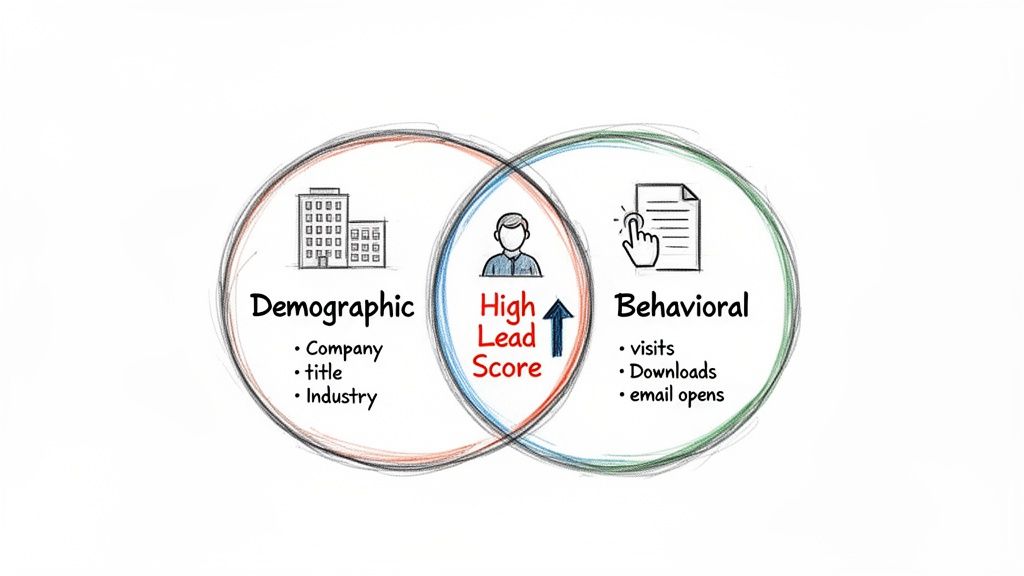
Relying on only one dimension creates critical blind spots. A high-fit lead (e.g., a CIO at a Fortune 500 company) with zero engagement is not ready for a sales call. Conversely, a highly engaged but poor-fit lead (e.g., a student downloading every whitepaper) will waste your sales team's time. A blended model ensures you only prioritize leads that are both the right person and at the right time.
How to Implement a Blended Scoring Model
Balancing explicit and implicit signals requires creating two distinct scoring categories that work in tandem. Marketing automation platforms like HubSpot and Marketo are built to manage this dual logic.
Explicit (Fit/Demographic) Scoring:
- Ideal Customer Profile (ICP) Match: Assign high scores for attributes that align perfectly with your ICP. For example, Industry: "Manufacturing" (+20 points) or Company Size: "500-2,000 employees" (+15 points).
- Disqualification: Use negative scoring to filter out poor fits. For instance, Job Title: "Student" (-50 points) or Email Domain: "@gmail.com" (-10 points).
Implicit (Intent/Behavioral) Scoring:
- High-Value Actions: Weight actions that signal strong buying intent more heavily. A "Request a Demo" form submission could be +50 points, while visiting the pricing page is +15 points.
- Engagement Recency: Implement score decay. A pricing page visit today (+15 points) is far more relevant than one from six months ago (+2 points). This ensures scores reflect current interest levels.
Key Takeaway
Lead qualification is a two-part equation: Fit + Intent. Your scoring model must solve for both variables. Explicit scoring confirms a lead is in your target market, while implicit scoring signals they are actively exploring a solution.
Practical Example
A B2B fintech company sells a compliance platform primarily to mid-market financial services firms. They struggled with low-quality MQLs.
- Old Model: Any lead who downloaded an ebook got +20 points, quickly becoming an MQL. This sent students and consultants to sales.
- New Blended Model: They created two scores. A lead needs a Fit Score of 30+ AND a Behavior Score of 40+ to become an MQL.
- Fit Score: Industry "Financial Services" = +25 points; Company Size "100-1000 employees" = +15 points.
- Behavior Score: Attended "Compliance Best Practices" webinar = +25 points; Visited pricing page = +15 points.
This change filtered out unqualified but engaged leads, increasing sales-accepted lead (SAL) rates by 45% because the sales team only received leads that matched their ideal profile and showed active buying signals.
Impact Opportunity
Combining explicit and implicit scoring dramatically improves lead quality and sales efficiency. It prevents sales reps from wasting cycles on enthusiastic but unqualified prospects and ensures they never miss an ideal-fit account that suddenly shows buying intent. This alignment creates a highly efficient pipeline where marketing delivers genuinely sales-ready leads.
3. Establish Lead Scoring Governance and Regular Recalibration
A lead scoring model is a dynamic tool, not a static monument. It begins to lose accuracy the moment it’s launched because markets shift, buyer behaviors evolve, and your own product offerings change. One of the most critical, yet often overlooked, lead scoring best practices is to treat your model like a living system that requires formal governance and scheduled maintenance. Without a structured process for review and recalibration, your once-powerful model will become stale, leading to misaligned priorities and a loss of credibility with the sales team.
How to Implement Scoring Governance
Establishing governance means creating a framework of ownership, communication, and continuous improvement. This ensures your model adapts alongside your business.
- Form a Committee: Create a cross-functional steering committee with representatives from Sales, Marketing, and Revenue Operations (RevOps). This group owns the model's performance and strategy.
- Schedule Regular Reviews: Institute a mandatory monthly or quarterly review meeting. The goal is to analyze performance data, discuss qualitative feedback from sales, and decide on necessary adjustments.
- Document Everything: Maintain a "living document" or version control system for your scoring model. Every change, no matter how small, should be recorded with the date, the rationale behind the change, and the expected impact. This creates a transparent audit trail.
- Establish a Feedback Loop: Create a simple, accessible channel for sales reps to provide direct feedback on lead quality. This could be a dedicated Slack channel or a field in your CRM.
Key Takeaway
Treating your lead scoring model as a product with its own lifecycle of updates and improvements is essential for long-term success. Governance turns a one-time project into a sustainable, revenue-driving program.
Practical Example
A mid-sized B2B tech firm noticed their MQL-to-SQL conversion rate had dropped by 15% over six months. Their scoring model, untouched for a year, was still heavily weighting downloads of an old whitepaper for a legacy feature.
- Old Process: No formal review. The model became outdated as the company pivoted its marketing focus to a new AI-powered platform.
- New Governance Process: They established a quarterly scoring council. In their first meeting, they analyzed closed-won deals and discovered that leads who attended a recent "AI Integration" webinar were 4x more likely to close. They immediately adjusted the model to heavily score that webinar attendance.
This single change, driven by a formal review process, reversed the decline in their conversion rate within one quarter.
Impact Opportunity
Implementing a governance structure prevents "model drift" and ensures your lead scoring system remains a reliable predictor of sales success. It builds trust between marketing and sales, improves lead acceptance rates, and ensures that your most valuable resources are consistently focused on leads with the highest propensity to convert, adapting in real-time to market feedback.
4. use Predictive Scoring Models (AI/ML-Based Approaches)
While rule-based scoring provides a solid foundation, one of the most powerful lead scoring best practices is to graduate to a predictive, AI-driven model. Instead of manually assigning points based on hypotheses (e.g., "VP" = +15 points), predictive scoring uses machine learning algorithms to analyze your historical sales data. The model identifies the complex, often hidden patterns and combinations of attributes that truly correlate with closed-won deals, automatically assigning a score based on conversion probability. Platforms like Salesforce Einstein and HubSpot use this to find signals that human analysis might miss, creating a more dynamic and accurate system.
How to Implement Predictive Scoring
Transitioning to an AI-based model requires clean data and a strategic approach. The core idea is to let your own success data build the model for you.
- Data Foundation: Your CRM must have sufficient, clean historical data. A common benchmark is at least 50-100 closed-won opportunities, along with a larger pool of closed-lost deals for the model to learn from. Garbage in, garbage out is the golden rule here.
- Model Training: The AI platform (like Salesforce Einstein or an embedded tool in 6sense) analyzes your historical leads and contacts, comparing those that converted against those that did not. It identifies the statistically significant firmographic, demographic, and behavioral traits of your best customers.
- Model Deployment: Once trained, the model scores new incoming leads based on how closely they match the profile of past successful deals. High scores are given to leads that exhibit the combination of traits most likely to result in a win.
Key Takeaway
Predictive scoring moves beyond educated guesses to a data-driven probability model. It answers the question, "How much does this new lead look like the ones we've actually won?" This makes it inherently more accurate and adaptable than a static, rule-based system.
Practical Example
A B2B manufacturing tech company used a rule-based model that heavily weighted "Director of Engineering" titles. After implementing a predictive model, they discovered a surprising insight: leads who downloaded their "Compliance & Safety Standards" whitepaper and worked at companies with 200-500 employees had a 4x higher conversion rate, regardless of title.
- Old Model: Job Title "Director" = +20 points. Any whitepaper download = +10 points.
- New Predictive Model: The AI automatically assigned a 92/100 score to a "Plant Manager" who downloaded the "Compliance" guide from a 350-employee company, while a "Director" from a large enterprise who downloaded a general guide only scored 65/100.
This shift surfaced a new, high-converting persona the sales team had been overlooking, leading to a significant increase in qualified pipeline from a previously untapped segment.
Impact Opportunity
Adopting predictive scoring allows your team to focus on leads with the highest statistical probability of closing, dramatically improving efficiency and forecast accuracy. It automates the discovery of your true ideal customer profile, adapts to market changes as new data is collected, and uncovers non-obvious buying signals that a manual rules-based system would almost certainly miss.
5. Define Clear MQL Thresholds and Lead Routing Logic
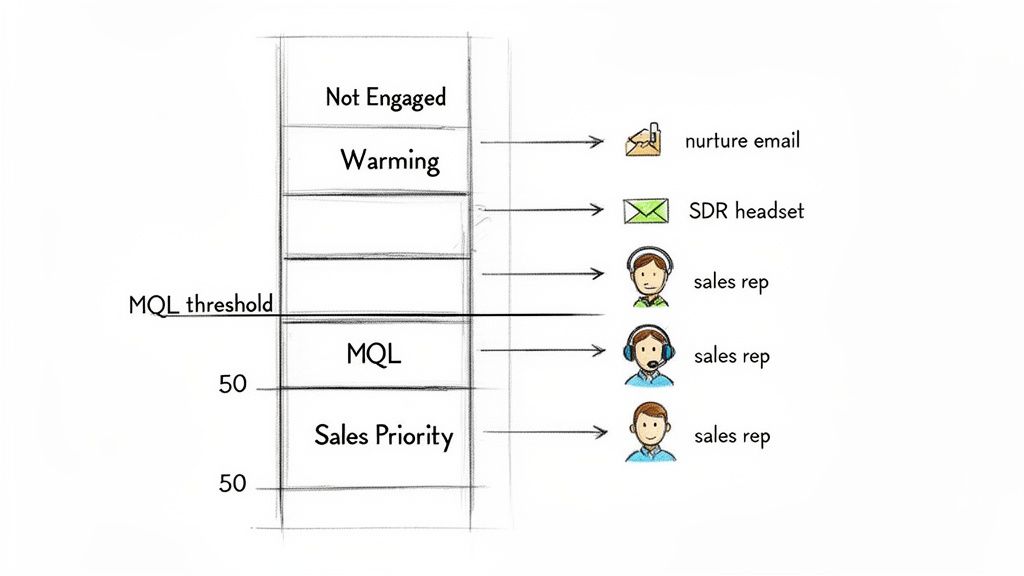
A high lead score is meaningless without clear, automated rules for what happens next. A critical lead scoring best practice is to establish an explicit threshold that defines when a prospect transitions from a marketing-engaged contact to a Marketing Qualified Lead (MQL) ready for sales. This threshold eliminates ambiguity, enabling automated routing and ensuring that the sales team receives a consistent, predictable flow of qualified opportunities. Without a defined trigger point, even the most sophisticated scoring model results in operational chaos and missed revenue.
How to Implement Data-Driven Thresholds
Setting your MQL threshold should be a data science exercise, not a gut-feeling decision. It involves analyzing historical data to find the score where lead-to-opportunity conversion rates show a significant, meaningful increase. This ensures your threshold is based on proven success patterns rather than arbitrary numbers.
- Analyze Score Bands: Group your historical leads into score ranges (e.g., 0-25, 26-50, 51-75, 76-100). For each band, calculate the actual conversion rate from lead to sales-qualified opportunity (SQL).
- Identify the Inflection Point: Pinpoint the score where the conversion rate jumps significantly. For example, if leads scoring 50-59 convert at 8%, but leads scoring 60+ convert at 35%, your MQL threshold should be set at 60 points.
- Define Routing Logic: Create simple, documented rules. For example, a score of 60+ triggers an MQL status change and immediate assignment to an SDR. Leads with a score of 40-59 enter a 30-day "fast nurture" sequence, while those below 40 remain in a long-term nurture track.
Key Takeaway
Your MQL threshold is the single most important rule in your lead management process. It acts as the gatekeeper between marketing and sales, and its effectiveness directly determines sales team efficiency and marketing ROI. Base it on historical conversion data, not guesswork.
Practical Example
A B2B manufacturing company was struggling with low lead acceptance from their sales reps. They analyzed two years of CRM data and found a clear pattern in their lead scores versus closed-won deals:
- Old Model: Any lead with a score of 50+ was routed to sales. This produced a 12% MQL-to-SQL conversion rate, and reps complained about quality.
- New Data-Driven Model: The analysis revealed that leads scoring 75 points or higher had a 45% MQL-to-SQL conversion rate. They adjusted the threshold to 75 points.
While this reduced the total volume of MQLs by 20%, the MQL-to-SQL rate more than tripled. The sales team's trust in marketing-generated leads was restored, and they began closing deals from MQLs faster.
Impact Opportunity
Implementing clear, data-backed MQL thresholds provides immediate operational clarity and efficiency. It stops the sales team from wasting time on lukewarm leads, allowing them to focus their energy on prospects with a proven, statistically significant likelihood of converting. This directly improves sales pipeline velocity, boosts morale, and strengthens the crucial alignment between marketing and sales.
6. Create Segment-Specific Scoring Models (Account-Based Marketing Focus)
A one-size-fits-all lead scoring model is a relic of outdated marketing. Today's most effective revenue teams recognize that different customer segments exhibit fundamentally different buying signals and decision criteria. Creating separate, segment-specific scoring models is a crucial best practice, especially for Account-Based Marketing (ABM) strategies, where the goal is precision over volume. A high-value signal from an enterprise prospect in the financial services vertical (e.g., downloading a compliance whitepaper) is vastly different from a key signal from an SMB in manufacturing (e.g., viewing a pricing page). Segmenting your models ensures that the score you assign is a true reflection of intent and fit within that specific context.
How to Implement Segment-Specific Scoring
Building distinct models requires you to first define your core segments and then map their unique buying journeys to specific data points. This approach moves beyond generic behavioral scoring to a highly relevant, contextual system.
Vertical-Specific Models:
- Financial Services: Award high points for engagement with content on data security, regulatory compliance (SOX, GDPR), and integration with legacy financial systems (+20 points).
- Healthcare: Score engagement with HIPAA compliance guides, patient data privacy content, and EMR/EHR integration case studies highest (+25 points).
- Manufacturing: Prioritize leads interacting with content on operational efficiency, supply chain optimization, and ROI calculators related to production uptime (+20 points).
Company Size Models (Enterprise vs. SMB):
- Enterprise: Assign significant value to engagement from multiple contacts within the same account, especially from IT or procurement titles (+30 points for 3+ contacts). High scores for downloading security documentation or implementation guides.
- SMB: Focus on signals from business owner or director-level titles. Prioritize pricing page visits, free trial sign-ups, and demo requests as high-value actions (+25 points).
Key Takeaway
Lead scoring accuracy plummets when you treat a Fortune 500 CIO and a 50-person startup founder the same. Segment-specific models ensure that your scoring logic is relevant to the unique buying committee, pain points, and sales cycle of each target audience.
Practical Example
A marketing automation platform sells to both SMBs and Enterprise clients. Their generic model treated a "demo request" as a universal +50 point action. However, they noticed Enterprise deals stalled if IT was not involved early.
- Old Model: Any "Demo Request" = +50 points.
- New Segmented Model:
- SMB Segment: "Demo Request" = +50 points.
- Enterprise Segment: "Demo Request" = +20 points, but "Downloaded Security Whitepaper" = +40 points. A combination of both signals a truly qualified enterprise lead.
This simple adjustment stopped their sales team from chasing enterprise demo requests from non-technical business users who lacked buying authority, focusing them instead on accounts showing both business need and technical validation.
Impact Opportunity
Implementing segment-specific scoring dramatically increases the relevance and predictive power of your MQLs. For ABM programs, it is non-negotiable, ensuring that account scores accurately reflect engagement from the right personas with the right content. This leads to higher MQL-to-SQL conversion rates, more productive sales conversations, and a system that intelligently prioritizes leads based on their unique market context.
7. Integrate Lead Scoring into CRM and Marketing Automation Workflows
A lead score is just a number in a database until it triggers a specific, valuable action. One of the most critical lead scoring best practices is to operationalize your model by embedding it directly into your CRM and marketing automation workflows. When a lead's score is simply a data point for manual review, its value depreciates with every passing minute. Integrating scoring with platforms like Salesforce, HubSpot, or Marketo transforms it from a passive report into an active, intelligent system that orchestrates the customer journey in real-time.
How to Implement Integrated Scoring Workflows
The goal is to create automated, score-based triggers that advance leads through the funnel without manual intervention. This ensures speed, consistency, and scalability in your lead management process.
High-Score Triggers (Sales-Ready):
- Automatic Routing: When a lead's score crosses a defined MQL threshold (e.g., > 75 points), a workflow should immediately assign it to the correct sales representative based on territory, industry, or other rules.
- Task Creation: The same workflow can create a task in the CRM (e.g., "New High-Scoring Lead: Follow Up Within 2 Hours") and send a real-time notification to the assigned rep via email or Slack.
Mid-Score Triggers (Nurturing):
- Segmented Nurturing: If a lead has a moderate score (e.g., 40-74 points), a workflow can automatically enroll them in a specific nurture campaign designed to increase their engagement and educate them further.
- Content Personalization: Different score bands can trigger different nurture paths. A lead with high firmographic but low behavioral scores might receive top-of-funnel educational content, while one with high behavioral scores gets a case study or demo offer.
Low-Score or Score Decay Triggers:
- Re-engagement: Leads with low or decaying scores can be automatically added to a long-term, low-touch re-engagement sequence to maintain brand awareness.
Key Takeaway
Lead scoring without workflow integration is like having a sophisticated car alarm that doesn't make any noise. It detects the event but fails to trigger the necessary response. Automation is what turns scoring data into immediate, revenue-driving action.
Practical Example
A B2B technology company using HubSpot noticed that leads exceeding a score of 80 had a 70% chance of closing if contacted within one hour. They built a workflow to capitalize on this insight.
- Old Process: A marketing manager manually reviewed a high-score report daily and assigned leads. The average response time was 8 hours.
- New Integrated Workflow: A HubSpot workflow now instantly triggers when a lead score is greater than 80. It simultaneously assigns the lead to a sales rep via round-robin, creates a high-priority task in their queue, and sends them a Slack notification with the lead's key details.
This automated process reduced the average lead response time to under 30 minutes and directly increased their MQL-to-opportunity conversion rate by 45%.
Impact Opportunity
Integrating your scoring model with your core sales and marketing systems closes the operational gap between identifying a good lead and acting on it. This automation eliminates human delays, ensures no qualified lead is missed, and allows your sales team to focus on selling rather than manually sorting through lists. This is a foundational element for scaling a predictable revenue engine, and professional CRM integration services can ensure these systems are flawlessly connected.
8. Implement Sales Acceptance Rate (SAR) and Lead Quality Metrics
A lead scoring model without a feedback loop is just a theoretical exercise. The ultimate test of its accuracy is not the MQL count, but whether the sales team finds the leads valuable enough to pursue. This is where Sales Acceptance Rate (SAR), the percentage of MQLs that sales accepts and works, becomes a crucial best practice. A low SAR is a direct signal that your scoring model is misaligned with sales' real-world qualification needs, delivering leads that lack quality or readiness.
How to Implement and Track Key Quality Metrics
Implementing a strong feedback system involves more than just tracking one number. It requires a suite of metrics that provide a complete picture of lead quality and scoring model performance.
- Sales Acceptance Rate (SAR): This is your primary health metric. Calculate the percentage of MQLs passed to sales that are officially accepted or moved to a "working" stage in the CRM within a defined SLA. A healthy benchmark for most B2B organizations is 75-85%.
- MQL-to-SQL Conversion Rate: This tracks the percentage of MQLs that progress to a Sales Qualified Lead or Opportunity stage. It measures how effectively your scoring identifies leads with genuine purchase intent.
- Sales Cycle Length by Score Band: Analyze if leads with higher scores truly close faster. If a lead with a score of 150 has the same sales cycle length as one with a score of 80, your high-value scoring criteria may be inaccurate.
- Win Rate by Score Band: The most definitive metric. Leads with the highest scores should have a demonstrably higher win rate. If not, your model is not correctly identifying your ideal customer profile and buying signals.
Key Takeaway
Your lead scoring model is not a "set it and forget it" system. It's a dynamic tool that must be continuously validated against real-world sales outcomes. SAR and related conversion metrics are the data-driven feedback mechanism that turns a good model into a great one.
Practical Example
A mid-market SaaS company was proud of generating 500 MQLs per month but suffered from low sales morale. An audit revealed their SAR was a dismal 45%. Sales reps were rejecting leads primarily because they came from the wrong industry verticals.
- Old Model: Focused broadly on job titles and content downloads, regardless of industry.
- New Aligned Model: They introduced negative scoring for non-target industries (-50 points) and added +20 points for leads from their top three target verticals. They also implemented a simple "Reject Reason" field in their CRM.
Within two months, their MQL volume dropped to 350, but the SAR jumped to 79%. The sales team was now spending their time on fewer, but significantly better, leads, which increased the MQL-to-opportunity conversion rate by 40%.
Impact Opportunity
Focusing on SAR transforms the conversation between sales and marketing from one of quantity ("we need more leads") to one of quality ("we need better leads"). This alignment builds trust, reduces wasted sales effort on unqualified prospects, and directly improves the efficiency and predictability of your revenue pipeline.
9. Use Negative Scoring and Disqualification Rules to Filter Waste
While positive scoring is essential for identifying high-potential leads, a truly efficient model also actively filters out unsuitable prospects. One of the most impactful lead scoring best practices is implementing negative scores and hard disqualification rules. This approach prevents sales reps from wasting valuable time on leads that will never convert, such as competitors, students, or companies from unsupported regions. By actively removing noise from the system, you enable your team to focus exclusively on prospects with genuine potential.
How to Implement Negative Scoring and Disqualification
Applying this strategy involves defining clear "anti-ICP" (Ideal Customer Profile) attributes and engagement patterns that signal a poor fit or declining interest.
- Explicit Disqualification: This involves automatically flagging and removing leads from the active sales queue based on specific criteria.
- Firmographics: Automatically disqualify leads from competitor domains (
@competitor.com), companies with fewer than 10 employees, or those in geographies you do not serve. - Demographics: Filter out job titles that have no purchasing influence, such as "Intern," "Student," or "Freelancer."
- Firmographics: Automatically disqualify leads from competitor domains (
- Negative Scoring: This method de-prioritizes leads without completely removing them, which is useful for prospects who were once a good fit but have gone cold.
- Engagement Decay: Apply negative points for prolonged inactivity. For example, a lead that has not opened an email or visited the site in 60 days could receive -20 points.
- Low-Value Actions: Assign negative scores for actions that indicate a lack of serious interest, such as visiting only the "Careers" page (-15 points).
Key Takeaway
An effective lead scoring system is as much about exclusion as it is about inclusion. Negative scoring and disqualification rules are crucial for protecting your sales team's most valuable resource: their time. It shifts the model from simply collecting leads to curating a high-quality pipeline.
Practical Example
A manufacturing software company noticed its sales reps were spending hours chasing leads from small businesses and students who downloaded their free resources. They implemented new rules in their marketing automation platform:
- Old Model: Ignored company size and job function, leading to a high volume of low-quality MQLs.
- New Aligned Model:
- Disqualification Rule: Automatically disqualify any lead with a free email domain (Gmail, Yahoo) OR a company size of "1-10 employees."
- Negative Scoring: Apply -10 points for job titles containing "Intern" or "Assistant."
This simple change reduced their MQL volume by 40% but increased the MQL-to-SQL conversion rate by 60% because sales reps were only engaging with qualified, relevant prospects.
Impact Opportunity
Implementing disqualification and negative scoring directly improves sales productivity and forecast accuracy. By systematically removing unqualified leads, you create a cleaner, more focused pipeline, reduce lead leakage, and ensure marketing and sales resources are concentrated on opportunities that have a realistic chance of generating revenue.
10. Continuously Monitor and Adapt Scoring Based on Win/Loss Analysis
A lead scoring model is not a "set it and forget it" tool; its accuracy and relevance decay over time as markets shift and buyer behaviors evolve. One of the most critical lead scoring best practices is to establish a continuous feedback loop driven by win/loss analysis. This process involves systematically examining closed-won and closed-lost opportunities to identify which scoring attributes consistently correlate with success. By analyzing the characteristics of deals your team actually wins, you can refine your model to more accurately predict future outcomes, ensuring it remains a powerful, data-driven asset.
How to Implement Win/Loss Analysis for Scoring
Integrating win/loss insights requires a structured process to connect deal outcomes back to the initial lead scoring criteria. This turns historical performance into a predictive guide for future lead prioritization.
- Data Collection: For every closed deal (won or lost), capture the lead's final score and the breakdown of its components (e.g., firmographic score, behavioral score, intent score). Standardize reasons for losses, such as "No Budget," "Lost to Competitor," or "No Decision."
- Pattern Identification: On a quarterly basis, aggregate this data. Look for patterns. Do your won deals consistently have high behavioral scores but average firmographic scores? Did a batch of lost deals all come from a specific industry you previously scored highly?
- Correlation Analysis: Use analytics tools, from simple pivot tables in Excel to more advanced statistical analysis, to find which specific attributes have the strongest correlation with a "Closed-Won" status. For instance, you might find that downloading a specific "Implementation Guide" has a higher correlation with winning than attending a general webinar.
- Model Recalibration: Adjust point values based on your findings. If 75% of your wins involved a "VP of Operations," but only 10% involved a "Marketing Manager," the score for the former should be significantly higher. This data-backed adjustment is far more effective than relying on assumptions.
Key Takeaway
A static lead scoring model is a depreciating asset. Win/loss analysis is the recurring maintenance that ensures your model evolves with your market and continues to accurately identify the leads most likely to become high-value customers.
Practical Example
A B2B manufacturing software company heavily weighted engagement from "IT Director" titles, assuming they were the key decision-makers. A quarterly win/loss analysis revealed a surprising trend: while IT Directors were involved, over 80% of closed-won deals were championed by "Operations Managers" who had viewed a specific "Production Efficiency" case study.
- Old Model: Job Title "IT Director" = +25 points. Viewed any Case Study = +10 points.
- New Aligned Model: Job Title "Operations Manager" = +30 points. Viewed "Production Efficiency" Case Study = +20 points.
This recalibration shifted focus to the true champions within their target accounts, leading to a 25% increase in sales-accepted leads the following quarter. For deeper insights into this type of analysis, exploring advanced reporting and analytics services can reveal hidden patterns in your sales data.
Impact Opportunity
Implementing a win/loss analysis feedback loop transforms your lead scoring from a static hypothesis into a dynamic, learning system. It ensures that sales and marketing resources are always focused on leads that mirror the profiles of past winners. This directly improves MQL quality, increases conversion rates, and shortens sales cycles by eliminating wasted effort on leads that data proves are unlikely to close.
10-Point Lead Scoring Best Practices Comparison
| Approach | Implementation complexity | Resource requirements | Expected outcomes | Ideal use cases | Key advantages |
|---|---|---|---|---|---|
| Align Lead Scoring with Sales Qualification Criteria (BANT/MEDDIC) | Moderate — workshops to map scoring to sales frameworks | Cross-functional time, CRM rule updates, periodic calibration | Higher sales acceptance, faster time-to-sale, predictable pipeline | B2B organizations with defined sales qualification processes | Shared definitions with sales, improved MQL quality, better forecasting |
| Implement Explicit and Implicit Scoring (Demographic + Behavioral Signals) | High — dual-track scoring and tracking setup | Tracking tech, data integration, analytics, historical behavior data | Better intent detection, real-time routing, fewer false positives | Mid/large B2B with significant engagement data and web/email activity | Combines fit + intent, adaptive models, defensible to sales |
| Establish Lead Scoring Governance and Regular Recalibration | Low–Moderate — organizational process and cadence | Steering committee time, reporting tools, documentation/version control | Sustained model relevance, reduced drift, clear ownership | Organizations experiencing model drift or multi-team GTM | Continuous improvement, accountability, documented changes |
| use Predictive Scoring Models (AI/ML-Based Approaches) | High — model training, validation, explainability work | Historical deal data (50–100+ wins), ML vendor or data science, monitoring | Higher accuracy, uncovers hidden predictors, scalable scoring | Mature CRMs with sufficient historical deal data | Superior predictive power, automated weighting, real-time scoring |
| Define Clear MQL Thresholds and Lead Routing Logic | Low–Moderate — data-driven thresholding and workflows | Analytics to set thresholds, workflow configuration, SLAs | Unambiguous handoffs, automated routing, measurable conversion bands | Teams needing clear handoff rules and automation | Eliminates ambiguity, enables workflow automation, measurable bands |
| Create Segment-Specific Scoring Models (ABM Focus) | High — multiple models and segment assignment logic | Segment data, model maintenance, separate reporting | Higher relevance and conversion for priority segments | ABM, vertical-focused GTM, enterprise vs SMB strategies | Precision targeting, personalized nurture, better ABM outcomes |
| Integrate Lead Scoring into CRM and Marketing Automation Workflows | Moderate–High — platform integrations and workflow design | CRM/MA configuration, integration engineering, testing | Automated actions, faster lead response, scalable operations | Organizations seeking operationalized scoring and faster handoffs | Operationalizes scores, closed-loop tracking, reduces manual steps |
| Implement Sales Acceptance Rate (SAR) and Lead Quality Metrics | Moderate — requires consistent data capture and dashboards | Sales discipline for data entry, analytics/BI tools, reporting cadence | Quantitative feedback loop, clearer alignment with sales | Teams needing objective KPIs to validate scoring models | Objective measurement of lead quality, drives recalibration and alignment |
| Use Negative Scoring and Disqualification Rules to Filter Waste | Low–Moderate — rule definition and system configuration | Policy decisions, rule implementation, periodic review | Reduced wasted effort, improved sales productivity | High-volume lead environments with many non-fit inquiries | Removes low-value leads early, conserves sales resources, improves focus |
| Continuously Monitor and Adapt Scoring Based on Win/Loss Analysis | Moderate–High — structured win/loss program and analysis | Win/loss capture, analysts, correlation tools, periodic reviews | Empirically driven model updates, better predictor identification | Data-driven orgs focused on improving win rates and model validity | Evidence-based adjustments, identifies true predictors, builds credibility |
From Theory to Transformation: Activating Your Lead Scoring Strategy
Navigating the market of modern B2B growth requires more than just generating leads; it demands a sophisticated, data-driven approach to identifying and prioritizing the opportunities most likely to convert. Throughout this guide, we've dissected the core components of a high-performance lead scoring system. We've moved beyond surface-level advice to provide a strategic blueprint for transforming your go-to-market engine.
The journey from a rudimentary, static scoring model to a dynamic, intelligent system is not just an operational upgrade; it is a fundamental shift in how your marketing and sales teams collaborate to create predictable revenue. By implementing these lead scoring best practices, you bridge the critical gap between marketing-generated interest and sales-qualified pipeline, ensuring every resource is focused on high-potential accounts.
Key Takeaways: Your Blueprint for Action
The path to lead scoring mastery is built on a foundation of strategic alignment, continuous improvement, and technological use. Remember these key principles as you embark on your implementation or optimization journey:
- Alignment is Non-Negotiable: Your scoring model must be a direct reflection of your sales team's qualification criteria (like BANT or MEDDIC). Without this foundational alignment, even the most complex system will fail to deliver value, creating friction instead of velocity.
- Data is Your Foundation: A successful program relies on a rich blend of explicit data (firmographics, demographics) and implicit data (behavioral signals, intent data). Equally important is the commitment to data hygiene and the strategic use of negative scoring to actively filter out noise and improve lead quality.
- Dynamic, Not Static: Lead scoring is not a "set it and forget it" initiative. The most effective systems are living entities, continuously recalibrated through regular governance meetings, win/loss analysis, and feedback loops like the Sales Acceptance Rate (SAR).
- AI is the Accelerator: While rules-based scoring provides a solid starting point, predictive AI models represent the next frontier. By analyzing thousands of data points to identify hidden conversion patterns, AI can uncover opportunities and predict outcomes with a level of accuracy that human-driven rules simply cannot match.
Impact Opportunity: From Inefficient to Intelligent
Implementing a strong lead scoring framework delivers compounding returns across the entire revenue organization. It’s about creating a system that works smarter, not just harder.
A mid-market manufacturing firm was struggling with an overwhelmed inside sales team chasing a high volume of low-quality "demo requests" from students and competitors. By implementing a scoring model that combined firmographic data (industry, company size) with negative scoring for non-business email domains and behavioral data (viewing specific technical spec sheets vs. the careers page), they reduced unqualified leads routed to sales by 70%. This allowed the sales team to focus their energy on a smaller pool of high-potential leads, resulting in a 25% increase in their MQL-to-SQL conversion rate within one quarter.
The ultimate goal is to build a predictable, scalable revenue engine. Mastering these lead scoring best practices is a strategic imperative that directly impacts your bottom line by increasing sales efficiency, maximizing marketing ROI, and creating a more cohesive and effective go-to-market team. This is how you transform your CRM from a simple database into the intelligent command center of your growth strategy. The principles are clear, the path is defined, and the competitive advantage is waiting.
Ready to move from theory to transformation? If you're looking to implement a sophisticated, AI-driven lead scoring system that aligns with your unique business goals, the experts at Prometheus Agency can help. We specialize in turning your CRM and tech stack into a high-performance revenue engine, providing the strategic guidance and technical expertise to accelerate your growth. Learn more about how we build intelligent go-to-market systems at Prometheus Agency.