88% of organizations use AI, yet only 10% consider it core to how the business operates. AI strategy consulting closes that execution gap by turning scattered AI activity into governed workflows, accountable ownership, and measurable business outcomes.
The popular advice is to start with the latest model, buy access for everyone, and let experimentation reveal the winners. That approach confuses availability with adoption. Teams can access capable tools and still fail to redesign work, protect data, train users, or connect AI activity to revenue.
The practical question isn't whether your company should use AI. It's whether your operating model can absorb it without creating unmanaged risk, duplicated effort, and another collection of disconnected pilots.
Defining the Value of AI Strategy Consulting
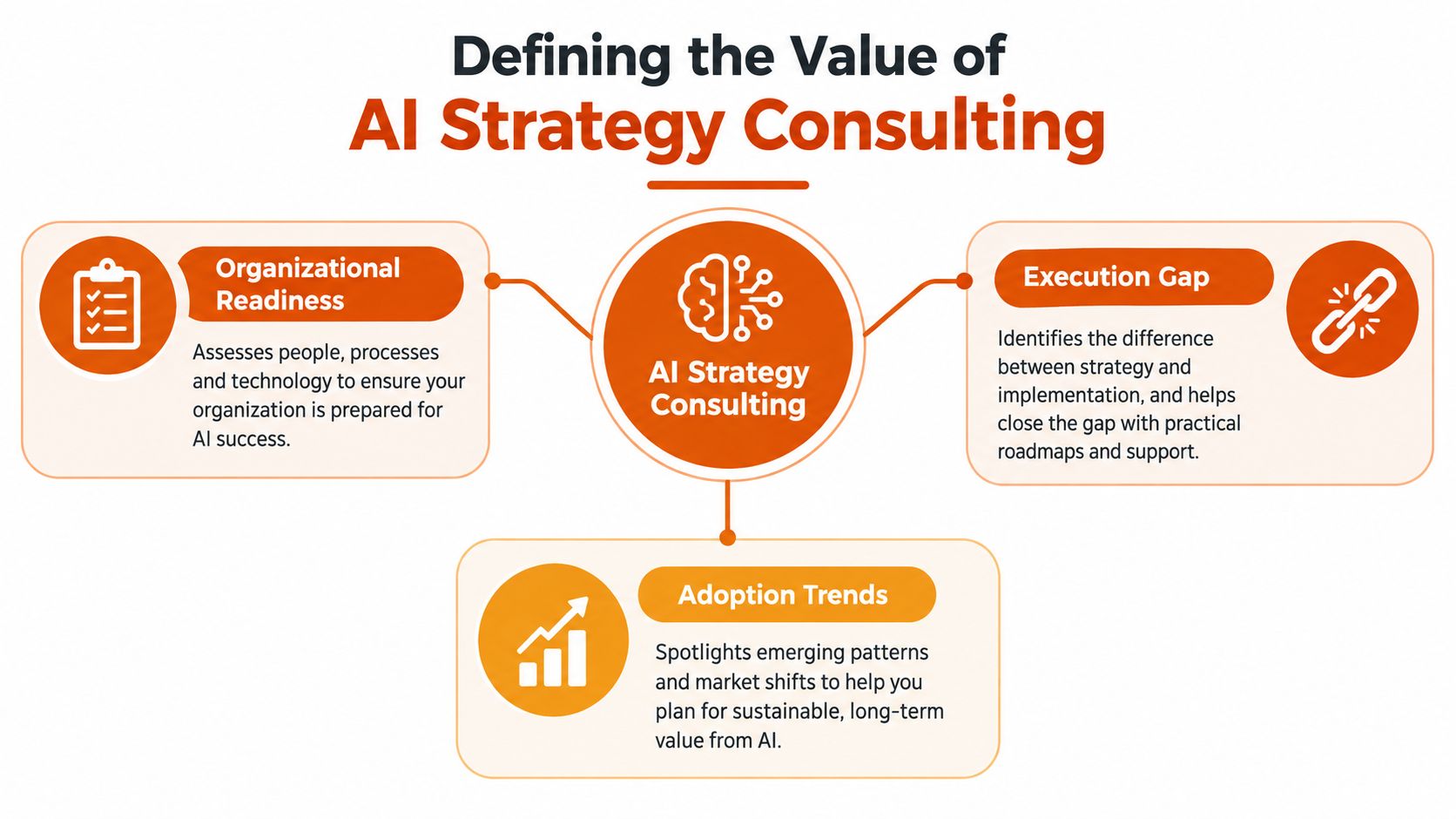
The execution gap is now the central problem. Publicis Sapient reports that 73% of organizations use AI regularly or across most business processes, but only 10% say AI is core to how the business operates (Publicis Sapient's 2026 enterprise AI report). That difference separates tool adoption from business transformation.
AI strategy consulting is the discipline that bridges high-level ambition and daily operational reality. A serious engagement doesn't end with a list of promising models or a technology procurement recommendation. It maps where decisions happen, how work moves between teams, which systems hold the necessary data, and what controls must exist before an AI-enabled process can operate in production.
Readiness comes before rollout
A useful strategy sequences people, process, technology, and governance rather than treating them as separate workstreams. If a sales team receives an AI prospecting assistant before leadership defines qualification rules, CRM ownership, and review standards, the company hasn't accelerated its go-to-market system. It has created another source of inconsistent activity.
A 2026 benchmark across 420 organizations found average AI governance maturity at 2.1 out of 5, with 88% falling short of the readiness required for scaled AI (Forrester Wave AI Consulting Services Q2 2026). The implication is direct. Deployment velocity without operating-model controls creates compliance exposure, adoption drag, and expensive rework.
Practical rule: Don't scale a use case until someone owns its outcome, someone approves its controls, and the underlying workflow has a measurable baseline.
From ambition to capability
The consultant's value lies in converting abstract goals into a capability-based roadmap. That means identifying whether the next constraint is data quality, integration, workflow design, workforce skills, governance, or executive decision rights.
The output should be specific enough to guide investment. A marketing team might need a governed content workflow and CRM enrichment before it needs a custom agent. A manufacturer might need service-data normalization and technician adoption before predictive maintenance can produce reliable recommendations. The technology matters, but organizational readiness determines whether it creates value.
The Market Evolution and Strategic Imperative
AI strategy consulting has become a major services market, but the commercial opportunity is not created by model access alone. One analysis estimates the market at USD 8.4 billion in 2024, growing to USD 59.4 billion by 2034 at a 21.6% CAGR, with North America accounting for over 38% of advisory spending (AI consulting market analysis). Forecasts differ because firms define the category differently, yet buyers increasingly fund implementation, change management, governance, and operating-model redesign alongside strategy.
Implementation services represented 38.5% of service-type share in 2025, according to that market summary. The shift matters in practice. A strategy deck can identify promising use cases, but revenue appears only after teams change workflows, managers reinforce new behaviors, and controls operate under production conditions.
AI adoption has also changed who buys consulting. In 2025, 88% of organizations globally used AI in at least one business function, compared with 78% the previous year. Among those organizations, 23% were scaling agentic AI and 39% were experimenting with it (AI's impact on consulting).
That level of activity produces a more demanding brief. Leadership teams with existing tools need decisions about which workflows deserve investment, what evidence supports production release, who owns adoption, and how teams will handle risk. Buying another model rarely resolves those questions.
The professional services market shows the same shift. Generative AI appeared in 27.1% of projects in 2025, up from 19.3% in 2024, a 40% year-over-year increase. The benchmark also reported that 77% of Management Consultancies Association member firms had integrated AI into their systems or enabled staff to use AI models. 76% used AI for research, while 68% increased automation.
The strategic imperative is to connect AI activity to operating results, not to copy adoption figures. Boards should require a clear relationship between investment, capability development, governance controls, and outcomes such as faster service delivery, stronger pipeline quality, or improved operating efficiency. Organizational readiness determines whether expanding model capability produces measurable business value.
Frameworks for Phased AI Implementation
The safest path from concept to production is phased, but phased doesn't mean slow. It means each stage removes a specific uncertainty before the organization commits more money, data, and people.
1. Diagnose the current state
Start with an inventory of workflows, systems, data sources, policies, and decision owners. Score each candidate use case against business value, feasibility, data readiness, risk, and adoption complexity.
A benchmark-driven diagnostic is more useful than an open-ended ideation workshop. PwC's AI Readiness Assessment uses a proprietary diagnostic and benchmarking compendium drawn from 500+ S&P organizations and a cross-industry survey of 70+ leaders to identify gaps, prioritize recommendations, and create a sequenced roadmap (AI governance research).
2. Test a narrow workflow
Choose a process with a visible owner and a clear baseline. For example, test AI-assisted account research on a defined segment, not across every commercial team. Measure research quality, time saved, handoff completion, and CRM data accuracy.
The pilot should use production-like permissions and review rules. A sandbox that ignores real access controls can prove that a model responds well while teaching the team nothing about operational feasibility.
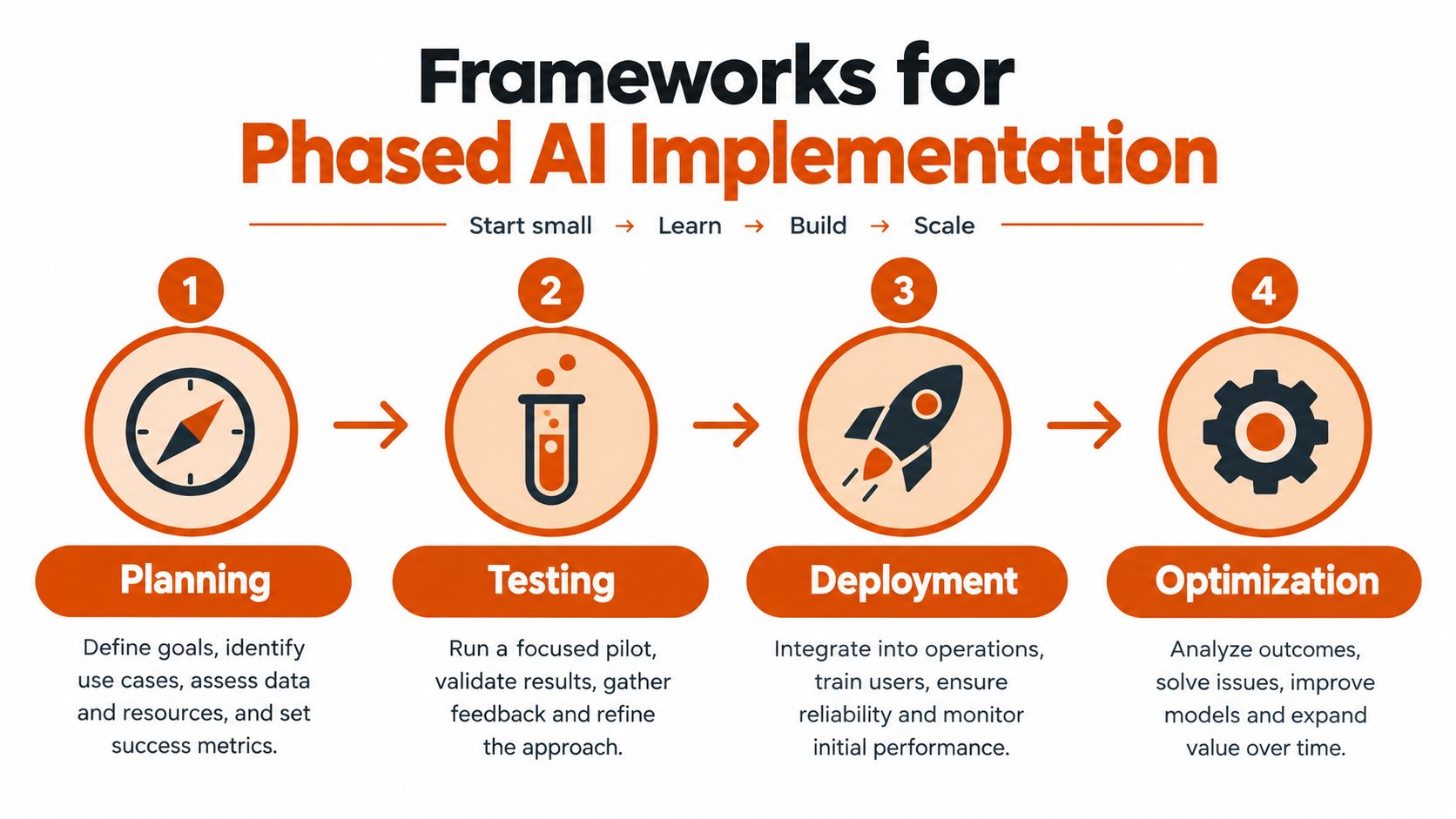
3. Deploy with ownership
Once the workflow meets its success criteria, integrate it into the systems people already use. That could mean a CRM action, a service-desk workflow, a document review queue, or a manufacturing planning interface. Assign an accountable business owner, technical owner, risk owner, and adoption lead.
The AI transformation roadmap should show dependencies, decision gates, training actions, and retirement criteria for approaches that don't work.
4. Optimize the operating model
Scale only after the team understands failure modes. Review outputs, exceptions, user behavior, data drift, and business impact on a regular cadence. Then expand to adjacent workflows where the same data, controls, and skills can be reused.
This four-stage sequence prevents a common failure: treating a successful demo as evidence of enterprise readiness. A demo proves possibility. A governed production workflow proves usefulness.
Real-World Examples of AI Transformation
A manufacturer rarely needs an abstract “AI transformation.” It needs fewer unplanned stoppages, more reliable service decisions, or faster quoting. A professional-services firm needs better research throughput, consistent quality, and stronger client delivery. The intervention should begin with that operational pressure.
Manufacturing example
Consider a manufacturer with maintenance records spread across an ERP, service notes, and technician documents. A tempting first move is to purchase a predictive model. A more practical move is to standardize the failure taxonomy, connect the relevant records, and build an assistant that retrieves approved maintenance guidance for technicians.
That approach creates value before prediction becomes reliable. It also exposes constraints: incomplete historical records, inconsistent terminology, unclear approval responsibility, and frontline skepticism. The pilot should therefore track recommendation usefulness, technician acceptance, exception handling, and whether the workflow improves the existing maintenance process.
Professional services example
A consulting or legal team may spend significant effort finding prior work, comparing documents, and preparing research summaries. An AI research assistant can help retrieve and synthesize material, but only if the firm defines source permissions, citation expectations, review thresholds, and client-confidentiality rules.
The strongest design keeps a qualified professional accountable for the final judgment. AI accelerates retrieval and drafting, while the human reviewer validates interpretation, context, and risk. That division protects quality without forcing experts to perform every low-value search manually.
Revenue operations example
A B2B growth team might use AI to prioritize accounts, summarize buying signals, and recommend next actions inside the CRM. The value doesn't come from adding another dashboard. It comes from connecting account selection to campaign execution, sales follow-up, attribution, and pipeline review.
The useful unit of transformation isn't the model. It's the workflow that changes a business decision.
Across these examples, the tactical move is the same: select one operational bottleneck, embed AI into the existing system of work, define human review, and expand only after the process produces trustworthy evidence.
Selecting the Right AI Strategy Partner
The right partner depends on the problem you need solved. A global systems integrator may fit a complex ERP integration with demanding security requirements. A specialist enablement partner may fit a middle-market company that needs readiness diagnosis, workflow design, CRM optimization, and adoption support without creating a large transformation program.
Compare partners on what they do after the strategy presentation.
| Evaluation area | Strong signal | Warning sign |
|---|---|---|
| Business alignment | Connects use cases to revenue, cost, service, or risk outcomes | Leads with model features |
| Execution | Can build, integrate, test, and train | Delivers recommendations only |
| Governance | Defines permissions, review, monitoring, and escalation | Treats compliance as a later phase |
| Adoption | Changes roles, incentives, workflows, and habits | Assumes users will adopt automatically |
| Accountability | Names owners and decision gates | Leaves success criteria vague |
Match the engagement to maturity
An early-stage organization may need a readiness audit and a prioritized opportunity set. A company with active pilots may need production engineering, data remediation, and change management. A mature enterprise may need portfolio governance, model-risk oversight, and continuous optimization.
Ask candidates to show how they'd handle a use case that fails. Partners who only discuss upside often haven't owned the operational consequences. Ask for sample deliverables, decision rights, pilot exit criteria, and the people who will work directly with your teams.
For teams focused on organic acquisition and AI-enabled content operations, specialized AI SEO services can complement broader transformation work. The same selection standard applies: evaluate whether the service connects content activity to qualified demand, process ownership, measurement, and governance.
Use this AI evaluation framework for vendor selection to pressure-test proposals before signing. Prometheus Agency is one option for growth leaders seeking readiness diagnostics, ROI-focused pilots, CRM implementation, and adoption support, while other partners may be better suited to large-scale infrastructure or regulated systems integration.
Overcoming Common Pitfalls and Risks
AI programs rarely stall because a model cannot produce an answer. They stall because the organization has not agreed on which outputs are acceptable, who reviews them, or how they enter a working process. The primary constraint is often organizational readiness and governance maturity, not model capability.
The main barriers include data privacy and cybersecurity at 42%, data quality at 34%, and regulatory uncertainty at 31%. More than half of businesses also report skills gaps and recruitment challenges as implementation blockers (KPMG Global AI Pulse).
Put controls beside the use case
Keep governance connected to delivery. For each workflow, define data access, retention, human review, logging, escalation, and acceptable use. A customer-facing assistant needs clear disclosure limits and handoff rules. An internal research tool needs approved repositories and a process for verifying sources.
The EU AI Act provides a risk-based framework. The AI Office and Member State authorities are scheduled to apply it from 2 August 2026. Stand-alone high-risk Annex III systems are scheduled for 2 December 2027, while AI embedded in regulated products is scheduled for 2 August 2028, according to the EU AI Act FAQ.
Treat adoption as delivery work
A named strategy does not change behavior by itself. 35% of professionals at firms with a named AI strategy say daily practice does not match it, citing missing tools, insufficient training, and limited shared understanding among common reasons (Future of Professionals 2026).
Train people inside the workflow rather than through a one-off seminar. Give managers usage standards, users practical examples, and executives a scorecard covering adoption, quality, exceptions, and business impact. Review those signals regularly, then adjust the process, controls, or training before expanding the program.
Measuring ROI and Planning Next Steps
ROI measurement starts before the pilot. Choose a baseline, define the business outcome, and decide what evidence will justify expansion. “People used the tool” is an adoption metric, not a return metric.
Build a balanced scorecard
Use measures that reflect the whole operating change:
- Revenue quality: Track qualified opportunities, conversion progression, retention signals, or expansion activity where the AI workflow directly influences them.
- Operational speed: Measure cycle time, queue age, response time, or research effort against the pre-pilot baseline.
- Quality and control: Monitor error rates, review outcomes, exceptions, policy violations, and escalation volume.
- Adoption depth: Track active usage by role, completion of the redesigned workflow, manager reinforcement, and the proportion of work completed without shadow tools.
- Capability growth: Record training completion, new process ownership, reusable data assets, and the team's ability to improve the workflow without permanent external dependence.
For measurement design, the guide from Outrank offers useful context on connecting content activity to business returns. For AI programs, apply the same discipline to the full workflow rather than attributing every downstream result to the model.
Assign the people who make scale possible
A practical program needs an executive sponsor who can resolve priorities, a business owner responsible for the outcome, a technical owner for integration and reliability, a risk owner for controls, and an adoption lead for training and workflow change. These roles can be shared in a smaller company, but the responsibilities can't disappear.
Plan in decision gates rather than optimistic promises. The diagnostic gate confirms the problem and baseline. The pilot gate confirms usefulness and control. The production gate confirms integration and ownership. The scale gate confirms that the process can expand without multiplying risk.
Use this framework for measuring AI ROI to connect financial outcomes with operational indicators. The impact opportunity is larger than labor reduction alone. A well-designed program can improve response speed, increase the consistency of revenue execution, strengthen customer service, and give leaders better visibility into where work is getting stuck.
Start with one workflow where the owner feels the pain and the data is accessible. That constraint produces a more credible business case than a broad AI vision, and it gives the organization evidence it can use for the next investment decision.
Prometheus Agency helps growth leaders turn existing technology stacks into governed, scalable revenue systems through AI readiness audits, CRM optimization, go-to-market strategy, ROI-proving pilots, and implementation support. Visit Prometheus Agency to request a complimentary Growth Audit and AI strategy session focused on your highest-value operational opportunities.